
Livraison le jour même ou le lendemain

Qualité garantie

Débloquez vos offres de bienvenue: Livraison GRATUITE | Jusqu'à -80 % | 30 jours d'essai gratuits à JoyPlus
Téléchargez l'application
For creators and on-the-go vloggers, the promise of a pocket-sized camera with cinema-worthy footage is incredibly appealing. The problem? The market is flooded with models boasting tempting spec sheets that ultimately disappoint in the field. Before you buy, it's crucial to sidestep the marketing traps that lead straight to disappointment.
As a product expert for the Joybuy editorial team, my mission is to guide you through this tech jungle. Here are the 3 most common pitfalls to avoid:
To make an informed choice, you need to focus on what truly matters for the quality of your productions. Here are the non-negotiables.
Smooth motion is the signature of professional video. The only technology that guarantees this result without compromise is 3-axis mechanical stabilisation, also known as a gimbal.
Unlike electronic stabilisation, an integrated gimbal physically corrects shakes, vibrations, and tilts across three axes (pan, tilt, and roll). The result: perfectly smooth footage, even while walking or running, with zero loss in quality. This is THE essential feature for a portable camera stabiliser designed for vlogging.
A 4K vlogging camera is more than just its resolution. The image sensor size is the most critical factor for visual quality. A larger sensor captures more light. In practical terms, this translates to:
Recent models like the Pocket 4 feature a 1-inch CMOS sensor, a size once reserved for much bulkier cameras. Paired with capabilities like 4K video at 240 fps (frames per second), it opens the door to ultra-smooth slow-motion with stunning clarity.
A good DJI Creator Combo isn't just a random assortment of accessories. It's a cohesive ecosystem designed for real-world filming needs. The must-haves to look for:
Instead of an endless list, here are our targeted recommendations based on the criteria and pitfalls we've just discussed.
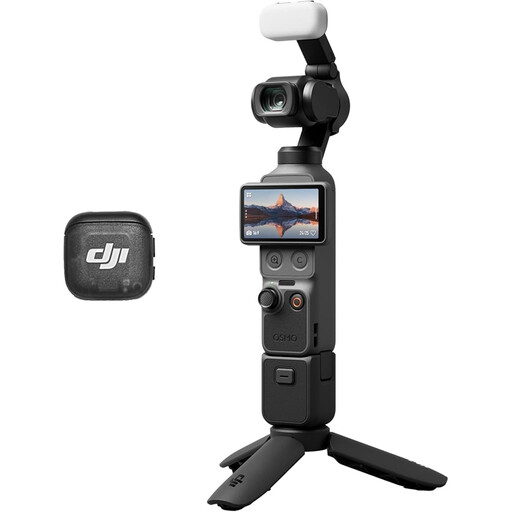
Why this choice? This is the ultimate all-in-one solution for the creator who refuses to compromise on quality but wants to travel light. The combo is incredibly comprehensive and ready for professional productions right out of the box.
It checks all the boxes: a true 3-axis mechanical gimbal, a large 1-inch sensor, and a pack of genuinely useful, high-quality accessories (mic, handle, lens). The "Creator Combo" name is well-deserved.
Recording in 4K/240 fps for spectacular slow-motion. The generous 107 GB of internal storage and a 14-stop dynamic range offer maximum flexibility in post-production.
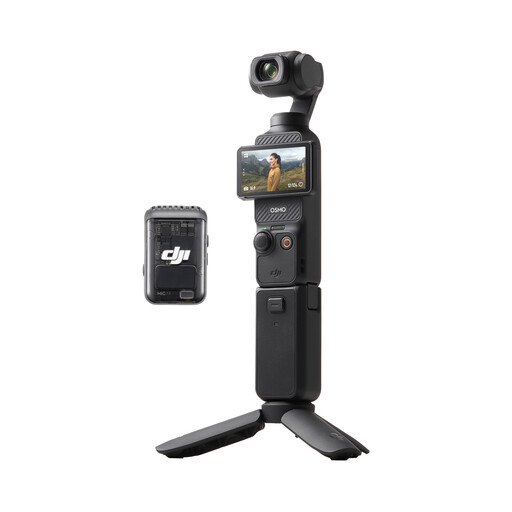
Why this choice? For the creator seeking the best performance-to-price ratio. It offers 95% of its bigger brother's capabilities at a more controlled price point, without ever sacrificing the essentials: image quality and stabilisation.
It's built on the same solid foundations: a 3-axis mechanical gimbal and a 1-inch sensor. The creator bundle includes the DJI Mic 2 transmitter, ensuring pro-level audio from the very first take.
The 10-bit D-Log M colour profile offers immense latitude for colour grading. Its large 2-inch rotating touchscreen is a major plus, letting you switch from horizontal to vertical format in a single motion.
We have curated a complete range of products for you that meet our strict selection criteria and current standards.
Is the Creator Combo really essential for beginners? If you plan to talk to the camera, the answer is a resounding yes. Good audio is crucial for keeping your audience engaged, and the combo's wireless mic (like the DJI Mic 2) is a game-changer compared to the built-in microphone. For purely visual projects, the base model might suffice, but the combo is more versatile and cost-effective in the long run.
What are the real differences between the DJI Pocket 4 and the Pocket 3? The Pocket 4 mainly stands out for its ability to shoot in 4K at up to 240 fps (compared to 120 fps for the Pocket 3), its more generous internal storage (107 GB), and an improved dynamic range. That said, the Pocket 3 remains an extremely powerful professional pocket camera, with specs (4K/120 fps, 1-inch sensor, D-Log M) that already exceed the needs of most creators.
Is the Pocket 4's 107 GB of built-in storage enough? For daily use, 107 GB offers plenty of headroom. However, if you plan on shooting long takes in 4K at 120 or 240 fps, adding a microSD card is essential to avoid running out of space and to simplify transfers. Think of the internal storage as an excellent safety net and a real day-to-day convenience.