
Livraison le jour même ou le lendemain

Qualité garantie

Débloquez vos offres de bienvenue: Livraison GRATUITE | Jusqu'à -80 % | 30 jours d'essai gratuits à JoyPlus
Téléchargez l'application
Navigating the vast world of DJI drones can be overwhelming. Between ultra-light models for travel, high-speed racers designed for FPV immersion, and semi-professional aircraft, making the right choice is tough. This guide is here to help you make sense of it all and identify the DJI drone that truly fits your needs, whether you're a content creator, an adventurer, or simply a tech enthusiast.
Before comparing models, there are a few technical and regulatory criteria to consider to guide your decision.
Across the European Union, a drone's weight is a crucial factor. Models weighing less than 250 grams, like the DJI Mini 4 Pro, fall into the C0 category. This is a major advantage, as this classification exempts them from many restrictions, making them the ideal travel drone. For drones over 250g, online training and registration with your local aviation authority become mandatory. In any case, an essential pre-flight check is to consult your local authority's official map to verify authorised flight zones.
While most DJI drones now shoot in 4K, the final image quality depends on many other factors. The most important is arguably the sensor size: a larger model, like the 1-inch CMOS on the DJI Air 3S, captures more light and delivers far better performance in low-light conditions. Dynamic range (HDR) and colour profiles (like D-Log M) are also decisive assets for those who love to fine-tune their footage in post-production and aim for a cinematic look.
Here, it all comes down to the effect you're after. For smooth, stable, and polished aerial shots, a camera drone stabilised on a 3-axis gimbal remains the gold standard. Conversely, for a fully immersive flight experience and adrenaline-fueled sequences, an FPV (First Person View) drone like the DJI Avata 2, flown with goggles, opens up unique creative possibilities and guarantees a thrilling ride.
We have selected three flagship models, each tailored to a specific user profile.
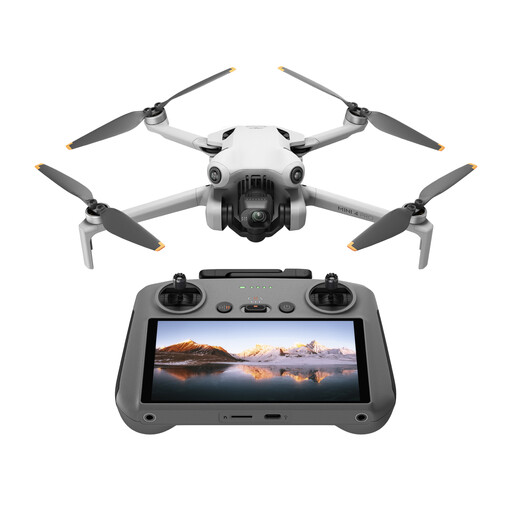
DJI Mini 4 Pro (DJI RC 2), Foldable Mini Drone with 4K Camera
What sets it apart Its key advantage is its feather-light weight, coming in under the 249-gram regulatory threshold. But its real strength lies in packing advanced technologies once reserved for heavier models, such as omnidirectional obstacle sensing and native vertical shooting, which is perfect for social media content.
Key Features
Who is it for? This is the go-to drone for travellers and on-the-go content creators. It offers a perfect blend of performance, portability, and ease of use, without compromising on image quality or safety.
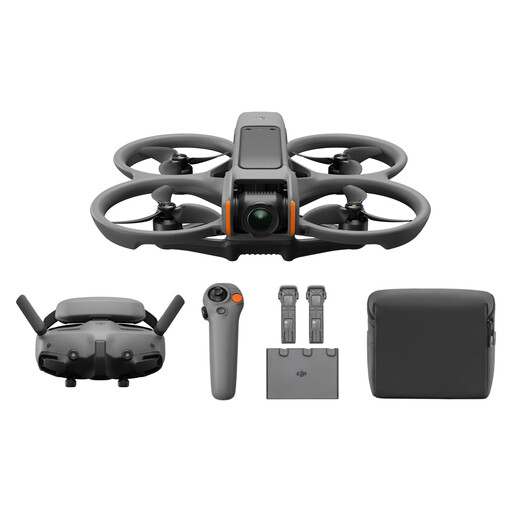
DJI Avata 2 Fly More Combo (3 Batteries), FPV Drone with 4K Camera
What sets it apart The Avata 2 is a machine built entirely for immersion. Paired with the DJI Goggles 3 and the RC Motion 3 controller, it literally puts the pilot in the heart of the action. Its intuitive, gesture-based control and simplified acrobatic modes make it surprisingly accessible, even for newcomers to FPV flight.
Key Features
Who is it for? It's aimed at thrill-seekers and videographers looking for dynamic and spectacular POV (Point of View) shots. Its robustness and almost immediate learning curve make it an excellent gateway into the world of FPV.
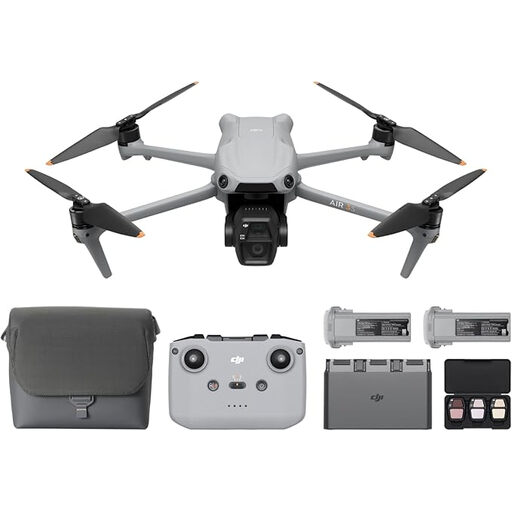
DJI Air 3S Fly More Combo (RC-N3), Drone with 1-Inch CMOS Camera
What sets it apart The Air 3S blurs the line into the professional world. Its standout feature is a dual-camera system, led by a main 1-inch CMOS sensor. This setup gives it remarkable image quality, especially in low light, that rivals that of much more expensive models.
Key Features
Who is it for? It is designed for demanding photographers and videographers, even semi-professionals, for whom image quality is the number one priority but who don't want to be weighed down with heavy, complex gear.
This selection is just a glimpse of the brand's flagship models. If your needs are different or if you want to explore all the possibilities before you buy a drone, feel free to browse our full catalogue.
As soon as a drone has a camera, you generally need to register as an operator with your local aviation authority. The golden rules are simple: respect privacy, never fly over people, and always check the official maps for no-fly or restricted zones. The drone's class (C0, C1, etc.) then determines the specific training and flight conditions required.
Without a doubt, the DJI Mini series, and specifically the DJI Mini 4 Pro. Its light weight reduces regulatory hurdles, while its multiple obstacle sensors and assisted flight modes make piloting safer and more forgiving of beginner mistakes. It's the ideal choice for a first-time purchase.
No, and this is a crucial point. While 4K has become the standard, it isn't everything. The sensor size, lens quality, dynamic range (HDR), and colour science are far more decisive criteria. Simply put: it's better to have an excellent sensor shooting in 1080p than a mediocre one in 4K.