After small DIY jobs, choose a canister vacuum whose instructions allow it to pick up the type of waste you have, then select a suitable capacity and accessories for the amount of debris. A wet and dry vacuum is worth considering if you also need to pick up liquids. For regular fine dust, check the stated dust class and how the filter is cleaned. If the material you have worked on may contain asbestos or another hazardous dust, stop considering a consumer vacuum and get the risk assessed.
Who is this choice for?
People cleaning up ordinary dry debris
After drilling, assembly or a small DIY project at home, you need to pick up identified waste without having to empty the vacuum repeatedly. Capacity matters, but the machine should also be easy to handle and store.
Households that occasionally deal with wet mess
If cleaning also involves water or wet leaves, check that the model is approved for wet and dry use. Its net liquid capacity may differ from the stated tank capacity.
People dealing with dust of uncertain origin
After sanding, drilling or cutting an old or unidentified material, first establish what the dust is before choosing a vacuum. A machine intended for ordinary debris does not mean it is suitable for picking up that dust.
What should you check before buying?
Before cleaning up after small DIY jobs at home, first identify the material you have worked on and the waste it has produced. Then compare usable capacity, whether you need wet pick-up and how much space you have for the machine.
| Criteria |
What to check before buying |
Who is this for? |
| Type of dust and filtration |
Identify the material you have worked on, then check which materials the specific model is approved for and its stated dust class. Class L does not mean the vacuum is suitable for picking up suspect dust. |
If I’m not sure what the material I’m sanding or drilling contains, I need to understand the risk before thinking about cleaning up. Around 33% of consumers would put identifying the material and filtration first. |
| Capacity for dry debris |
Compare usable net capacity, bag capacity if applicable, and accessories suitable for the permitted waste, rather than looking at gross capacity alone. |
When several areas are covered in sawdust or small pieces of identified debris, I want to avoid having to empty the vacuum repeatedly. Capacity for dry waste would be a priority for around 27% of consumers. |
| Liquid pick-up |
Look for explicit approval for wet and dry use, and check the net liquid capacity and the instructions for using the filter and bag. |
If I also need to pick up water or wet mess, a machine limited to dry waste won’t meet my needs. Around 20% of consumers would prioritise wet pick-up. |
| Portability and storage |
Check the weight, dimensions, hose and cable length or, for a cordless model, battery compatibility and what is included. |
I need to move the machine or store it in a small space, even if that means accepting a smaller tank. Around 20% of consumers would put this compromise first. |
Mistakes to avoid after DIY work
-
Assuming ‘wet and dry’ means ‘all types of debris’
This description alone doesn’t specify which types of DIY waste the vacuum can pick up. Nilfisk notes, for example, that coarse debris such as screws, glass or gravel can damage a conventional vacuum cleaner.
Before buying, make a list of what you need to pick up and check it against the permitted uses and exclusions in the instructions for your chosen model.
-
Choosing a machine based on gross capacity
According to Bosch Professional, the GAS 20 L SFC has a gross tank capacity of 19 L, but offers 15 L net capacity, 7.5 L net capacity for liquids and 6.7 L net capacity in the bag. These figures relate to different uses.
Compare the net capacity that suits your clean-up: dust with a bag, the tank without a bag, or water.
-
Assuming class L is suitable for all fine dust
The INRS notes that crystalline silica is found in materials such as concrete and mortar. For workplace risk prevention, dust that may contain toxic or carcinogenic substances requires class H equipment. The ‘class L’ label alone therefore doesn’t mean suspect dust can be treated as ordinary dust.
If the material is old, mineral-based or unknown, stop looking for a consumer vacuum until the risk has been identified and the appropriate prevention measures established.
-
Choosing a small tank for a large clean-up
A format that’s easy to carry may mean more frequent emptying. Bosch Professional, for example, states that the cordless GAS 18V-6LS has a gross capacity of 6 L. Compare this figure with the amount of waste to be removed, not just the space available for storage.
For several rooms, a garage or a patio, estimate the amount of waste and compare net capacities before opting for a compact model.
Brands to consider, depending on the model
These ranges offer useful points of comparison for small DIY jobs at home. Check that the stated capacities and dust classes apply to the specific model you’re considering.
Nilfisk
Depending on the model, Nilfisk’s wet and dry range is designed for cleaning at home, in the garage or outdoors.
- Nilfisk lists a 22 L tank and an indicator that tells you when to clean or replace the filter for its Multi II 22.
- A range-wide filtration statement doesn’t replace the stated dust class for the specific model you buy. Check which materials it is approved for, too.
Bosch Professional
The range includes site vacuums in different sizes and capacities, including corded wet and dry models and a more compact cordless option.
- Bosch Professional states that the GAS 20 L SFC and GAS 12-25 LS have class L filtration and semi-automatic filter cleaning.
- Gross capacity doesn’t necessarily match the net capacity available for dust, the bag or water. Class L does not mean the vacuum is suitable for picking up hazardous materials.
Makita
Makita offers corded site vacuums with different dust classes and capacities, and features that vary by model.
- Makita lists class L models and the class M VC2211MX1, which has automatic filter cleaning and a low airflow warning.
- Check the dust class, permitted materials and accessories for your chosen model. None of these features alone means it is suitable for use on material suspected of containing asbestos.
Wet and dry vacuum cleaners on Joybuy
This option is for ordinary wet or dry cleaning at home, in the garage or in the workshop. Before choosing it for your DIY jobs, check the instructions for permitted waste and the conditions for picking up liquids.
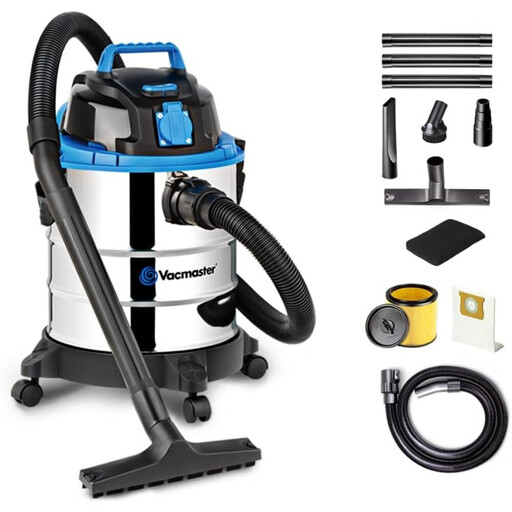 Image unavailable
Vacmaster VQ1220SC, 20 L wet and dry vacuum cleaner
For ordinary wet or dry cleaning at home, in the garage or in the workshop, provided the instructions allow the waste in question and explain how to pick up liquids.
The product title lists a 20 L tank, a 1,250 W motor, a 2,430 W tool socket and a blower function. Check the usable net capacity and accessories needed for your intended use.
Do not use this machine for harmful or suspect dust. For ordinary fine dust or small pieces of rubble, first check the instructions to make sure they can be picked up.
View on Joybuy
Frequently asked questions
Can all canister vacuums pick up water?
No. Choose a model whose product details and instructions explicitly allow wet pick-up. Check its net liquid capacity, which is different from the tank’s gross capacity. For example, Bosch Professional states that the GAS 12-25 LS has a net liquid capacity of 18 L, while its gross tank capacity is 25 L.
Is class L enough to pick up concrete dust or dust from an old material?
Not on its own. First identify the material and the dust it produces. The INRS notes that concrete and mortar may contain crystalline silica. Class L should not be taken as approval to pick up hazardous or unidentified dust.
What should I do if I suspect asbestos after DIY work?
Don’t continue cleaning with a domestic vacuum or a class L model intended for ordinary waste. The Ministry for Ecological Transition states that direct work on asbestos-containing materials by private individuals should be exceptional and limited, and recommends using qualified companies for major work. Get the situation assessed and follow the appropriate prevention measures.
Should I clean the filter after every DIY job?
Follow the instructions for your model rather than sticking to a set cleaning schedule. Nilfisk says the Multi II 22 has an indicator for when to clean or replace the filter, while Bosch Professional states that the GAS 20 L SFC and GAS 12-25 LS have semi-automatic filter cleaning. Don’t handle a filter loaded with waste of uncertain origin as if it contained ordinary dust.


