
Livraison le jour même ou le lendemain

Qualité garantie

Débloquez vos offres de bienvenue: Livraison GRATUITE | Jusqu'à -80 % | 30 jours d'essai gratuits à JoyPlus
Téléchargez l'application
Choosing a tool set is not always straightforward, especially when manufacturers advertise 121, 172 or even 450 pieces. An impressive number does not guarantee that the contents will actually meet your needs. Whether you are carrying out automotive repairs, installing network cabling, working on a school project or tackling construction work, it is better to examine the set’s contents than rely on the number of accessories.
A generously equipped set may simply contain duplicate pieces, rarely used sizes and accessories that are incompatible with your equipment. Instead, check:
For maintaining a bicycle, assembling furniture or repairing a household appliance, a compact set is often more practical than a large case filled with accessories you will never use.
Labels such as “reinforced,” “professional” or “long-lasting” are not enough to assess a tool. When comparing two sets, focus instead on the material, surface treatment, dimensions and mechanism quality.
Chrome vanadium (Cr-V) steel is commonly used for sockets and wrenches. Heat treatment can improve the metal’s resistance, but it does not mean the tool can safely exceed its recommended torque. Improvised extensions or pipes used to gain extra leverage can damage both the tool and the fastener.
A poorly designed case wastes time: accessories become mixed up, some go missing and every job becomes more laborious. Check the quality of the case, how securely the pieces are held and how clearly they are marked.
For electrical or IT work, also check the tool’s intended use. A crimping tool for network cables cannot replace a model designed for electrical terminals. Similarly, a socket set is not intended for work on a live circuit.
For tools exposed to significant mechanical forces, prioritize a specification sheet that identifies the material used, such as Cr-V or S2 steel for certain bits. A chrome finish makes cleaning easier and slows oxidation, but it does not eliminate the need to wipe tools dry after use in damp conditions.
Cutting tools and masonry chisels deserve particular attention. Inspect the striking area, the metal treatment and the condition of the tip. Wear safety glasses and suitable gloves, then check for cracks or deformation before every use.
A socket’s diameter alone is not enough to confirm compatibility. You must also consider the drive size:
A 72-tooth ratchet, with a 5° return angle, is especially convenient in hard-to-reach spaces. However, this feature does not mean it can withstand every torque level.
In woodworking, construction and renovation work, measuring tools must remain easy to read and sufficiently rigid. A 300 mm combination square with metric and imperial graduations, a spirit level and a marking scribe can replace several individual tools.
For school use, readability and impact resistance are more important than having a large number of accessories. The Maped product featured below includes a 30 cm ruler, two 21 cm set squares and a 12 cm protractor. According to its product listing, the graduations are UV-printed.
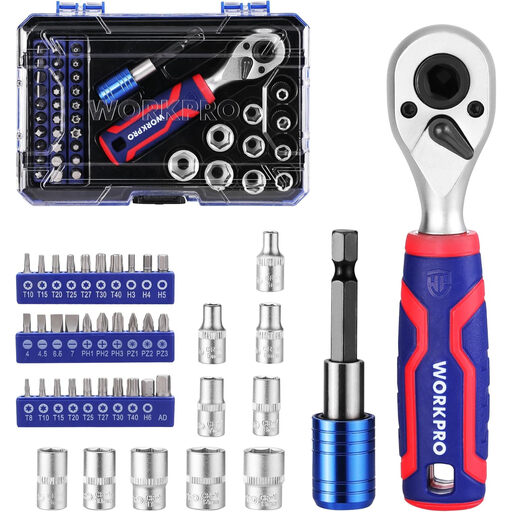
Why it suits this profile: Its compact format is ideal for minor household repairs, furniture assembly and routine vehicle maintenance.
The product listing details all 42 pieces, including 10 metric sockets and 30 bits, rather than simply highlighting an inflated total.
It includes a 72-tooth 1/4″ ratchet with a 5° return angle, along with a storage case.
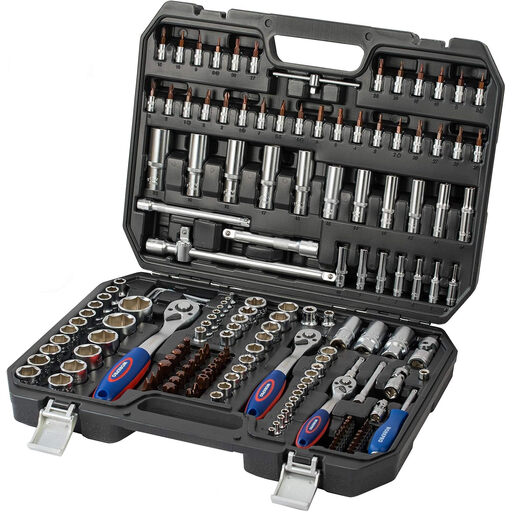
Why it suits this profile: Its extensive selection is designed for amateur mechanics, motorcycle and bicycle maintenance, as well as regular repairs around the home.
The list separates the 1/4″, 3/8″ and 1/2″ sockets, Torx sockets, extensions and universal joints, allowing you to verify exactly what the case covers.
Three 72-tooth ratchets and a molded case with a dedicated slot for every piece.
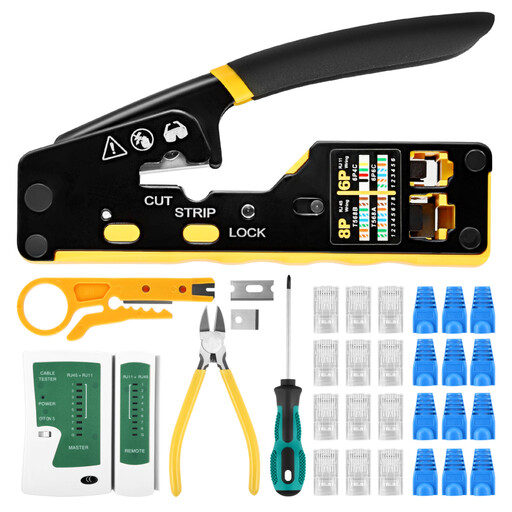
Why it suits this profile: A targeted solution for network cabling, IT maintenance, office work and DIY projects requiring crimping.
Its specialized purpose helps you avoid buying a large mechanical tool case when your needs mainly involve cables and connectors.
The stated contents include a crimping tool, cable cutter, wire stripper and cable tester.
Why it suits this profile: Its broad range of sockets and bits is well suited to automotive and mechanical work requiring multiple sizes.
The product listing distinguishes between drive sizes and dimensions, including deep, Torx and spark-plug sockets, rather than relying on a vague inventory list.
Heat-treated chrome vanadium steel, three ratchet handles and a 45 × 10 × 33.5 cm carrying case, according to the product listing.
We have brought together an up-to-date selection of products chosen to meet practical criteria for crafts, maintenance and DIY projects in France.
For maintaining a car or motorcycle, start by comparing socket sizes and drive sizes. The 121-piece DURATECH set includes metric and SAE sockets, two 1/4″ and 3/8″ ratchets, hex keys, bits and a case. With its screwdrivers, voltage tester and combination wrenches, the 123-piece WORKPRO set is suitable for both certain household tasks and automotive work.
The 450-piece WORKPRO set is better suited to workshops with ample storage space. Before buying it, check how much room you have available, how heavy the case is and how often you will realistically use the accessories.
Masonry calls for tools that can withstand repeated impacts. The three-piece ValueMax chisel set includes 10, 12 and 16 mm sizes, with a stated blade hardness of between HRC 53 and 60. Use them with a suitable hammer or club hammer, and never with a power tool unless the manufacturer explicitly permits it.
For measuring, the 300 mm WORKPRO combination square combines a stainless steel rule, a zinc-alloy head, a spirit level, a marking scribe and metric and imperial graduations. For geometry classes, the Maped marking set brings together a ruler, set squares and a protractor in a format that slips easily into a school bag.
A 40- to 50-piece set already covers the essentials: driving screws, handling small fasteners, assembling furniture and carrying out light maintenance. You can then expand your toolkit with specialized tools, such as a crimping tool, measuring instruments or diagonal cutters, depending on your projects.
Wipe the pieces after every use, remove any traces of moisture and return each accessory to its designated slot. Never use a socket on a fastener of a different size, and always follow the recommended torque. Regular inspections make it easier to spot cracks, deformation or a worn mechanism at an early stage.
Not necessarily. For home users, the right choice depends primarily on how often the tools will be used, the types of fasteners involved and the storage space available. Professional tools may offer a wider range of sizes and greater durability, but a more focused set also helps you avoid paying for unused accessories and makes storage simpler.