
Livraison le jour même ou le lendemain

Qualité garantie

Débloquez vos offres de bienvenue: Livraison GRATUITE | Jusqu'à -80 % | 30 jours d'essai gratuits à JoyPlus
Téléchargez l'application
A pair of pliers that slips on a fitting, a clamp that leaves marks on wood or a folding workbench that lacks stability can quickly turn a minor repair into an unexpected expense. When choosing the right DIY and repair tools, it is worth looking beyond the number of pieces, marketing claims and price tag.
Requirements vary depending on the job: furniture assembly, plumbing, car maintenance, amateur woodworking or everyday repairs. Here are the key criteria to consider before placing an order, along with a selection of products available on Joybuy.
Tongue-and-groove pliers can grip round, flat or hexagonal objects. That does not mean they are suitable for every diameter. If the maximum opening is too limited, you may end up forcing the tool or working from an unsafe position.
For plumbing tools, always check:
A 180 mm pair of pliers and a 250 or 305 mm model are not designed for the same tasks. The former is easier to handle in confined spaces, while the latter offers a wider opening and greater leverage, at the cost of a larger footprint.
A pliers set may look appealing on paper, but some pieces may never leave the box. For automotive work, four circlip pliers in different configurations can prove far more useful than a comprehensive assortment filled with duplicate tools.
Check the contents of the case carefully: straight or angled pliers, models for internal or external circlips, tip diameter, case and included accessories. This simple check helps you avoid paying for functions you will never use.
A powerful clamp is not necessarily suitable for varnished wood, laminate or painted parts. Unprotected jaws can leave marks, even when the clamp is applied correctly.
For clamping pliers and woodworking clamps, look for nylon pads or an equivalent material, a comfortable handle and a sufficiently rigid rail. The advertised clamping force should also be viewed realistically: it can never compensate for a poorly positioned workpiece or an unstable support.
The opening is the maximum width of the workpiece that the tool can hold. Jaw depth indicates how far the jaws can reach from the edge. Both measurements are particularly important when assembling panels, gluing battens or holding a workpiece during a repair.
For example, the 150 mm WORKPRO model has a jaw depth of 62 mm, a maximum opening of 150 mm and an advertised clamping force of 68 kg. Sold as a pair, it can also be converted into a spreader. These specifications make it easy to check whether the tool suits your projects, without attributing capabilities beyond those stated by the manufacturer.
Heat-treated steel, chrome vanadium steel and forged carbon steel are common materials used in repair tools. However, the material alone is not enough to predict a tool’s service life. Also consider:
For work on circuits containing liquids, hose clamp pliers should be selected according to the type of hose. The DURATECH model featured below is designed for flexible hoses, not rigid, reinforced or high-pressure lines.
A quick-adjustment button makes it easier to change positions, but it does not eliminate the need to check jaw alignment. When using circlip pliers, wear safety glasses: the ring can be ejected violently if the tip is not properly engaged.
Before using a folding workbench, check its locking systems and make sure it rests completely flat. Stated load capacities apply to specific configurations; they should never be interpreted as an invitation to exceed the manufacturer’s limits.
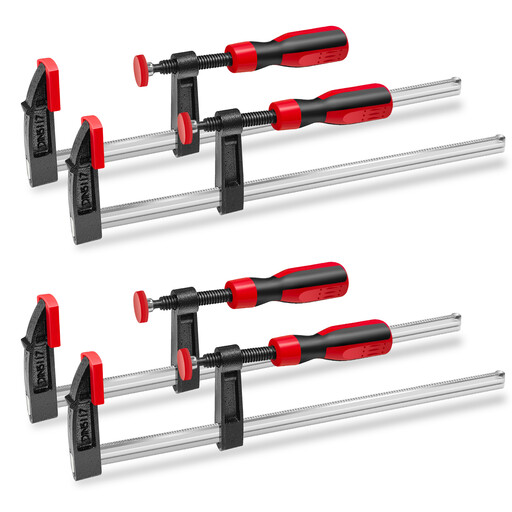
Why this choice suits this profile: This four-piece clamp set is ideal for small assemblies, crafting projects and household repairs that require several points of support.
The F-style design makes it easy to assess each clamp’s capacity. Even so, check the dimensions listed on the product page before ordering.
Four tools in a single set, making it easy to distribute pressure across a workpiece or work on several components at once.
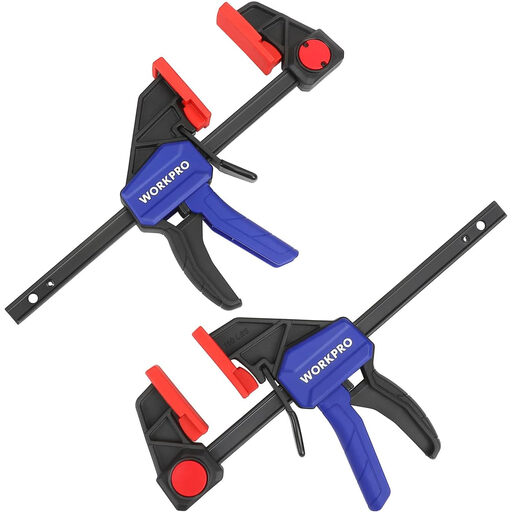
Why this choice suits this profile: One-handed operation and nylon jaw protectors make it easier to hold components securely when assembling furniture or working on a woodworking project.
The specifications are clearly stated: 150 mm reach, 62 mm depth and 68 kg of clamping force. Do not exceed the latter figure.
Protected jaws, quick release and conversion into a spreader.
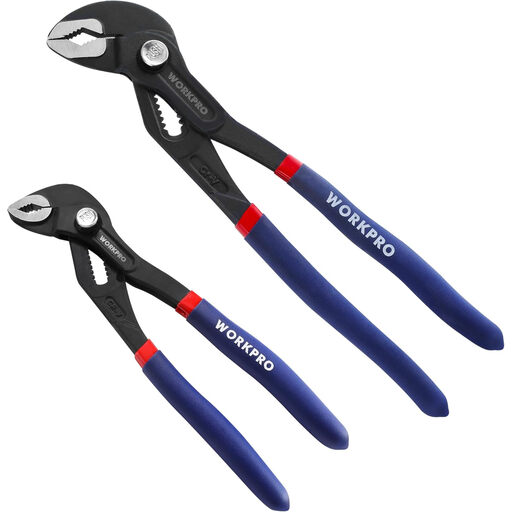
Why this choice suits this profile: The two lengths cover everything from small fittings to larger components, making the set suitable for plumbing, mechanical work and routine maintenance.
The maximum openings differ: 33 mm for the 180 mm pliers and 43 mm for the 250 mm model. Choose the size according to the fitting.
Chrome vanadium steel, push-button adjustment and resin handles.
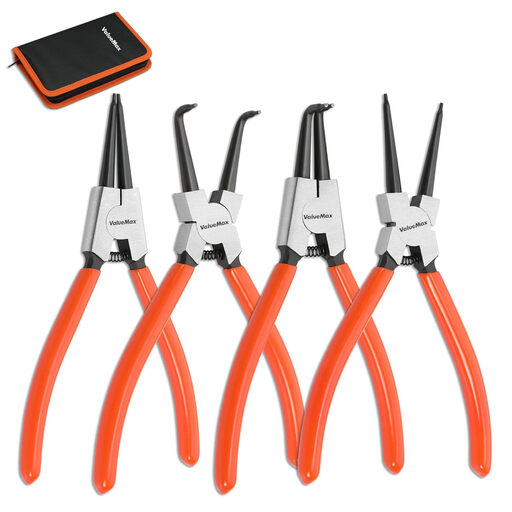
Why this choice suits this profile: The four configurations cover internal and external circlips, in both straight and angled formats, making the set suitable for mechanical and automotive work.
The 1.6 mm tips and stated openings of 33 to 36 mm must match the circlip being used. Wear safety glasses and never force an incompatible ring.
Carbon steel, ergonomic handles and a zippered case included.
We have put together an updated selection of products that meet these criteria for clamping and repair work.
To round out a workshop, several tool categories can meet specific requirements:
Measure the fitting’s outside diameter, then compare it with the pliers’ maximum opening. Tongue-and-groove pliers with pronounced teeth are suitable for gripping and loosening many components. However, they must not be used on an installation that is pressurised or still connected to a water supply.
Service life depends on frequency of use, applied load, humidity and maintenance. Wipe your tools after every use, dry them before storing and lightly lubricate metal joints if recommended by the manufacturer. Replace any pliers with deformed jaws, excessive play or damaged handles.
Yes, provided its dimensions, load capacity and locking system are suitable for your space. Measure the available area with the workbench fully deployed and ensure the floor is completely stable. If you use it outdoors, store it away from moisture after completing your work to limit wear on the metal components.