
Livraison le jour même ou le lendemain

Qualité garantie

Débloquez vos offres de bienvenue: Livraison GRATUITE | Jusqu'à -80 % | 30 jours d'essai gratuits à JoyPlus
Téléchargez l'application
Managing incontinence can often be a challenge. Whether it's to ensure a loved one's comfort, for personal use, or even for house-training a pet, the market for disposable pads is vast, and marketing promises can be misleading. As the Head of Product Recommendations at Joybuy, my mission is to help you gain clarity. Let's break down the pitfalls to avoid and the criteria that truly matter to make the right choice.
Before making a decision, learn to see through the marketing claims that often hide disappointing performance behind attractive packaging.
To ensure you make the right choice, here are the three technical points to examine closely.
A quality super-absorbent pad almost always relies on a multi-layer design. Here’s how it works:
The pad's size must be appropriate for its intended use. A 90?x?85?cm waterproof pad is a versatile all-rounder, offering excellent coverage for a single bed without being excessive. For an armchair, more compact dimensions (60?x?60?cm or 60?x?90?cm) are often more practical. A good rule of thumb: measure the surface you need to protect (the torso area on a bed, the seat of an armchair) to choose the size that will offer maximum protection without causing discomfort.
A good pad is often versatile. A model designed for adult incontinence can perfectly serve as a puppy training pad, whether for house-training a puppy or for the comfort of an elderly pet. In this case, opt for robust products whose structure can withstand scratches and tears, and which effectively neutralise odours.
We have selected products that meet specific needs, applying the performance criteria we've just detailed.
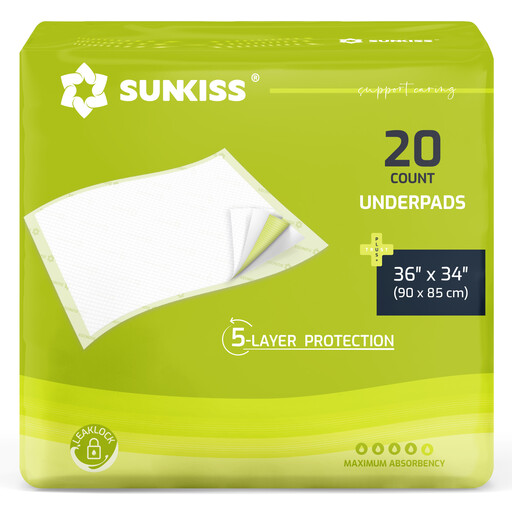
Why it's a great choice: For a caregiver, peace of mind and the comfort of the person they are caring for are top priorities. This disposable bed protector offers a large surface area of protection, which reduces the stress of nighttime leaks and significantly lightens the laundry load. Its soft top layer is designed for prolonged contact with the skin.
Its 5-layer structure with Super-Absorbent Polymers (SAP) instantly captures and gels liquids. The result: no damp feeling or leaks, unlike basic pads that saturate quickly. Its breathable top sheet prevents the risk of irritation.
The large 90 x 85 cm size ensures maximum bed coverage. The multi-layer design guarantees rapid absorption and securely locks in liquids for truly reliable protection.
Why it's a great choice: For training a puppy or ensuring the comfort of a senior pet, you need a pad that is absorbent, durable, and non-slip. Multi-use pads like the SUNKISS model are an excellent alternative, but a range dedicated to pets can offer specific advantages.
A good puppy training pad includes an SAP core to neutralise ammonia odours and has a structure that resists scratches. This avoids the pitfall of flimsy pads that tear and leak at the first opportunity.
Versatility is its strong suit. Products like SUNKISS are highly effective, and a range specifically designed for pets may also offer various sizes or adhesives to keep the pad in place.
We have curated a complete selection of products that meet our performance criteria and safety standards.
As the name suggests, a disposable pad is for single use only. For perfect hygiene and to prevent irritation, it is essential to change it as soon as it is soiled. Never attempt to wash or reuse it.
Yes, absolutely. It's often an economical solution. A disposable bed protector for adults, especially a robust, multi-layer model, will make an excellent training pad. Just check that it is durable enough not to be shredded. Note that products designed for pets sometimes contain attractants to aid in training.
The rule is simple: measure the area you need to protect. For a bed, the pad should cover at least the width of the pelvis and torso. A size like 90?x?85?cm is ideal for a single bed. For an armchair or car seat, measure the seat and choose a slightly larger size to cover the edges properly. A well-sized pad stays in place better and ensures more effective protection.