
Livraison le jour même ou le lendemain

Qualité garantie

Débloquez vos offres de bienvenue: Livraison GRATUITE | Jusqu'à -80 % | 30 jours d'essai gratuits à JoyPlus
Téléchargez l'application
Disposable gloves serve a wide range of needs: preparing food, cleaning a bathroom, handling everyday products, DIY tasks or carrying out precision work. Yet the information on the packaging doesn't always make comparison easy. A promise of strength doesn't necessarily specify the stresses it can withstand, while the word "comfort" doesn't guarantee a good fit throughout use.
Before you buy, three pitfalls deserve your attention:
Nitrile gloves are made from a synthetic elastomer. They are often chosen for their puncture resistance, durability and the absence of natural latex. Textured surface models make gripping easier for cleaning, food preparation or light tasks. However, you should check the limits stated on the packaging, particularly when solvents, acids or heat are involved.
Latex gloves offer great flexibility and good tactile sensitivity. Thin models are suitable for tasks requiring precision, such as decorating, hair colouring or certain household tasks. On the other hand, they are not recommended for people who are allergic or sensitive to natural latex proteins. The presence of powder is also worth checking, depending on your preferences and skin tolerance.
Vinyl gloves are generally intended for everyday tasks, handling food and activities with little exposure to significant mechanical stress. Latex-free, they are available in powdered or powder-free versions. Their fit is often less snug than latex or nitrile gloves: choose them especially when absolute precision isn't a priority.
For gloves intended for food contact, look for an explicit statement of compliance and check the conditions of use. When the manufacturer indicates compatibility with "all types of food", this claim relates to the product described and should be confirmed on its packaging or product sheet.
In a professional setting, some products display references such as EN 455, EN 374 or EN 420. These standards correspond to different requirements and assessment methods. They do not mean the glove is suitable for all chemicals or all situations. Always consult the pictograms, performance levels and restrictions mentioned by the manufacturer.
Terms like "antibacterial", "hypoallergenic" or "reinforced protection" should not be taken as general guarantees. A phrase such as "hypoallergenic" describes a claimed characteristic for the product; it does not rule out the risk of an individual reaction. If irritation occurs, stop using it immediately.
Sizes S, M, L and XL are not perfectly standardised from one brand to another. Measure the width of your palm, then consult the manufacturer's size chart. The glove should fit the hand without compressing the fingers or forming excessive creases.
Inspect each glove before using it. A disposable glove should never be reused, even if it appears intact. Remove it carefully after the task and dispose of it in accordance with local guidelines.
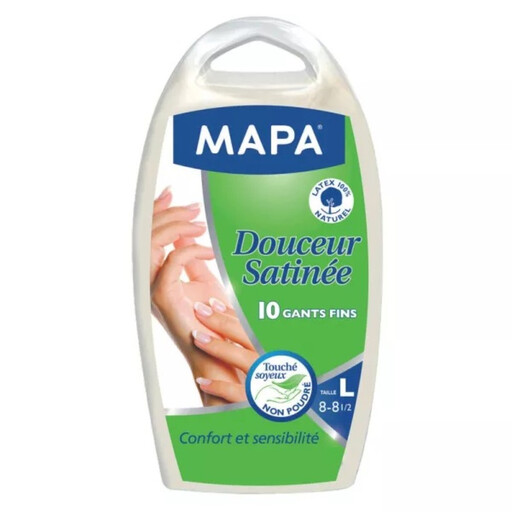
Why this choice suits this profile: This small pack lets you try thin gloves for household tasks, decorating or crafts, without building up a large stock.
The product sheet clearly states the pack of 10 gloves, size L and the powder-free formula. So you know exactly what quantity you're buying.
Fine natural latex, satin interior and powder-free. This product is not recommended for people allergic to natural latex.
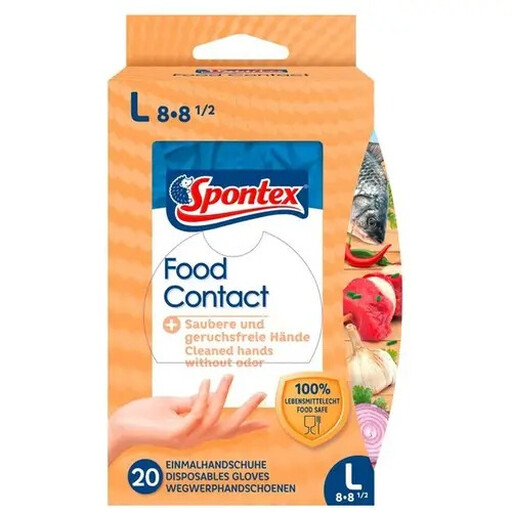
Why this choice suits this profile: This model is aimed at people who prefer a latex-free material and a clear indication for food preparation.
The product sheet mentions a certification for food contact and a pack of 20 gloves. However, the usage limits, particularly with strong acids and sharp objects, must still be respected.
Latex-free nitrile, size L and indication for all types of food according to the product information.
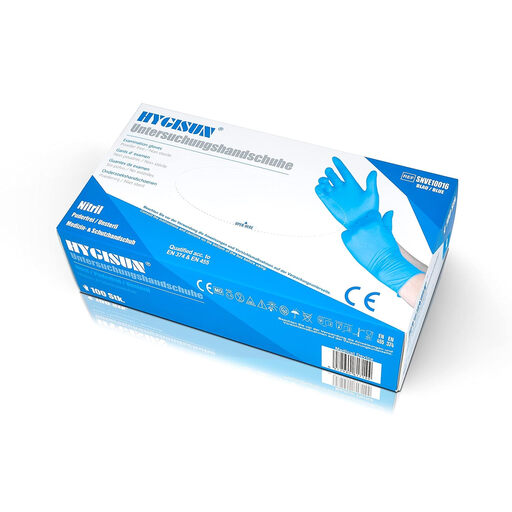
Why this choice suits this profile: With 100 gloves in size S, this box is suitable for regular use in the kitchen, for cleaning or certain professional activities, subject to checking its suitability for your line of work.
The product sheet states a latex-free and powder-free composition, a textured surface and the references EN 455, EN 374 and EN 420. Nevertheless, check the permitted uses on the packaging.
Blue nitrile, ambidextrous design, textured surface and pack of 100 gloves in size S.
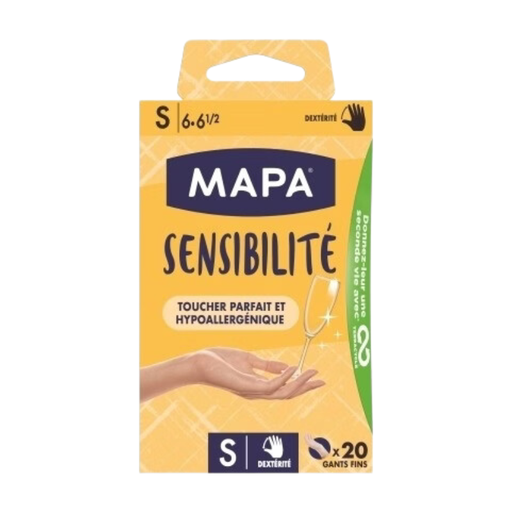
Why this choice suits this profile: This format lets you try thin vinyl gloves for everyday tasks, with a size S and a powder-free formula.
The vinyl composition, the absence of latex and the quantity of 20 gloves are clearly stated. So there's no risk of confusing a small box with a professional pack.
Latex-free vinyl, powder-free, size S and a fine feel claimed for everyday tasks.
We've put together a comprehensive list, updated in real time, of products that meet these strict selection criteria and European safety regulations.
Start by checking for an explicit food contact statement on the product sheet or packaging. Latex-free nitrile can be suitable for food preparation when the product is certified for this use. Vinyl is also offered for certain food handling tasks. As for latex, don't choose it without checking any restrictions and the sensitivity of the users.
It all depends on the task, humidity, perspiration and the condition of the glove. Replace it if it is torn, soiled or damp inside, but also after a change of activity, to limit cross-contamination. A disposable glove is designed for a single use: it should not be washed and then reused.
Measure the width of your palm, without including the thumb, then compare it to the brand's size chart. Put the glove on without forcing: the fingers should reach the end, while the palm should remain well fitted. For precision tasks, a size that is too large generally impairs control. Conversely, for prolonged use, avoid any excessive compression.