Who is each size best for?
The number of people in your household isn’t the only factor when choosing a dishwasher size. How often you cook, the size of your dishes and your installation options all matter too.
One person in a studio or small flat
If you don’t build up much washing-up, compare a mini countertop model with a 45 cm appliance. Check that you have room for the mini on your worktop and that its baskets can fit the plates, pans and glasses you use regularly.
A couple with a small kitchen and existing connections
If you often cook for two, a freestanding 45 cm model may save you from running a mini dishwasher so often. However, check that there’s enough room to open the door, and confirm that you have a water supply, electricity and a suitable drain.
A tenant whose installation options are still to be confirmed
Start by checking the available space and connections. Some mini models with a tank don’t need a fixed water supply, but their instructions should also explain how to drain the waste water and install the appliance.
What should you check before choosing?
Start with the amount of washing-up you produce between cycles, then rule out sizes that won’t fit the space or work with your connections. Next, compare the usage information for the models that are still suitable.
| Factor |
What to check |
What I need |
| Capacity |
Compare the number of place settings and the basket layout with the dishes you actually use. UFC-Que Choisir describes freestanding 45 cm models as holding 9 to 10 place settings, and 60 cm models as holding 12 to 17; check the capacity of each mini model individually. |
I want to avoid having to run a small appliance too often, without setting aside 60 cm for a capacity I’d rarely fill. |
| Space |
Measure the width, depth and height, as well as the space needed in front of the door. A countertop model takes up worktop space; a compact integrated model needs a suitably sized cavity. |
I need to be able to use the kitchen with the dishwasher installed and its door open. |
| Connections |
For a plumbed-in appliance, check the water supply, electricity and drainage requirements in the instructions. For a mini model with a tank, also check how to fill it and drain the waste water. |
I need to be able to use the appliance where I plan to put it, without assuming that “no fixed water supply” means “no installation requirements”. |
| Water and energy |
Check the label for the exact model and compare water use per Eco cycle, energy use per 100 cycles and programme duration. Factor in capacity too: two different-sized appliances won’t handle the same amount of washing-up per cycle. |
I’d rather choose a size I can load in line with my mealtimes than base my decision on the energy rating letter alone. |
| Noise |
Check the stated noise level in dB(A) and the noise emission class. UFC-Que Choisir highlights how important noise levels can be when the kitchen is open to the living area. |
A cycle shouldn’t disturb anyone resting or working in a room near the kitchen. |
| Installation and maintenance |
Check what delivery and installation include, and whether new connections need to be fitted. Look up the repairability index for the model and check the maintenance guidance. |
I want to know what’s involved in installing and maintaining the appliance, not just whether it fits in the kitchen. |
| Washing up by hand |
If there’s no suitable space or connections, reconsider your choice of appliance rather than trying to force an installation. If you don’t have much washing-up, also think about how a mini model would fit into your current routine. |
I’d like to cut down on washing up by hand, but not at the cost of an appliance that’s difficult to install or load every day. |
Which brands should you consider?
These brands are examples of the sizes and information you can look into. They don’t represent the features of every model in their ranges or indicate whether those models are included in the Joybuy selection below.
Beko
Beko’s French range includes slimline 45 cm freestanding dishwashers, with some models listed as holding 10 place settings.
- Worth exploring if you have 45 cm of width and want to compare several models with this capacity.
- Check the label and product details for each model: capacity, noise and energy use aren’t the same across the whole brand.
Electrolux
Electrolux’s French website features compact integrated models, as well as freestanding 45 cm and 60 cm dishwashers.
- The brand lists its compact integrated ESL2500RO as 55 cm wide with 6 place settings—an example to compare with the dimensions of your kitchen unit.
- A compact integrated model needs to be checked for fit, door clearance and connections. Its width alone doesn’t confirm that it’s compatible.
Bosch
Bosch’s installation guidance highlights the checks to make for a plumbed-in dishwasher.
- It covers the water supply, electricity and drainage—details to check against the instructions for the model you choose.
- Installation guidance isn’t enough to conclude that a Bosch appliance washes better, runs more quietly or lasts longer than another model.
Mini countertop dishwashers on Joybuy
The models below are mini countertop dishwashers to consider if this size suits your dishes and available space. They aren’t a substitute for comparing 45 cm or 60 cm freestanding models if you have the room and the necessary connections.
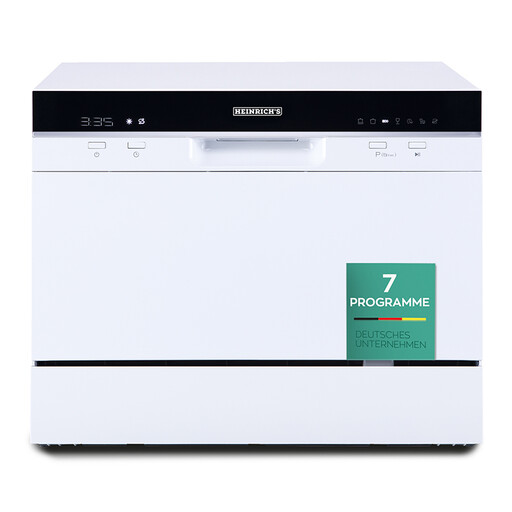 Image unavailable
Heinrich's HTG 8840 Weiss, 6 place settings
Worth considering if six place settings suit the dishes you usually use and you can connect a countertop appliance where you plan to put it. The product name lists seven programmes, a delay start of up to 24 hours and automatic door opening. Check the model’s instructions for its dimensions, door clearance and connections.
View on Joybuy
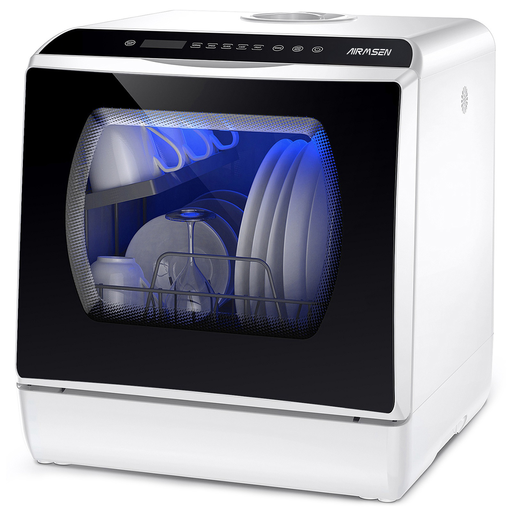 Image unavailable
AIRMSEN countertop dishwasher, 5 L tank
The built-in tank listed may suit a household without a fixed water supply at the chosen location. The product name mentions a 5 L tank and “5+1” wash cycles. Check the instructions for the space required, a stable surface and how to drain the waste water.
View on Joybuy
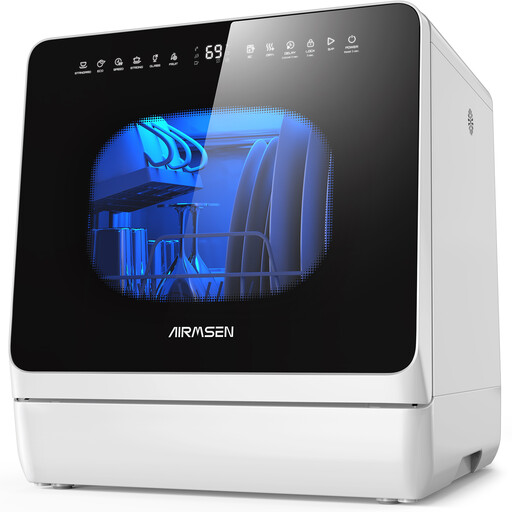 Image unavailable
AIRMSEN countertop dishwasher, 8 programmes
This mini model may be an option if space calls for a countertop appliance. Its name lists eight programmes, a built-in water softener, a delay start and a child lock. The claim that it can be used without a fixed connection doesn’t remove the need to check the instructions for a suitable water supply and drainage setup in your kitchen.
View on Joybuy
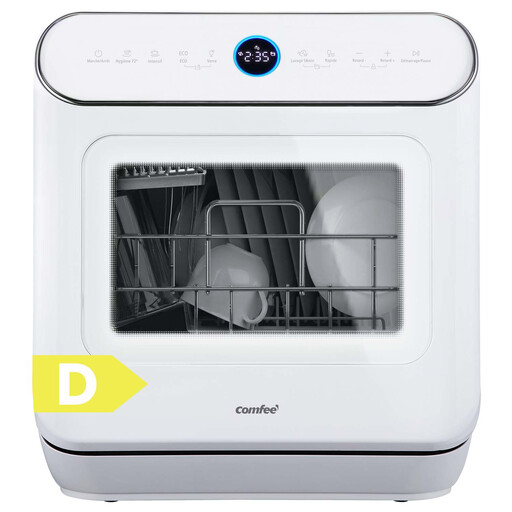 Image unavailable
COMFEE CDWMT305WD, mini tabletop model
This tabletop size is designed for smaller loads. Check that the basket can hold the plates and utensils you use regularly. The product name lists seven programmes, a delay start of up to 24 hours and automatic door opening. Check the instructions to confirm how to fill the appliance and drain the water.
View on Joybuy
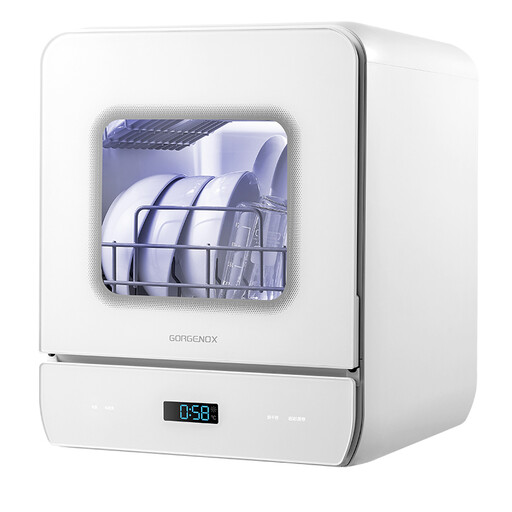 Image unavailable
GORGENOX DW5-D40A, listed capacity of 3 place settings
The listed capacity of three place settings means it’s worth checking the basket if you use large dishes. The product name mentions hot-air drying and a softening system. Before choosing this countertop model, check its dimensions and water supply and drainage requirements against your available space.
View on Joybuy
Frequently asked questions
Can you put a mini dishwasher with a tank anywhere?
No. Although some models don’t need a fixed water supply, they still need an electricity supply, a stable surface and somewhere to drain the waste water. Check the dimensions and instructions for the specific mini model before deciding where to put it.
What do you need for a 45 cm or 60 cm dishwasher?
A plumbed-in appliance needs a suitable water supply, electricity and drainage, as Bosch’s installation guidance points out. Check the instructions for the model you’re considering and the connections available; don’t assume that installation includes fitting new connections.
How do you compare the energy use and noise levels of two models?
Compare the labels for energy use per 100 cycles, water use per Eco cycle, the duration of that programme, capacity and stated noise level. Gifam explains the units used for energy and water; also consider how much washing-up each appliance can hold.
Should you fill the dishwasher before starting a cycle?
ADEME recommends waiting until it’s full to limit consumption per load of washing-up. However, don’t cram the baskets: choose a capacity that lets you load your usual dishes without affecting the wash.
How does the repairability index help you choose?
According to the ministry responsible for ecological transition, dishwashers are among the product categories covered by this index. Check the score and its breakdown for the model you’re considering. It provides information about repairability, but doesn’t guarantee a particular lifespan.


