A small kitchen without a usable water supply
If you can fill a tank by hand, a countertop model could save you from needing a fixed water connection. You’ll still need a stable worktop, a suitable socket and a practical route for the waste water.


If your small kitchen doesn’t have a usable water supply, start by looking at countertop dishwashers with a water tank. They can be filled by hand, but you’ll still need a way to drain the water, a suitable socket and a stable surface. Consider a model that connects to the water supply, or even a 45 cm freestanding dishwasher if capacity is your priority, only after checking that you have the necessary connections and space.
If you can fill a tank by hand, a countertop model could save you from needing a fixed water connection. You’ll still need a stable worktop, a suitable socket and a practical route for the waste water.
A tank lets you consider an installation without altering the water supply. If you’re thinking about making any connections, check that they’re technically compatible and what the work involves. ANIL advises that alterations to rented premises or equipment require the landlord’s written consent.
If you have a water supply, drainage and floor space available, compare 45 cm freestanding dishwashers too. Midea France lists the MDWEF1034CW-WG-EU as having capacity for 10 place settings; make sure its dimensions and connection requirements suit your kitchen.
First work out how you’ll fill and drain the appliance, then measure the space before comparing the stated capacities.
Consider this if: you can’t use a dedicated water supply and are happy to fill the appliance by hand.
Bear in mind: you’ll still need to drain the water, and capacity depends on the size of countertop model you choose.
Consider this if: you can confirm there’s a compatible tap and a suitable drain in your limited space.
Bear in mind: a connection saves you filling the appliance by hand, but it depends on the model and your existing installation. If you rent, it also depends on the nature of the work involved.
Consider this if: capacity matters more than saving space, and you have the necessary connections and floor space.
Bear in mind: this format won’t solve the problem if you don’t have a usable water supply.
| What matters | What to check | Who is it for? |
|---|---|---|
| Water supply | Whether the specific model has a tank, how it’s filled and whether it also offers a water connection. | If there’s no usable water supply, I want to fill the appliance by hand rather than install a fixed connection. Around 36% of consumers put this flexibility at the top of their list. |
| Drainage | Where the drainage hose can go, how it should be positioned and secured according to the instructions, and whether a container will be stable if one is required. | If the hose needs to run to a sink or container, I need to be able to route it safely to prevent spills or movement. Around 29% of consumers put having a practical drainage set-up first. |
| Space and capacity | Overall dimensions, clearance for the door to open, stability of the surface and room for your usual load of dishes. | In a kitchenette, I want an appliance that fits on my worktop without compromising too much on capacity. Around 21% of consumers make this their priority. |
| Greater capacity | Floor space, water supply, drainage and a socket before choosing a freestanding appliance. | If I can confirm the connections are available, I’d rather look at an appliance that holds more dishes. Around 14% of consumers put capacity first. |
A tank replaces a fixed water supply, not the waste-water outlet. A poorly secured hose or unsuitable container could cause an overflow.
Before buying, check where the hose needs to go and read the instructions for how to position and secure it.
Depth, height and door clearance matter too when you have a small worktop. A narrow model won’t necessarily have room for the dishes you usually wash.
Measure the available space in all three dimensions, check that the surface is stable and compare the stated capacity with the size of your plates.
A connection option on the appliance doesn’t guarantee that it’s compatible with your existing tap or that you’re allowed to alter a rented property’s plumbing. ANIL advises that alterations to rented premises or equipment require the landlord’s written consent. Whether a particular connection counts as an alteration depends on the work involved.
First check the instructions, the existing installation and your tenancy agreement. Get written permission before making any plumbing alterations.
Daan Tech describes Bob as a 34 × 49 × 49 cm mini countertop dishwasher that can be used with its integrated 4 L tank or connected to a water supply.
HAVA lists an integrated 5 L tank for its R01 and R09 countertop models, which measure around 43 × 43 × 46 cm.
Midea France describes the MDWEF1034CW-WG-EU as a 45 cm freestanding dishwasher, with capacity for 10 place settings and dimensions of 845 × 448 × 600 mm.
Electro Dépôt lists, among other options, a Valberg mini dishwasher with capacity for 6 place settings and 45 cm freestanding models.
These two countertop models are designed to be filled by hand, making them an option for small kitchens without a dedicated water supply. Before choosing, check that their drainage and installation requirements suit your space.
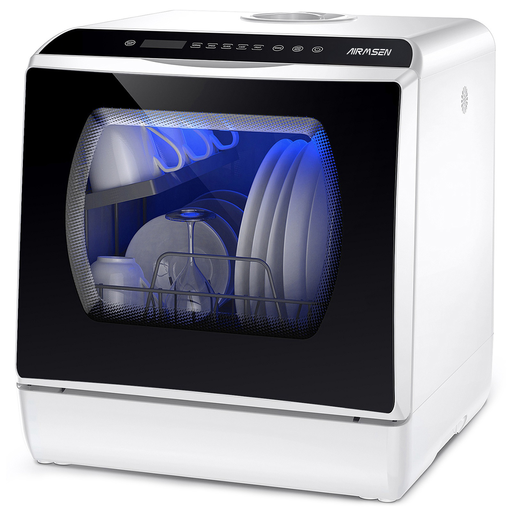 Image unavailable
Worth considering if you want to fill a countertop appliance by hand, without a direct water supply. The product title lists an integrated 5 L tank and 5+1 wash cycles.
Have a suitable container ready for the waste water, and check the instructions for how to secure the hose and allow the necessary clearance. The guidance for this model specifies a flat, stable surface and a properly earthed socket, with no extension lead or multiway adaptor.
 Image unavailable
Consider this if you want to fill the tank by hand but would also like the option of connecting the appliance to a tap. The product title lists 6+3 programmes and an energy rating of D.
According to the information provided for this model, the tap adaptor isn’t included. Secure the drainage hose and check the instructions for its outlet position, the required clearance and the full electrical requirements. The guidance specifies an earthed 220–240 V socket and advises against using extension leads.
Yes, provided the model is specifically designed to be filled from a tank. Daan Tech lists this option for Bob with a 4 L tank, while HAVA offers it on the R01 and R09 with 5 L tanks. You’ll still need suitable drainage and an appropriate power supply.
It drains through a hose, and where the hose can go depends on the model. Daan Tech describes drainage into a trap or portable use for Bob, while HAVA lists a sink or bucket for the R01. Check the instructions for the permitted outlet and how to secure the hose.
In France, alterations to rented premises or equipment require the landlord’s written consent, as ANIL advises. An adaptor or temporary connection won’t necessarily count as an alteration in every case. Check the work involved and your tenancy agreement before making any changes to the installation.
Not if you can’t use the water supply required by the freestanding model. Midea France lists the MDWEF1034CW-WG-EU as having capacity for 10 place settings, but you’ll also need to check that drainage, a socket and floor space are available.