Who are these formats suitable for?
In a kitchen where you don’t need to keep a fitted-unit front, your choice mainly depends on the available space and how the appliance will be connected.
Renters and anyone fitting out a kitchen
If you have a water inlet, a waste-water outlet and floor space, a freestanding dishwasher means you won’t need to add a cabinet door. Measure the available width before choosing between the 60 cm and 45 cm formats.
Studio flat and kitchenette dwellers
If floor space is limited and you don’t have much washing-up, a compact countertop model is worth considering. Check the space on your worktop, how the model is filled and where the waste water will go.
Households with an open-plan kitchen
If the appliance will run near your living area, compare its noise level as well as its capacity. The energy label also lets you compare water per cycle and electricity per 100 cycles on the same reference basis, as explained by ADEME.
What should you check before choosing?
First work out where the appliance can go and how it will connect to the water and electricity supplies. Then compare capacity, noise and energy and water use.
60 cm freestanding
Consider this if: you have enough width, suitable connections and regularly have a large amount of washing-up.
Bear in mind: it takes up more floor space than the other two formats.
45 cm freestanding
Consider this if: a 60 cm appliance won’t fit, but you have floor space and standard connections.
Bear in mind: it has less capacity; its narrower width doesn’t mean you can skip the connections.
Compact countertop
Consider this if: you have a small amount of washing-up, particularly if floor space is limited.
Bear in mind: capacity is limited and, with a water-tank model, you’ll need to fill it by hand. You’ll still need to arrange waste-water drainage.
| Factor |
What to check |
Think about your needs |
| Space |
Measure the width, height and depth of the space, then check there’s enough clearance to open the door. If the appliance is going under a worktop, make sure it’s low enough to fit. |
I want to install the appliance without a cabinet front or a dedicated recess. UFC-Que Choisir explains that freestanding models already have their own finished exterior. |
| Connections |
Locate the water inlet, waste-water outlet and a suitable socket separately. For a water-tank model, check the manual to find out how the waste water should be drained. |
If the water inlet is some distance away, I’ll look at water-tank compact models, but won’t assume they work without drainage or electricity. |
| Capacity |
Compare the stated place settings with the amount of washing-up you usually have. Don’t assume capacity based on width alone. Check the dimensions of the exact model, too. |
For larger loads, I’d prioritise suitable capacity over saving a few centimetres; for a kitchenette, a smaller load may be enough. |
| Noise |
Compare the dB level and noise class listed for each model, taking its capacity and location into account. |
My kitchen opens onto the living area, so the stated noise level will influence my choice, even if two appliances take up a similar amount of space. |
| Energy and water use |
On the energy label, compare the kWh per 100 cycles and the litres per reference cycle. ADEME explains the basis for both figures. |
I want to compare figures calculated on the same basis, without treating them as guaranteed consumption for every programme I use. |
Joybuy models for two types of space
This selection includes freestanding dishwashers for floor-standing installation and a countertop compact for a small kitchen. Before choosing, compare their dimensions and connection requirements with your existing setup.
 Image unavailable
Hotpoint H4FD641A freestanding dishwasher, 60 cm, 14 place settings
This format suits a floor-standing space if its stated capacity of 14 place settings matches the amount of washing-up you have. The product description lists a 60 cm width, a noise level of 41 dB and a white finish. Check the full dimensions, door clearance and connections before buying. To compare its electricity use with other models, check the kWh per 100 cycles figure on the label for this variant.
View on Joybuy
 Image unavailable
Samsung DW60M6050FS freestanding dishwasher, 14 place settings
Its stated capacity of 14 place settings may suit larger loads if you have space for the appliance near the connections. The product description lists seven cycles and a grey finish; check the dimensions, door clearance and energy-label details for this variant.
View on Joybuy
 Image unavailable
Indesit D2F HK26 S freestanding dishwasher, 60 cm, 14 place settings
This freestanding model is listed for 14 place settings, provided you have the necessary space and connections. The product description lists a 60 cm width, a grey finish and an E energy rating. Check the label for this variant to compare its kWh per 100 cycles, and check the full dimensions before installation.
View on Joybuy
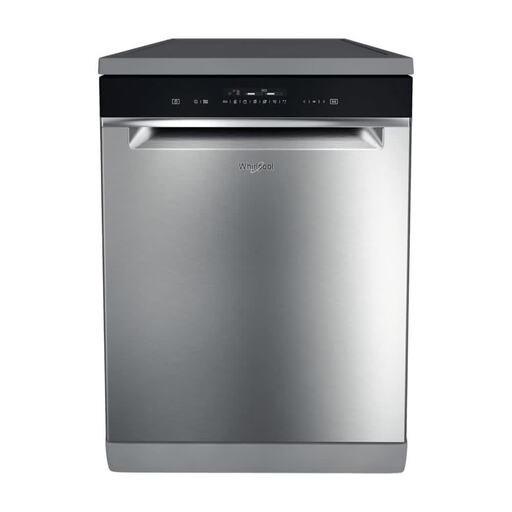 Image unavailable
Whirlpool WFP5O41PLGX freestanding dishwasher, 14 place settings
Its stated capacity of 14 place settings suits larger loads in a kitchen without a fitted-unit front. The product description lists a 60 cm width and a stainless-steel finish, but the stated dimensions also give a width of 67,5 cm. Confirm the actual width before planning the space. Check the door clearance and connections, too.
View on Joybuy
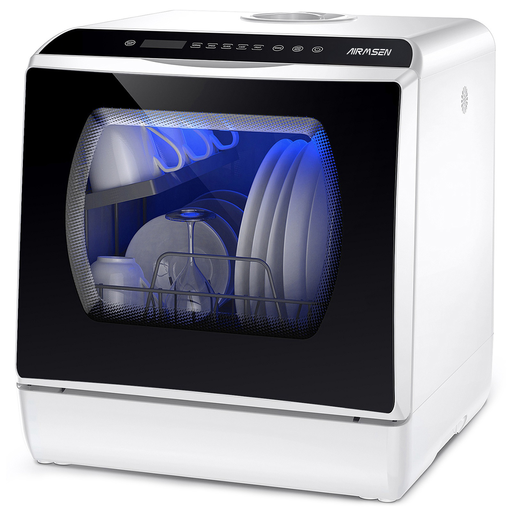 Image unavailable
AIRMSEN countertop compact dishwasher, 5 L water tank
This countertop model with an integrated water tank may suit a kitchenette where a water inlet isn’t nearby. The product description lists a 5 L tank and 5+1 wash cycles. You’ll still need an electricity supply, and should check the manual for instructions on draining waste water. Confirm the exact dimensions before setting aside space on your worktop.
View on Joybuy
Frequently asked questions
Do you need a cabinet front to install a freestanding dishwasher?
No. UFC-Que Choisir explains that a freestanding dishwasher already has its own finished exterior, so you don’t need an extra cabinet door. You should still check its dimensions and the connections at your chosen location.
What connections do you need for a 45 or 60 cm freestanding dishwasher?
You’ll need a water inlet, a waste-water outlet and a suitable electricity supply. Before buying, check that all three are accessible from the space you’ve measured.
Can a water-tank compact dishwasher work without a water inlet?
Yes, if the specific model has this filling option. Daan Tech says Bob’s 4 L tank means it can be used without a water inlet. You’ll still need to arrange waste-water drainage and have an electricity supply; check the manual for the compact model you choose.
Can you plug a dishwasher into an extension lead?
Don’t use an extension lead as a substitute for a suitable socket. Promotelec recommends connecting the dishwasher directly to a dedicated circuit. If you’re unsure about your home’s electrical installation, have it checked before connecting the appliance.
How can you compare the noise and energy and water use of two models?
Compare their noise levels and the figures on their energy labels. According to ADEME, electricity use is shown in kWh per 100 reference cycles and water use in litres per reference cycle. These figures don’t necessarily reflect every programme you use day to day.


