Households moving into a kitchen with no dedicated dishwasher space
A freestanding appliance has its own casing, so you can consider one without a fitted cabinet. You’ll still need to set aside a space that suits its dimensions and connections.


In a kitchen without a dedicated space for a dishwasher, start by measuring the available space and considering how much washing-up you generate. A 60 cm freestanding model usually holds 12 to 17 place settings, compared with 9 to 10 for a 45 cm model and fewer than 9 for a compact model, according to Que Choisir. Only consider an integrated model if the space and cabinet door are suitable for your chosen model. Before ordering, also check the connections, clearance for the door to open and, in an open-plan kitchen, the stated noise level.
A freestanding appliance has its own casing, so you can consider one without a fitted cabinet. You’ll still need to set aside a space that suits its dimensions and connections.
According to Que Choisir, a 45 cm model usually holds 9 to 10 place settings. If even this size won’t fit, a compact model with fewer than 9 place settings may suit a smaller volume of washing-up.
It’s worth comparing the dB(A) level and noise class of the models you’re considering, particularly if the dishwasher will be running while you’re using the living area.
Measure the available space and work out how much washing-up you generate before comparing noise and consumption figures.
| What to consider | What to check | Think about your needs |
|---|---|---|
| Size and capacity | Measure the width, height and depth, as well as the clearance needed for the door to open. Que Choisir gives 12 to 17 place settings as a guide for 60 cm models, 9 to 10 for 45 cm models and fewer than 9 for compact models. | If I have a lot of washing-up, I’ll need enough capacity and space. In a very narrow kitchen, I may be willing to settle for a smaller capacity and run more frequent cycles. |
| Installation and connections | Check the water supply, drainage, socket, space for the hoses and floor stability. Promotelec states that a dishwasher socket must be connected to a dedicated circuit; if in doubt, have the installation checked. | Without a fitted space, I’m looking for a freestanding appliance. For an integrated model, I also need to confirm that the cabinet space and door are compatible. |
| Noise | Compare the stated dB(A) levels and noise classes on the energy labels, using figures measured on the same basis. | My kitchen opens onto the living area, so noise is particularly important if I plan to run a cycle while that room is in use. |
| Water and electricity | ADEME recommends checking the kWh per 100 reference cycles and litres of water per reference cycle on the energy label. Compare figures calculated on the same basis. | If I run the dishwasher often, I want to look at its consumption rather than judge how much it uses by its energy class alone. |
A narrow appliance can still be deep: for example, Bosch lists the SPS2HKI58E as 600 mm deep and 450 mm wide. You’ll also need room for the hoses and the door to open.
Measure the full space, the clearance in front of the appliance and the space behind it, then check the manual for the exact model.
Que Choisir notes that models with 9 place settings aren’t necessarily cheaper than appliances with a larger capacity. Width alone won’t help you decide.
Compare appliances that fit your space, taking into account their capacity, energy label and stated noise level.
According to ADEME, an increase of 3 dB corresponds to almost double the noise. This is worth bearing in mind when the appliance is in an open-plan kitchen.
Check the dB(A) levels and noise classes of the models you’re considering, as well as when you plan to use the appliance.
An integrated model must fit the cabinet space and the planned door and cabinet front. A stated width of 60 cm doesn’t by itself guarantee compatibility.
Before ordering, check the installation measurements, the required cabinet front and the connections in the manual for your chosen model.
These examples show different sizes to compare. Their specifications apply to the models listed, not to every appliance from each brand.
The BDFS26041XQ is a 45 cm freestanding model to consider if width is limited.
The SPS2HKI58E is a slimline freestanding model, so its depth is an important factor when choosing where to put it.
The WFC3C42PX and W7IHP40LSC suit two different setups: a freestanding model or a fitted kitchen.
The FLV0647DW is an example of a compact freestanding model for a smaller volume of washing-up.
These models include standard-capacity freestanding dishwashers for a kitchen without a fitted space, as well as a tabletop compact model for smaller loads. Check the dimensions and connections for each model to make sure it will fit in your kitchen.
 Image unavailable
This freestanding model could suit a kitchen without a fitted space if there’s room for its 60 cm width and 14 place settings. The product name lists 41 dB and energy class C. Also check the depth, door clearance and space for the hoses.
 Image unavailable
Consider this 14-place-setting freestanding model if there’s room for a standard-capacity appliance. The product name lists seven programmes. Check the full dimensions, door clearance and energy label for the exact model.
 Image unavailable
With 14 place settings listed, this freestanding model is suited to a space that can accommodate a 60 cm appliance, rather than a narrow fitted space. The product name lists energy class E. Also measure the depth and allow space for the connections.
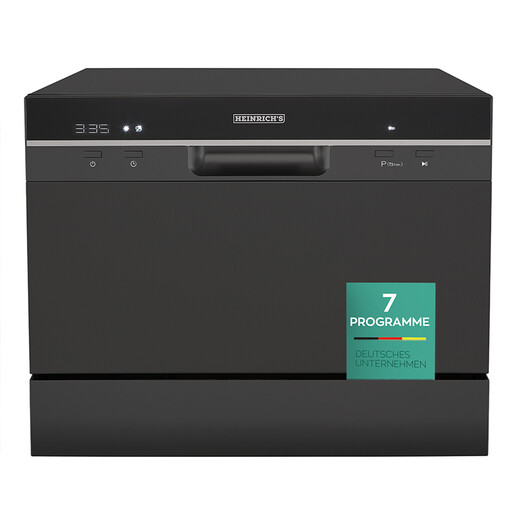 Image unavailable
This compact tabletop model has 6 place settings and suits smaller loads when there’s no room for a standard-size appliance. The product name lists seven programmes, 47 dB and energy class D. Check its full dimensions and the reach of the hoses.
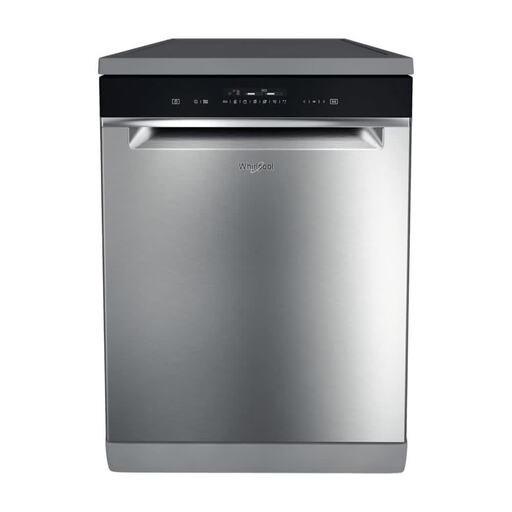 Image unavailable
This freestanding model has a stated capacity of 14 place settings and could suit a kitchen without a fitted space. Its product name lists a width of 60 cm and energy class C, but another width listed for this model is 67,5 cm. Check the actual width in the model documentation before choosing it for a measured space.
Yes. A freestanding dishwasher doesn’t need a fitted space: Que Choisir explains that it has its own casing. However, check the dimensions, water supply, drainage, socket and space for the connections before choosing a model.
Que Choisir gives 12 to 17 place settings as a guide for 60 cm models, 9 to 10 for 45 cm models and fewer than 9 for compact models. Choose a size that fits your space and has enough capacity for the washing-up you generate between cycles.
Compare the stated dB(A) levels and noise classes on the energy labels of the models you’re considering. According to ADEME, an increase of 3 dB corresponds to almost double the noise, so even a small difference in the figures is worth noting if the appliance will be running near the living area.
Yes. ADEME notes that the label shows, among other things, energy use in kWh per 100 reference cycles and water use in litres per reference cycle. Compare these figures on the same basis, as well as the energy class.