What should you check before choosing?
First rule out any formats that won’t work with the available space and existing connections. Then compare capacity and the information for the Eco programme across the models that are still suitable.
Integrated
Consider this if: you already have a suitable housing unit and, depending on the model, a compatible door panel.
Bear in mind: the installation diagram may require changes to the cupboard or connections.
Slimline freestanding
Consider this if: you have floor space but not enough width for a 60 cm model.
Bear in mind: a width of 45 cm doesn’t necessarily mean less height or depth; Bosch lists the SPS2HKI58E as measuring 845 × 450 × 600 mm.
Compact countertop
Consider this if: floor space is limited and a small appliance can handle the amount of washing-up you generate.
Bear in mind: the appliance takes up worktop space, and its water supply and drainage arrangements depend on the model.
Reworking the kitchen for a standard-size model
Consider this if: the formats that fit your kitchen can’t handle your household’s washing-up.
Bear in mind: modifying a cupboard or connections goes beyond simply choosing an appliance, so decide on this in advance.
| Factor |
What to check |
What matters to shoppers |
| Space and connections |
Measure the width, height and depth, and allow for the door to open. Compare these measurements with the model’s instructions and locate the water inlet and drain. |
If I can’t redo my kitchen, my priority is finding an appliance that can actually be installed in it. Around 33% of shoppers put this compatibility first. |
| Everyday capacity |
Compare the stated place settings with your plates, glasses and dishes, as well as the layout of the racks. |
When washing-up piles up between cycles, I want to avoid a small appliance regularly leaving dishes behind. Capacity is the main concern for around 27% of shoppers. |
| Fitting and reversibility |
Work out whether you need a housing unit, a door panel or changes to the existing installations. If you’re renting, discuss any planned work with your landlord. |
I want to keep the existing cupboards, especially if I rent my home. Around 20% of shoppers put limiting alterations first. |
| Energy and water use, cycle time and noise |
Look at place settings, litres per Eco cycle, kWh per 100 cycles, Eco programme duration and noise level together. |
In an open-plan kitchen, I want to run the appliance without overlooking the noise or the length of the cycle I’ll use. Around 20% of shoppers focus first on these day-to-day considerations. |
ADEME notes that the water and energy figures shown are for comparing the reference programme. Check capacity alongside these figures: appliances in different formats won’t necessarily handle the same amount of washing-up.
Countertop dishwashers on Joybuy
These countertop appliances are worth considering if you’re short on floor space. For each one, compare the stated capacity with your washing-up, and check the water supply, drainage and clearance needed to open the door.
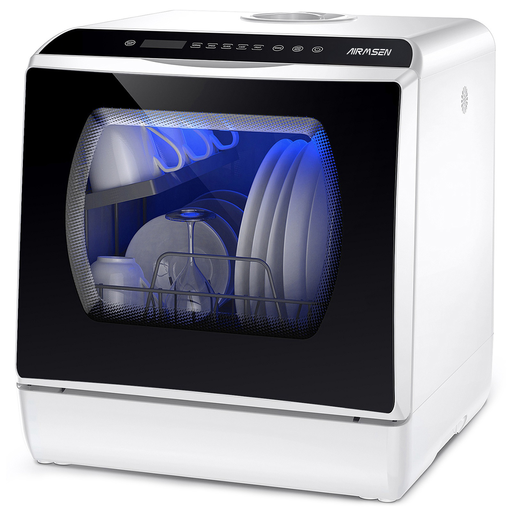 Image unavailable
AIRMSEN countertop dishwasher, 5 L tank
Worth considering if you’d prefer a countertop appliance to one that needs an integrated housing unit. The product title lists a 5 L tank and 5+1 wash cycles; check how much space it needs and how the water will drain away.
View on Joybuy
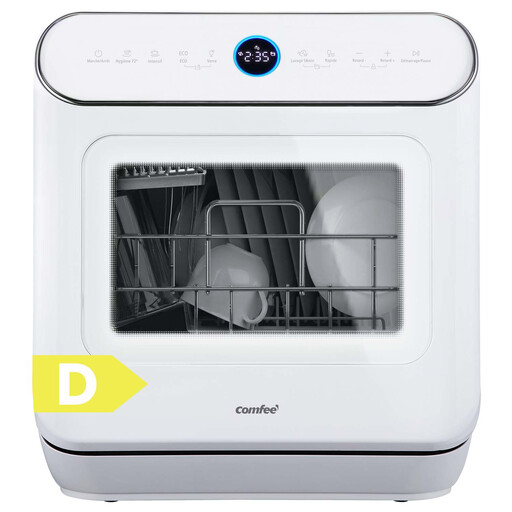 Image unavailable
COMFEE CDWMT305WD mini countertop dishwasher, white
Worth a look if a countertop model suits your kitchen. The product title lists 7 programmes and a D energy rating; check the instructions for drainage and the space needed to open the door.
View on Joybuy
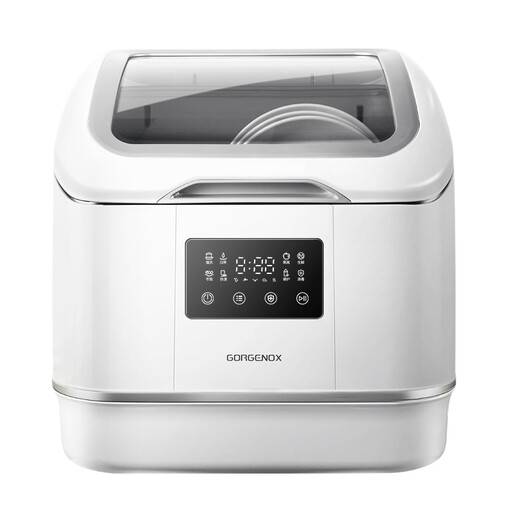 Image unavailable
GORGENOX DW4-D30A countertop dishwasher, 3-Set
Worth considering if you have space on your worktop and don’t generate much washing-up. Before choosing it, check how the water supply and drainage work: the words ‘no installation’ in the product title aren’t enough to confirm what connections are needed.
View on Joybuy
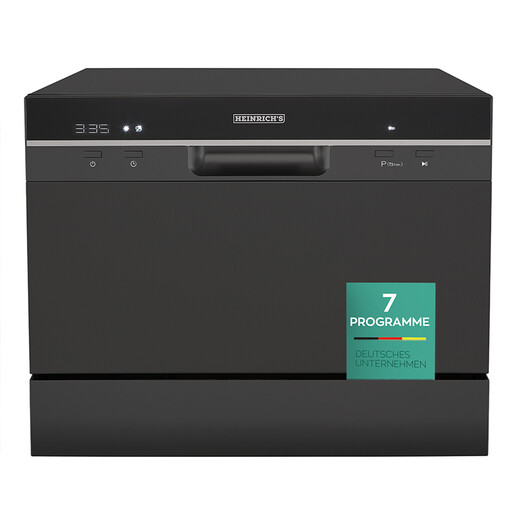 Image unavailable
Heinrich's HTG 8840 Schwarz countertop dishwasher, 6 place settings
Worth considering if you’re looking for a countertop appliance with a stated capacity of 6 place settings. The product title mentions 47 dB; check the exact model’s external dimensions, connections and energy label figures before comparing it with other appliances.
View on Joybuy
Frequently asked questions
What should I measure before ordering a dishwasher for a small kitchen?
Measure the width, height and depth of the space, as well as the route into it and the clearance needed to open the appliance door. Check which connections are available; for an integrated model, compare your measurements with the installation diagram for the exact model.
Does a countertop dishwasher always work without a water supply?
No: the water supply arrangement depends on the model. For example, Candy says its CP 6E51LS connects directly to a water supply; check the drainage instructions too before deciding where to put it.
How do I compare water and energy use across different formats?
Look at capacity, litres per Eco cycle and kWh per 100 cycles together, rather than focusing on just one figure. ADEME says the figures shown relate to a reference programme; check its duration and noise level too if these matter in your kitchen.
Can you install a dishwasher in a rented home?
You may be able to install an appliance in a rented home, but what’s practical depends on the changes required. Service-Public distinguishes between adapting a home and carrying out building work: if your plans involve the cupboards or existing installations, explain them to your landlord and check whether you need their permission before starting.
Does fitting an integrated dishwasher include adapting the kitchen?
Not necessarily: check exactly what the installation service includes. Electrolux’s pre-installation conditions state that its installers don’t carry out carpentry, plumbing or electrical work, so any changes to the housing unit or connections will need to be arranged separately.


