How do the options compare?
Countertop model
Consider it: if there’s no free space for an integrated appliance, but your worktop can accommodate one and your usual load is small.
Bear in mind: limited capacity may mean running more frequent cycles, and the appliance will take up worktop space.
45 cm slimline model
Consider it: if you have enough width and a countertop model won’t hold all the dishes you produce between meals.
Bear in mind: a narrower width doesn’t necessarily mean less depth or less clearance in front of the door.
Standard-size model
Consider it: if the space is suitable and dishes, pans and everyday crockery regularly add up to a large load.
Bear in mind: it takes up more width, so make sure your needs justify it rather than choosing it for the advertised capacity alone.
Washing up by hand
Consider it: if no appliance can be placed and connected safely, or if you have very few dishes to wash.
Bear in mind: you’ll need time to wash, dry and put away the dishes after meals.
To compare appliances that will work in your kitchen, start with your everyday load, then check the Eco cycle figures on the energy label. ADEME says this includes information such as capacity, water and energy use, programme duration and noise.
| What to consider | What to check | Who is this important for? |
|---|
| Space and installation |
Measure the width, depth and height, and check the door clearance. Consult the manual for connections and pipe routing. |
I can’t move my cupboards to make room for an appliance, so it needs to work where I have space. Around 36% of consumers put this installation constraint first. |
| Usable capacity |
Compare the stated place settings with your dishes and pans, then check the basket layout. |
If a day’s dishes won’t fit in one load, a small machine may mean running more cycles. Capacity is the main consideration for around 29% of consumers. |
| Noise and Eco cycle |
Check the dB, litres per cycle, kWh per 100 cycles and Eco programme duration for the exact model. |
In an open-plan kitchen, I want to be able to start a cycle without overlooking noise or how it fits around mealtimes. I also check water and energy use. Around 21% of consumers prioritise this everyday convenience. |
| Option without an appliance |
Check whether an appliance can genuinely be connected to the water supply and drainage. If not, make space to wash, dry and put dishes away by hand. |
When there aren’t many dishes and installing a machine would make the kitchen more complicated, I’d rather keep things simple. This is the top priority for around 14% of consumers. |
Countertop dishwashers on Joybuy
These countertop appliances are worth considering if there’s no space under your worktop. Before choosing one, compare its stated capacity, water supply method and dimensions with your dishes and the space you have available.
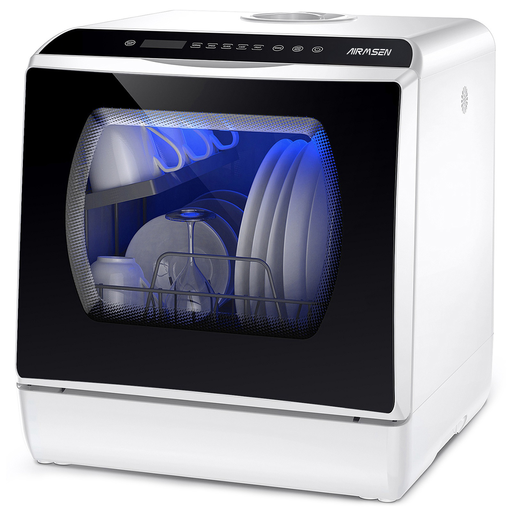 Image unavailable
AIRMSEN countertop dishwasher, 5 L tank
Worth considering if you’re looking for a freestanding appliance rather than an under-counter model. The title states that it has a built-in 5 L tank and several cycles. Check that there’s room to open the door and drain the water, then make sure its capacity suits your meals.
View on Joybuy
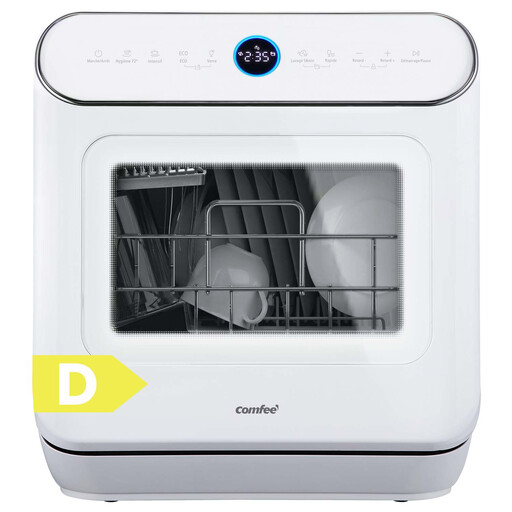 Image unavailable
COMFEE CDWMT305WD, white countertop dishwasher
Worth considering for a small load if you have room for it on your worktop. The title states that it has 7 programmes and a D energy rating. Check the manual for its capacity for your dishes, how it drains and the figures for the cycles you’re interested in.
View on Joybuy
 Image unavailable
Comfee' CDWMTO201D(W), white countertop dishwasher
Worth considering if you need a water supply option to suit a restricted space. The title states that it has a built-in 5 L tank and a D energy rating. Check how it drains, whether it can hold your dishes and which parts you’ll need if you plan to connect it to a tap.
View on Joybuy
 Image unavailable
Heinrich's HTG 8840, black countertop dishwasher, 6 place settings
Worth considering if a stated capacity of 6 place settings suits your everyday load. The title states that it has 7 programmes, produces 47 dB of noise and has a D energy rating. Check these figures on the model’s label, along with its dimensions and connection requirements.
View on Joybuy
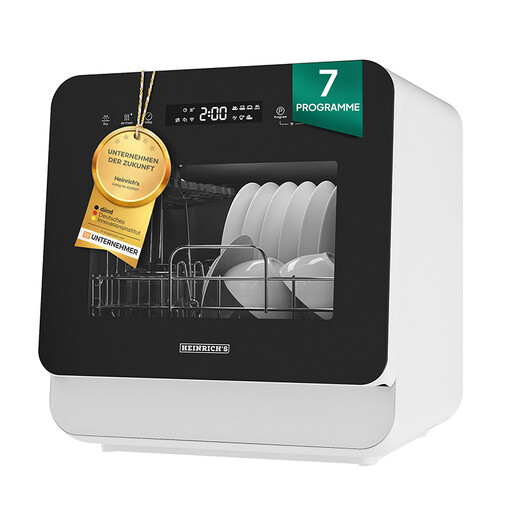 Image unavailable
Heinrich's HTG 8855, countertop dishwasher, 3 place settings
Only consider this if a small load of 3 place settings is enough between meals. The title states that it has 7 programmes, produces 56,3 dB of noise and has a C energy rating. Check the dimensions, drainage and label details before comparing it with another model.
View on Joybuy
Frequently asked questions
What should I measure before buying a dishwasher for a small kitchen?
Measure the width, depth and height of the space, as well as the clearance needed in front of the door and behind the appliance for the pipes. For example, Candy’s product details for the CP 6E51LW countertop model give its dimensions as 550 × 501 × 443 mm. So the word ‘compact’ is no substitute for checking the dimensions of the exact model.
Which connections should I check before ordering?
For an appliance connected directly to the water supply, check that you have a cold-water inlet, a drainage connection and a suitable electrical socket for the installation. Haier also advises making sure the pipes aren’t kinked. Check the model’s requirements in its manual, and ask a professional to inspect your existing installation if you’re unsure.
Does a new dishwasher sold in France need to carry an energy label?
Yes. The French Ministry of the Economy says that new dishwashers must display an energy label both in shops and online. To compare models, ADEME recommends checking details such as capacity, water use per cycle, kWh per 100 cycles, Eco cycle duration and noise.
Can I compare how much appliances use by looking at their quick programmes?
No, not using only the figures for the reference cycle shown on the label. ADEME says this is often the Eco programme. If you expect to use a quick programme regularly, check its details separately in the model’s manual.


