What should you check before choosing?
First, work out what type of space your kitchen can accommodate, then compare the dimensions and connections for the specific model. If your kitchen is open-plan, check the noise level too.
Freestanding
Consider this if: you don’t have a dedicated recess or cabinet door.
Bear in mind: the appliance will be visible and needs to be positioned close to the necessary connections.
Integrated
Consider this if: your cabinets include a suitable recess and compatible cabinet door.
You’ll need to: fit the appliance into the cabinetry rather than simply placing it on the floor; the cabinet door and its fixings are part of the installation.
Compact
Consider this if: there isn’t room for a standard-sized model and a smaller capacity will do.
Bear in mind: saving space doesn’t mean you can skip planning for the water supply and drainage required by the model.
| Consideration |
What to check |
Depending on your needs |
| Space and cabinetry |
Measure the width, height and depth, as well as the clearance in front of the door. If fitting it under a worktop, check the manual to see whether the top panel of a freestanding model can be removed and how much height you’ll have once it is. |
I want to install the appliance without blocking a walkway or assuming a freestanding model will fit under my worktop. For an integrated model, my kitchen also needs a suitable recess and cabinet door. |
| Noise |
Compare the dB rating and noise emission class on the energy labels for the models you’re considering, as recommended by ADEME. Don’t assume that one declared figure reflects the noise level of every programme. |
In an open-plan kitchen, I want to be able to run the appliance without causing too much disruption in the living room. |
| Connections |
Check the water supply, drainage and electricity supply. Consult the manual for hose routing and installation requirements; a countertop model also needs to sit on a stable surface. |
The space I choose must allow for the required connections and drainage, without relying on an improvised connection after delivery. |
| Capacity |
Compare the stated place settings with the space available and the amount of washing-up you usually have. For a compact model, also check how it fills and drains. |
If space is limited, a smaller capacity may suit me; if I wash more dishes at a time, I need to make sure it won’t be too small. |
| Water and energy |
According to ADEME, the energy label shows the energy rating, kWh per 100 cycles, litres per reference cycle and the duration of the Eco cycle. Compare these figures on a like-for-like basis. |
As well as choosing a model that fits my kitchen, I want to take account of water and electricity use and the duration of the reference cycle. |
Which brands should you compare?
These ranges offer a useful starting point when comparing configurations, but you’ll need to compare noise, dimensions and energy use for the specific models.
Bosch
Bosch’s French range includes freestanding, built-in and compact dishwashers, including 45 cm and 60 cm freestanding models.
- Its installation information helps you tell the difference between freestanding and built-in models.
- Check the dimensions, energy label and manual for your chosen model: range information doesn’t apply to every model.
Beko
Beko’s French range includes freestanding models, built-in models with a visible control panel and fully integrated models.
- This choice of configurations makes it easier to look for a model that suits your planned cabinetry.
- Compare capacity, dimensions, noise and the energy label for each model individually.
Whirlpool
Whirlpool’s French range includes freestanding and built-in dishwashers in 45 cm and 60 cm sizes.
- The configuration and stated width give you a starting point when searching for a model to fit your available space.
- Width alone won’t confirm whether installation is possible, or tell you the noise level or energy use of the model you choose.
Miele
Miele’s French catalogue includes freestanding, built-in and fully integrated appliances.
- The noise levels listed in the catalogue range from 41 to 45 dB, depending on the model.
- Don’t assume that the noise level or energy rating of one model applies to the whole brand.
Models for different spaces
This selection from Joybuy includes freestanding dishwashers, some of which may be worth considering for fitting under a worktop, as well as a countertop model for smaller spaces. First choose a configuration that suits your kitchen, then check the manual and energy label for each model.
 Image unavailable
Samsung DW60M6050FS freestanding dishwasher, 14 place settings, grey
Worth considering if you have room for a freestanding appliance without a cabinet door. The product description lists 14 place settings and 7 programmes; check the dimensions and connections before deciding where to put it. If you plan to fit it under a worktop, confirm in the manual that the top panel can be removed and that the resulting height will fit.
View on Joybuy
 Image unavailable
Hotpoint H4FD641A freestanding dishwasher, 60 cm, 14 place settings
Worth considering if you have a suitable space for a freestanding model. The product description lists a noise level of 41 dB and an energy rating of C. If you’re thinking of fitting it under a worktop, check the manual for details on removing the top panel, the resulting dimensions and the connections required.
View on Joybuy
 Image unavailable
Indesit D2F HK26 S freestanding dishwasher, 60 cm, 14 place settings
A freestanding option to consider if you’re looking for the 14 place settings stated in the product description. It lists an energy rating of E. Before choosing a spot under the worktop, check the available height, the model’s dimensions and the installation requirements in the manual.
View on Joybuy
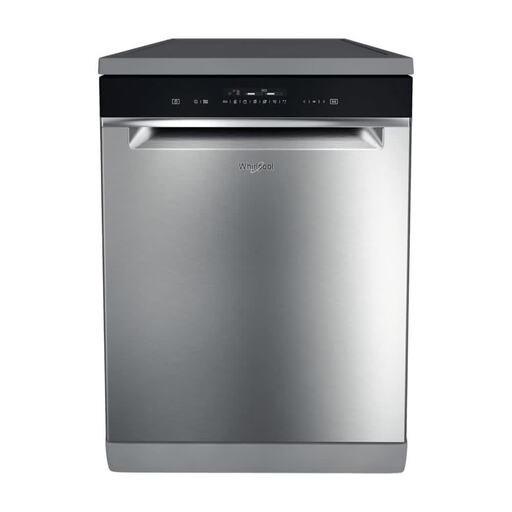 Image unavailable
Whirlpool WFP5O41PLGX freestanding dishwasher, 60 cm, 14 place settings
The product description lists a freestanding appliance with a C energy rating and a stainless steel finish. Confirm the exact dimensions before checking whether it will fit: the measurements in the product information don’t clearly match the stated width of 60 cm. Also consult the manual for connection requirements.
View on Joybuy
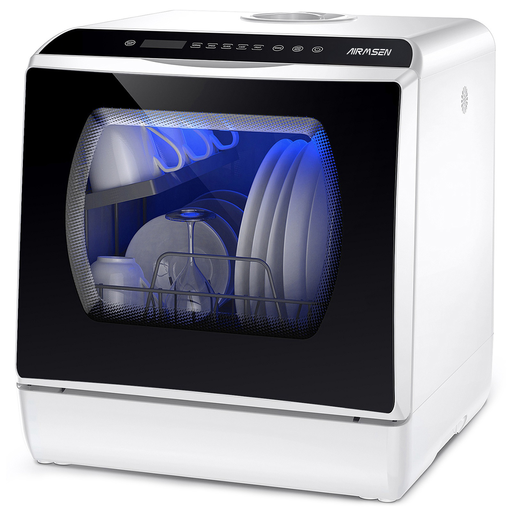 Image unavailable
AIRMSEN countertop dishwasher, 5 L tank
Worth considering if there isn’t room for a standard-sized appliance. The product description lists a 5 L tank and 5+1 wash cycles. Check that the capacity suits your needs, that you have a stable surface and that the hose can drain the wastewater. If your kitchen is open-plan, check the noise information for this model too.
View on Joybuy
Frequently asked questions
Can you fit a freestanding dishwasher under a worktop?
Yes, but only with some models. UFC-Que Choisir recommends checking whether the top panel can be removed. Then check the available height, depth with the hoses in place, door clearance and the installation requirements in the manual.
Which connections should you check before buying?
Make sure the space allows for the water supply, drainage and electrical connection required by the appliance. Connections, hose lengths and installation requirements vary by model, so consult the manual and have the installation assessed if changes to your kitchen are needed.
How can you compare noise levels in an open-plan kitchen?
Compare the dB rating and noise class on the energy labels of the models you’re considering, rather than relying on marketing terms. ADEME says that noise classes A and B indicate particularly quiet appliances; your choice will also depend on when you plan to run the dishwasher.
What should you look for on the energy label?
When comparing dishwashers, look at the energy rating, kWh per 100 cycles, litres per reference cycle and noise information. ADEME explains that the label also shows the capacity and Eco cycle duration. Compare these figures in light of the space available and how you plan to use the appliance.
Does a compact dishwasher mean you don’t need to plan for a water supply and drainage?
No. Some countertop models use a tank, while others need a water inlet; either way, check how the model you choose drains wastewater. You’ll also need a stable surface and a capacity that suits the amount of washing-up you have.


