For an open-plan or shared kitchen, first choose a capacity that suits the amount of washing-up produced between cycles. Then compare the stated noise level, eco programme duration and water consumption on the model’s energy label. A standard-size appliance may be suitable if several people regularly use it and there’s enough room; a 45 cm or tabletop model can work when space is limited, but check its capacity carefully. An integrated dishwasher needs a compatible cabinet space. Whatever the format, check the dimensions and connections before you buy.
Who is this option for?
People using the living room while the dishwasher is running
If your kitchen opens onto your living space, compare the noise level in dB and the noise class of the exact model. A delay-start function, if available, can help you choose when the cycle runs, but it won’t make the appliance quieter while it’s operating.
Households where the washing-up quickly piles up
If several people share meals at home, compare the place settings and basket layout with the amount of washing-up produced between cycles. Also check the eco programme duration if you need the same plates again soon.
People with small fitted kitchens
If you’re short on width or floor space, a 45 cm or tabletop appliance is worth considering. Measure the space and check the instruction manual for the power, water supply and drainage requirements before choosing this format.
Which criteria should you prioritise?
Start with the format your kitchen can accommodate, then weigh up capacity, noise and cycle timings. The figures on the energy label let you compare models against the criteria listed for their eco programme, according to ADEME and the European Commission.
Standard freestanding
Consider it: if several people regularly produce a lot of washing-up and you have a suitable space available.
Bear in mind: it takes up more space than a slimline or tabletop model; check the capacity and noise level of each model.
Integrated
Consider it: if you already have a compatible cabinet space and want the appliance to blend into your kitchen.
Bear in mind: the cabinet space, door panel and connections must be compatible with the model; integration alone doesn’t guarantee low noise.
45 cm or tabletop model
Consider it: if space is limited, choosing between a slimline floor-standing appliance and one placed on a suitable worktop or stand.
Bear in mind: its capacity may mean you need to run cycles more often; a tabletop model also needs a suitable water supply and drainage.
| What matters |
What to check |
Who is it for? |
| Noise while people are at home |
The model’s dB level and noise class; whether you can schedule the cycle. |
If the dishwasher runs while I’m using the living space, I want to keep noise to a minimum. Around 31% of consumers say quiet operation is their top priority. |
| Capacity and how often you need to run a cycle |
The place settings and basket layout compared with the amount of washing-up produced between cycles. |
When several people share meals, I’d prefer to fit everyone’s dishes in without having to run the appliance too often. Capacity comes first for around 25% of consumers. |
| Space and installation |
The model’s dimensions and the available space; connections and, for an integrated model, cabinet compatibility. |
In a fitted kitchen, I need to make sure the appliance will fit without assuming that modifications are possible. Format and installation are the top priority for around 25% of consumers. |
| Water, energy and cycle duration |
Litres of water per eco cycle, kWh per 100 eco cycles and the programme duration shown on the label. |
If I need clean dishes at specific times, I want to balance cycle duration with my consumption priorities. Around 19% of consumers put this balance first. |
Mistakes to avoid
-
Relying on the word “quiet” alone
In an open-plan living space, this claim doesn’t help you compare the noise levels of two models.
Check the dB level and noise class on the exact model’s label, then consider whether its operating times will suit everyone in the household.
-
Assuming a slimline model will have enough capacity
Que Choisir says that 45 cm appliances with 9 place settings can suit a small family, although they may need to be run every day. In a shared home, the amount of washing-up could change that calculation.
Think about what builds up between cycles and check whether the baskets have room for your dishes and pans, rather than looking only at the number of place settings.
-
Thinking you can put a tabletop model anywhere
Its use may depend on having a suitable surface and being close to a water supply and drain. Que Choisir highlights these constraints for one compact model it reviewed.
Check the dimensions, water supply method and drainage requirements in the manual for the model you’re considering.
-
Ordering an integrated model before measuring the cabinet space
An unsuitable cabinet space or door panel can prevent the appliance from being installed. Electrolux says its installers don’t carry out carpentry, plumbing or electrical work.
Measure the cabinet space, check the existing connections and confirm what the installation service includes before ordering.
Brands to consider
Beko
Worth considering if the available width is leading you towards a 45 cm freestanding model.
- Beko France’s product information for the BDFS26041XQ lists 10 place settings and 41 dB(A).
- These figures apply to the BDFS26041XQ, not every Beko dishwasher.
Whirlpool
Worth considering for a standard freestanding model if your household produces a lot of washing-up.
- Whirlpool France’s product information for the W7FHS51X lists 15 place settings and 41 dB.
- Check the dimensions and noise level of the model you’re considering: the W7FHS51X’s specifications don’t apply to the whole range.
Siemens
Siemens offers freestanding, integrated, compact and under-counter appliances, so the format can help you narrow down the range.
- The brand highlights remote scheduling options on selected models.
- Check the features of your chosen model, along with its energy label and installation requirements.
Dishwashers to explore on Joybuy
This selection includes integrated models, a standard freestanding appliance and tabletop models. Compare their format and capacity with your kitchen and washing-up routine, and check the specifications of the exact model before choosing.
 Image unavailable
AEG FSB34707Z integrated dishwasher, 14 place settings, class C
Worth considering for a shared kitchen that already has space for an integrated dishwasher. The title lists 14 place settings and a 60 cm format, but the stated width figures differ. Check the dimensions in the manual before deciding whether it will fit the cabinet space.
View on Joybuy
 Image unavailable
Hotpoint H4FD641A freestanding dishwasher, 14 place settings, white
Worth considering if several people regularly produce a lot of washing-up and you have space for a standard-size appliance. The title lists a width of 60 cm, 41 dB and class C. Check the full dimensions, connections and eco programme duration for this model.
View on Joybuy
 Image unavailable
Heinrich's HTG 8840 Schwarz tabletop dishwasher, 6 place settings
Worth considering if you’re short on floor space and 6 place settings will meet your household’s needs. The title lists 7 programmes, a 24 h delay start, 47 dB and class D. Check the dimensions, water supply and drainage requirements before deciding where to put it.
View on Joybuy
 Image unavailable
Samsung DW80H72YBB0U1 integrated dishwasher, 13 place settings
Worth considering for a kitchen with a suitable cabinet space, with a stated capacity of 13 place settings. The title lists a 60 cm format and class B. Check the cabinet space, door and connections. To compare noise levels in an open-plan kitchen, use the figure for the eco programme rather than one for a different programme.
View on Joybuy
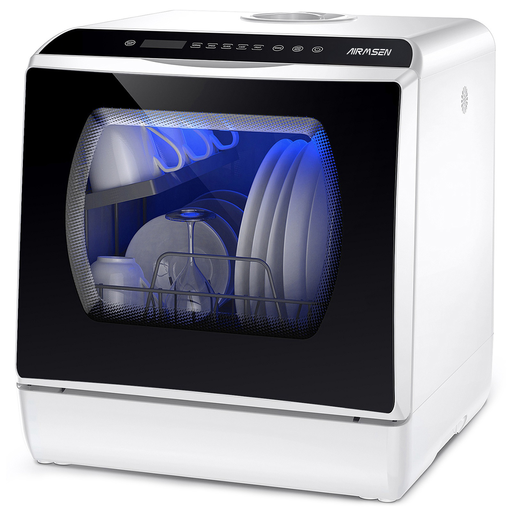 Image unavailable
AIRMSEN tabletop dishwasher, 5+1 cycles, 5 L tank
Worth considering if you’re looking for a tabletop appliance with a tank, but check how the wastewater will drain away. The title lists 5+1 cycles and a 5 L tank. If several people use the kitchen, check the model’s capacity, dimensions and noise level.
View on Joybuy
Frequently asked questions
What should I look for on the label for an open-plan kitchen?
First compare the dB level and noise class, then the place settings, water per eco cycle, energy per 100 eco cycles and the programme duration. ADEME and the European Commission present these figures as useful ways to compare dishwashers; check the label for every model you’re considering.
Will a compact appliance be enough for several people?
Only if its capacity suits the amount of washing-up produced between cycles. Que Choisir says that 45 cm models with 9 place settings can suit a small family, sometimes with daily use. For a tabletop appliance, also check the available space and the water supply and drainage requirements.
What should I check before ordering an integrated model?
Measure the cabinet space and check that the door panel, existing connections and model dimensions are compatible. Also ask what the installation service covers: Electrolux says its installers don’t carry out carpentry, plumbing or electrical work.
Does the eco programme suit a shared household’s routine?
It will if the programme finishes in time for you to use the dishes and everyone is happy with when the cycle runs. The programme’s duration, water and energy use are among the figures on the label; also check the model’s other programmes if you need the dishes sooner.


