Which criteria should you check first?
For an open-plan kitchen, first consider the noise level alongside the times you use the room. Then check the capacity against the space and connections available.
| Criteria | What to check | Consider your needs |
|---|
| Noise |
Check the dB figure and noise rating on the label for the exact model. If there’s an independent test, look at what it says about vibrations and beeps too: UFC-Que Choisir’s test protocol considers these aspects. |
I want to be able to run a cycle while people are using the living room, without relying solely on a “quiet” label. |
| Size and capacity |
According to Gifam’s guidelines, a 60 cm model holds 12 to 15 place settings, a 45 cm model holds 9 to 10, and a compact countertop model holds 6. Check the capacity and dimensions of the model you’re considering, as well as whether it can fit your larger dishes. |
Space is limited in my home: can I manage with a smaller load or more frequent cycles? If dishes tend to pile up, I should also consider the capacity of a 60 cm model. |
| Consumption |
On the label described by the European Commission, compare the kWh per 100 Eco cycles, litres per cycle and programme duration, as well as the energy rating. |
I expect to run regular cycles and want to compare figures based on the same programme, rather than looking at just one letter. |
| Installation |
Measure the space and check the water inlet, drainage and electrical supply against the instructions. For a built-in model, also check the cavity, door panel and fixings. |
If I’m replacing an appliance or considering a compact model for the worktop, the model I choose needs to fit the space and work with the available connections. |
Which brands should you compare?
These brands offer formats worth considering for an open-plan kitchen. Check the noise level, capacity and features of each specific model.
Bosch
A brand to consider if you’re comparing different installation types, including built-in models.
- Bosch’s product information for the built-in SMV2HTX08E details its dimensions, energy rating, water consumption per Eco cycle and noise rating.
- Features and installation requirements vary by model, so check the product information and instructions for the one you’re considering.
Beko
Worth considering if you’re comparing freestanding 45 cm dishwashers for a narrower space.
- Beko describes the BDFS26050XQ as a 45 cm model with 10 place settings.
- Beko says the SilentWash feature reduces noise on certain programmes for this model. This is the manufacturer’s claim, so check the model’s noise label too.
Miele
A brand to consider when comparing freestanding or integrated appliances, depending on your kitchen layout.
- Miele France’s range includes models with stated noise levels of 41 to 45 dB.
- Size and noise level depend on the model, so check the dimensions and label for the one you’re considering.
Dishwashers to consider on Joybuy
These models show two possible options for an open-plan kitchen: a 60 cm built-in appliance and compact countertop models. Compare their capacity and installation requirements with your available space and the amount of washing-up you have.
 Image unavailable
Samsung DW80H72YBB0U1, 60 cm built-in dishwasher, 13 place settings
Worth considering if you have a built-in space and need capacity for 13 place settings. The model name indicates a B energy rating; check the cavity, door panel and noise rating on the label for the exact model.
View on Joybuy
 Image unavailable
Heinrich's HTG 8840 Schwarz, compact dishwasher, 6 place settings
The countertop format and capacity for 6 place settings could suit a smaller amount of washing-up, if the installation works for you. The model name states 47 dB, 7 programmes and a D energy rating; check the dimensions, connections and noise rating on the label.
View on Joybuy
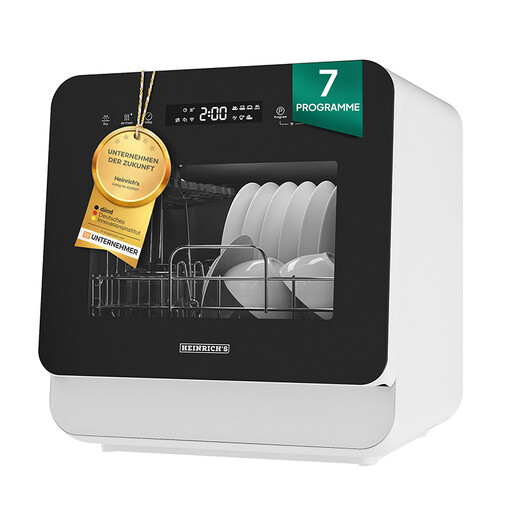 Image unavailable
Heinrich's HTG 8855, mini compact dishwasher, 3 place settings
Only consider this for a very small amount of washing-up and a suitable space on your worktop. The model name states 56.3 dB, 7 programmes and a C energy rating, so don’t assume it will be quiet in your living space. Check the dimensions and connection requirements too.
View on Joybuy
Frequently asked questions
Which noise indicator should I check for an open-plan kitchen?
Compare the dB figure and noise rating on the label for the exact model, rather than relying on its marketing name alone. If an independent test is available, its observations on vibrations and beeps can add to this information; UFC-Que Choisir considers these noises in its test protocol.
Is a 45 cm dishwasher always suitable for a small open-plan kitchen?
It’s suitable if the available width means this is the right format and its capacity meets your needs. Gifam’s guidelines are 9 to 10 place settings for a 45 cm model and 12 to 15 for a 60 cm one. Also compare the noise level of the model and how often you’ll need to run it.
What should you check before installing a dishwasher?
Measure the space and check the water inlet, drainage and electrical supply against the model’s instructions. For a built-in appliance, also check the cavity, door panel and fixings; Bosch recommends using a professional for installation.
What can you compare on the energy label?
For dishwashers covered by the EU label, it shows the energy rating, kWh per 100 Eco cycles, water use per cycle, capacity, Eco programme duration and noise emissions, according to the European Commission. Compare figures for the same programme and the exact model you’re considering.


