People living in a studio flat or with an open-plan kitchen
If your dishwasher is near the living area or sleeping space, compare its stated noise level and noise class. Think about when you’ll run the cycles, too.


In an open-plan kitchen or studio flat, start by comparing the stated noise level in dB and the noise class on the energy label. Then choose a size that suits your available space and how much washing up you need to do. A 45 cm model is narrower than a 60 cm one, but that alone doesn’t mean it uses less energy or water: compare the capacity, litres per Eco cycle and kWh per 100 Eco cycles for the specific models. Also consider when you’re likely to hear the cycle running at home.
If your dishwasher is near the living area or sleeping space, compare its stated noise level and noise class. Think about when you’ll run the cycles, too.
The width limits which models will fit, but capacity matters too. Check the number of place settings, whether there’s room for your dishes and the chosen model’s Eco consumption figures.
Before regularly scheduling a cycle for a potentially disruptive time, check the rules that apply to your home. ANIL points out that the duration, frequency and volume of a noise all count when assessing a nuisance to neighbours.
Start with the dimensions and noise level, then compare capacity and consumption using the same figures on the energy label.
| Criteria | What to check | Depending on your needs |
|---|---|---|
| Noise | Compare the dB and noise class of the specific models on their energy labels. ADEME identifies classes A and B as particularly quiet. | In an open-plan living space, I want to be able to run a cycle without overlooking the noise I might hear from the living area or sleeping space. |
| Size and capacity | Measure the space, check the installation type and connections, then compare the number of place settings and the basket layout. | A narrow space might point me towards a 45 cm model; for a worktop, I need to check that a compact appliance will fit the amount of washing up I usually have. |
| Water and energy | According to ADEME and the European Commission, the label includes figures such as litres per Eco cycle and kWh per 100 Eco cycles. Check the Eco cycle duration too; these figures don’t cover every programme. | I want to compare consumption on a like-for-like basis, without assuming that a narrower appliance necessarily uses less water or electricity. |
| When to run a cycle | Check the model’s scheduling options and the relevant rules for your building, tenancy agreement and local area. Consider how close it is to bedrooms and neighbours. | If I often run cycles at a different time, I want to choose a time that suits my home rather than relying on the delay-start function alone. |
This description isn’t enough to compare two dishwashers that will be used near a living space.
Put their energy labels side by side and compare the dB and noise class before weighing up their other features.
A 45 cm model can solve a space constraint, but its width doesn’t tell you how much water or electricity it uses.
Choose a suitable size and capacity first, then compare the litres per Eco cycle and kWh per 100 Eco cycles for the specific models.
Delay start changes when the cycle runs; it doesn’t stop noise that neighbours or people near a bedroom may hear regularly.
Check the relevant rules for your building, your tenancy agreement if applicable, and local regulations before making this a regular routine.
The French product page for the Whirlpool WSFO 3T223 P shows both an old A++ rating and an E rating. These shouldn’t be treated as the same information.
Check the energy label for the exact model reference on offer, and ask the seller to clarify if the documents don’t match.
These manufacturer models illustrate configurations worth comparing; their features don’t apply to every model from each brand.
The SMI4HCB19E is an example of a built-in appliance for a space around 60 cm wide.
The EEM43200L is an example of a fully integrated 45 cm appliance.
The WSFO 3T223 P is an example of a slimline freestanding appliance.
This selection includes worktop, freestanding and built-in appliances. Depending on your space, first compare their capacity and installation options, then check the noise information for the exact model.
 Image unavailable
This worktop model is worth considering if floor space is limited. The product title lists 6 place settings, 47 dB and a 24-hour delay start. Compare its stated capacity and noise level with your needs and the label for the version on offer.
 Image unavailable
Worth considering if you have room for a 60 cm appliance and need space for up to 14 place settings. The product title lists 41 dB and energy class C; check the noise class, Eco consumption figures and installation dimensions in the documents for the exact model.
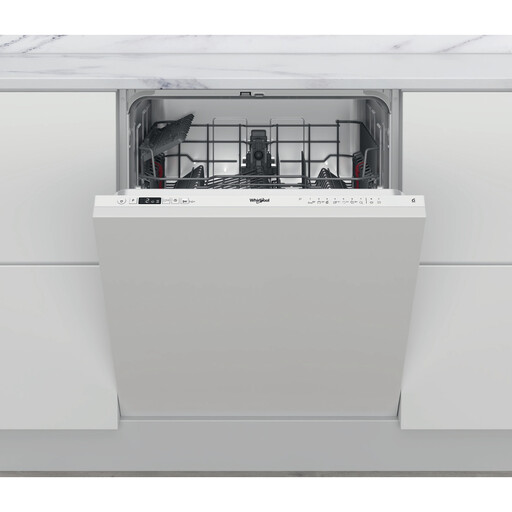 Image unavailable
This option is for a 60 cm built-in installation with a stated capacity of 14 place settings. The product title lists energy class E; check that it fits your cabinetry and door panel, and review the noise level and consumption figures on the label for the model on offer.
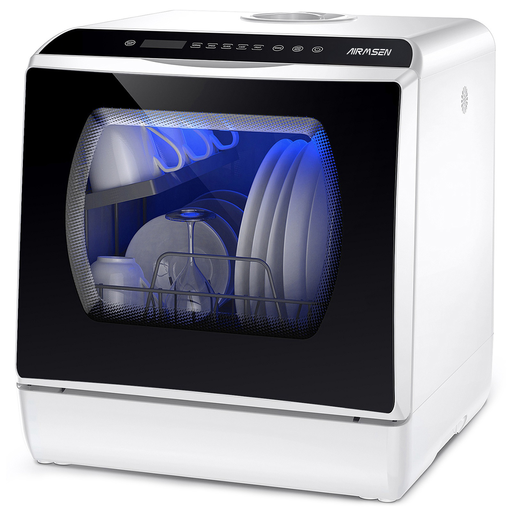 Image unavailable
A worktop model may suit a small space where a built-in appliance isn’t an option. The product title mentions a built-in 5 L tank and 5+1 wash cycles. Check the place-setting capacity, drainage and noise level if you’ll be running it near the living area.
 Image unavailable
This model is designed for a 60 cm built-in installation and has a stated capacity of 13 place settings. The product title lists energy class B; for an open-plan kitchen, check the noise level for the programme you’ll use, along with the niche dimensions and compatible door panel.
Compare their noise levels in dB and noise classes on the labels for the exact models. ADEME identifies classes A and B as particularly quiet. Also consider where the appliance will be in relation to your living spaces.
No. According to the European Commission, the label includes figures such as electricity use per 100 Eco cycles, water use per Eco cycle and the duration of that programme. Use the same figures to compare models, but don’t assume they apply to other programmes.
No. Width alone isn’t enough to tell. Compare the litres per Eco cycle and kWh per 100 Eco cycles on the labels for the appliances you’re considering, and make sure their capacity suits your washing up.
Measure the niche and check it against the dimensions and instructions for your chosen model. Also check the installation type and access to the connections. For an integrated appliance, make sure it’s compatible with your cabinetry and door panel.
Don’t assume that using delay start makes this a suitable time to run a cycle. ANIL points out that the duration, frequency and volume of noise are all relevant when assessing nuisance in a block of flats. Check your building’s rules, your tenancy agreement if applicable, and local regulations before making it a regular habit.