Without a dedicated space, a freestanding dishwasher gives you more flexibility when arranging your kitchen, as UFC-Que Choisir explains. A countertop compact model could work if its capacity is sufficient for your everyday dishes; an integrated model needs a suitable housing unit. Before choosing an appliance, check that you have space for it and the right connections. If you rent, find out whether installation would require changes to the existing fittings.
Who is this choice for?
People moving into a home without a dishwasher space
If there is no unit designed for a dishwasher, you can look at freestanding models without needing to add a kitchen door panel. UFC-Que Choisir highlights their flexibility compared with integrated models.
Small households with worktop space
A compact appliance is worth considering if its capacity suits the dishes you produce between cycles and you can set aside space for it on your worktop. UFC-Que Choisir describes 6-place-setting models in particular as space-saving.
Tenants looking to preserve the existing installation
If installation would mean altering a cupboard, the plumbing or the electrics in your rented home, check the plans before any work begins. ANIL points out that changes to rented premises or fittings require the landlord’s written consent.
How do the options compare?
In a kitchen without fitted units, first decide where an appliance could sit and be connected. Then choose a capacity that suits the dishes you accumulate between cycles.
Freestanding dishwasher
Consider this if: you don’t have a dedicated space, but can set aside a spot on the floor for a finished appliance.
The trade-off: it takes up floor space and needs to be connected where you plan to put it. UFC-Que Choisir distinguishes it from an integrated model because it offers more flexibility when arranging your kitchen.
Countertop compact dishwasher
Consider this if: floor space is limited, your worktop can accommodate the appliance and the amount of washing-up you produce suits its capacity.
The trade-off: it has less capacity than larger models. UFC-Que Choisir presents 6-place-setting compact models as suitable for smaller homes.
Integrated dishwasher
Consider this if: your kitchen already has a suitable space and integration is possible.
The trade-off: this isn’t an appliance you can simply place in an empty kitchen. UFC-Que Choisir explains that it needs to be fitted into a purpose-built space.
Washing up by hand
Consider this if: you haven’t yet identified a suitable space and connections, or would rather put off buying an appliance.
The trade-off: you’ll still need to wash your dishes by hand. Don’t assume that choosing this option alone will save water or energy.
| Criteria |
What to check |
Who it matters to |
| Space and layout |
Measure the available space and the clearance needed to open the door. If you plan to install the appliance under a worktop, check the conditions set out in the model’s manual. |
Without a dedicated space, I want to position the appliance without refitting the whole kitchen; around 36% of consumers would make layout their priority. |
| Everyday capacity |
Compare the place-setting capacity with the dishes you accumulate between cycles, including larger utensils. |
If pots and plates pile up quickly, a small appliance may not suit my routine; capacity would come first for around 27% of consumers. |
| Connections and renting |
Check the water inlet and waste outlet, as well as the suitable electrical socket. If rented fittings need to be altered, ask the landlord for written consent. |
Before choosing a model, I need to know whether I can install it without unsuitable connections or unauthorised alterations; around 27% of consumers would prioritise this. |
| Energy use and noise |
For appliances with a suitable capacity, check the kWh per 100 cycles, litres per cycle and noise level on the energy label. |
Once I’ve sorted out where it will go, I want to compare how the appliances perform day to day; water, energy and noise would be priorities for around 10% of consumers. |
When comparing labels, ADEME explains that energy use is shown in kWh per 100 reference cycles and water use in litres per reference cycle. These figures don’t replace the need to check the capacity and installation requirements of the model you choose.
Mistakes to avoid
-
Planning to install an integrated model as a freestanding appliance
According to UFC-Que Choisir, an integrated dishwasher needs to be fitted into a purpose-built space. So choosing one for an empty kitchen won’t solve the lack of fitted units.
If your kitchen has no dedicated space, look instead at a freestanding or compact appliance that suits the available space and connections.
-
Choosing the smallest model based only on the space it takes up
A 6-place-setting compact model may fit on a worktop, but that doesn’t mean it will hold the dishes produced by every household. UFC-Que Choisir also describes 45 cm-wide, 9-place-setting models for the needs of a small family.
Think about what accumulates between cycles before deciding whether the space you save makes up for the lower capacity.
-
Relying on an extension lead to plug in the appliance
Promotelec says a dishwasher should be plugged directly into a wall socket connected to a dedicated circuit, not an extension lead.
Check the available electrical supply before you buy. Don’t use an extension lead in place of a suitable installation.
-
Altering a rented home without written consent
Installation that changes rented premises or fittings is different from connecting an appliance without making alterations. ANIL points out that changes require the landlord’s written consent.
If your plans involve altering a cupboard, the plumbing or the electrics, get consent before starting any work.
Dishwasher brands to know
There are no brands to feature in this section.
Freestanding and compact appliances on Joybuy
These appliances let you explore two options for a kitchen without a dedicated dishwasher space: set aside a spot on the floor for a freestanding dishwasher, or use your worktop for a compact model. Their capacity and format alone don’t confirm that they’ll suit your home. Compare their dimensions and the instructions in their manuals with your existing installation.
 Image unavailable
Hotpoint H4FD641A freestanding dishwasher, 14 place settings
Worth considering if you have space on the floor and are looking for a freestanding appliance for your kitchen without a dedicated space.
Advertised width of 60 cm, noise level of 41 dB and energy rating C. Check the door clearance and the connections specified in the manual.
View on Joybuy
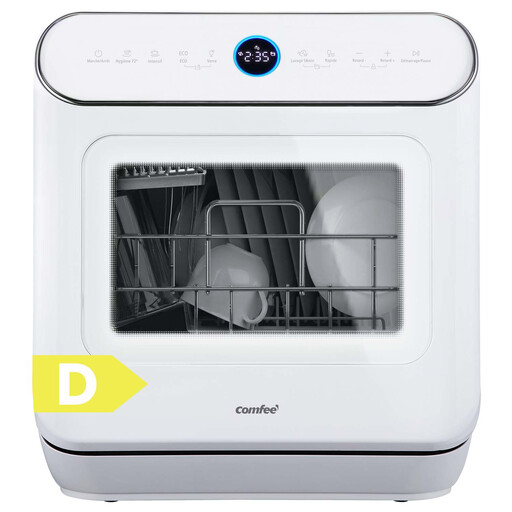 Image unavailable
COMFEE CDWMT305WD compact tabletop dishwasher, 3 place settings
Worth considering if you have space on your worktop and don’t have many dishes between cycles.
The title lists 7 programmes, a 24-hour delay start and energy rating D. Compare its capacity with your utensils and check the clearance and installation requirements in the manual.
View on Joybuy
 Image unavailable
Indesit D2F HK26 S freestanding dishwasher, 14 place settings
Another freestanding option if your kitchen can accommodate an appliance of this size and the stated capacity suits your dishes.
Advertised width of 60 cm and energy rating E. Check access for the hoses, door clearance and connections against the model’s manual.
View on Joybuy
 Image unavailable
Samsung DW60M6050FS freestanding dishwasher, 14 place settings
Compare it with other freestanding appliances if you need a stated capacity of 14 place settings and don’t have a dedicated space.
The title lists 7 cycles. Before buying, check the dimensions, door clearance and required connections against your kitchen.
View on Joybuy
 Image unavailable
Heinrich's HTG 8840 Schwarz tabletop dishwasher, 6 place settings
Worth considering if a 6-place-setting tabletop appliance suits the amount of washing-up you produce and can be positioned near the necessary connections.
The title lists 7 programmes, 47 dB and energy rating D. Measure the available space and check the clearance and connections specified in the manual.
View on Joybuy
Frequently asked questions
Can I install an integrated dishwasher in a kitchen without a dedicated space?
Not as a freestanding appliance: UFC-Que Choisir says an integrated model needs to be fitted into a purpose-built space. If your kitchen doesn’t have one, compare freestanding and compact models that suit the space available instead.
Can I plug a dishwasher into an extension lead?
No. Promotelec recommends plugging the dishwasher directly into a wall socket connected to a dedicated circuit, not an extension lead. Check the electrical installation before deciding where to put it.
Do I need my landlord’s consent to install a dishwasher in a rented home?
Written consent is required if the installation changes rented premises or fittings, as ANIL points out. For an appliance installed without making alterations, still check that the existing connections and the manual allow for your proposed installation.
How can I compare the energy and water use of two dishwashers?
Compare appliances with a capacity that suits your dishes, then check their energy labels. ADEME says electricity use is shown in kWh per 100 reference cycles and water use in litres per reference cycle. The noise level and Eco programme duration can also help you compare models.
Should I rinse dishes before putting them in the dishwasher?
ADEME advises against pre-rinsing dishes. It also recommends waiting until the dishwasher is full before starting a cycle, to help limit everyday water use.


