When dirty dishes pile up after meals, start by choosing a dishwasher that suits your available space and the amount you need to wash. A compact model with 6 place settings is better for smaller loads, while some 60 cm freestanding models offer 14 place settings. If you prefer a built-in model, check the cabinet aperture and door as well. Whatever the format, check the connections, then compare the specifications for the exact model on its energy label.
Which format is right for you?
Households with lots of washing-up
If plates, cutlery, dishes and saucepans are left waiting after several meals, compare the capacity with a typical load and look at the basket layout. The number of place settings alone doesn’t tell you how much room there is for larger items.
Smaller households with limited space
A compact model can free up floor space if you have a suitable worktop and connections. Que Choisir features 6-place-setting countertop models for smaller homes; their capacity is still different from that of a standard appliance.
Open-plan or fitted kitchens
In a living area, check the noise level listed for the exact model. If the appliance needs to fit in with your kitchen units, also check the cabinet aperture, door system and required door front.
Which criteria should you prioritise?
First narrow down the formats based on your usual load and available space: features can’t make up for insufficient capacity or an incompatible installation.
Compact
Consider it: for smaller loads when floor space is limited and you have room on a worktop.
Bear in mind: a smaller capacity may mean running more cycles if dishes and saucepans pile up.
60 cm freestanding
Consider it: if you have a suitably wide space and dishes regularly pile up. Some models offer 14 place settings, according to Electrolux France and Beko France.
Bear in mind: the appliance will be visible, and its capacity doesn’t indicate its energy consumption or washing performance.
Built-in
Consider it: if you have a compatible cabinet aperture and want the appliance to blend in with your kitchen units.
Bear in mind: the cabinet aperture, door and door front must be compatible with the model. Miele France notes that the door front is not supplied with some integrated appliances.
| Criteria | What to check | Who is it for? |
|---|
| Capacity |
Number of place settings and the actual space in the baskets for dishes and saucepans. |
After several meals, I want to load larger items too, without having to start another cycle straight away. Around 31% of consumers put this useful capacity at the heart of their choice. |
| Space and installation |
Appliance dimensions and door clearance; water, drainage and electricity connections, plus the cabinet aperture and door front if needed. |
If my kitchen requires a specific cabinet aperture or worktop space, whether the appliance can be installed there determines the format. This is the top priority for around 31% of consumers. |
| Noise |
Noise level in dB and noise class listed for the exact model. |
In an open-plan kitchen, I want to be able to run the appliance while the room is in use. Quiet operation comes ahead of other criteria for around 23% of consumers. |
| Energy use and maintenance |
kWh per 100 cycles, litres per cycle and Eco programme duration; the repairability index shown. |
For regular use, I want to keep track of water, electricity and maintenance over time. Around 15% of consumers make this their main concern. |
Mistakes to avoid
-
Relying on the number of place settings alone
Dishes, saucepans and food containers take up space that the place-setting figure doesn’t account for. If the capacity doesn’t suit your load, you may have to wash some items separately or run extra cycles.
Picture the washing-up from a typical meal, then look at the baskets and the space available for your larger items.
-
Ordering a built-in model without measuring your kitchen
An incompatible cabinet aperture or door can prevent installation, even if the stated width seems suitable. Bosch Électroménager also reminds customers to plan for the three connections required: water, electricity and drainage.
Compare your measurements with the model’s installation diagram, and check that the door front is compatible and that all the necessary parts are supplied.
Depending on your kitchen and appliance, you may need to adapt the unit, buy a separate door front or arrange professional installation.
-
Treating “quiet” as a measurement
The term doesn’t replace the noise emissions listed for a specific model. ADEME states that an increase of three decibels corresponds to almost twice the noise level.
Compare the dB value and noise class on the label. You can also consult an independent test if you want to assess the noise while the appliance is running.
-
Looking only at the energy class
The energy class alone doesn’t tell you how much water is used per cycle or how long the Eco programme takes. According to the European Commission, these details are listed separately on dishwasher energy labels.
Check the kWh per 100 cycles, litres per cycle, Eco programme duration and capacity together, then look at the maintenance requirements for the model.
Regular use also means allowing for the consumables and maintenance required for the appliance.
Brands to consider
Bosch
Bosch Électroménager provides useful installation information to help you check the water, electricity and drainage connections before choosing a model.
- Connection instructions to compare with your kitchen setup.
- Bosch’s stated AquaStop conditions apply to the appliances and installation specified by the brand; they don’t apply to all its dishwashers.
Beko
For a 60 cm freestanding model, Beko France features the 14-place-setting BDFN26443G, among others.
- A model to consider if 14 place settings suit your usual load.
- Compare noise, energy class and consumption for the specific model you’re considering, rather than assuming they’re the same across the brand.
Electrolux
Electrolux France lists the ESS68600SX as a 60 cm freestanding dishwasher with 14 place settings.
- Its specification sheet gives it an A energy class and a consumption of 54 kWh per 100 cycles. These figures apply to the ESS68600SX only.
- The listed Eco programme duration for this model, 5 h 10, is worth comparing with your usual routine.
Miele
Miele France offers several installation options, including integrated appliances that can be fitted with a door front to match your kitchen units.
- Options to consider if fitting the appliance into a fitted kitchen is a priority.
- Check that the door is compatible and that the door front is supplied with your chosen model: Miele notes that it may not be included.
Dishwashers to consider on Joybuy
This selection includes freestanding models for regular loads, a built-in model for a fitted kitchen and compact models for smaller loads. Compare each appliance with the space you have and the load you expect to wash.
 Image unavailable
Hotpoint H4FD641A freestanding dishwasher, 14 place settings
Worth considering if you have space for a freestanding model and regularly wash dishes from several meals.
Stated width of 60 cm, noise level of 41 dB and energy class C. Check the Eco programme duration and consumption on the energy label for the exact model.
The product information warns of a risk of hot steam when the door opens automatically after a high-temperature cycle. Keep children away from the door at this point.
View on Joybuy
 Image unavailable
Samsung DW80H72YBB0U1 built-in dishwasher, 13 place settings
For a fitted kitchen, provided the cabinet aperture, door and door front are suitable for the model.
Stated width of 60 cm and energy class B. Check the installation measurements and energy consumption details before ordering.
View on Joybuy
 Image unavailable
Indesit D2F HK26 S freestanding dishwasher, 14 place settings
Another freestanding option if dishes pile up and you have a suitable space for it.
Stated width of 60 cm and energy class E. Compare consumption and Eco programme duration on the energy label; also check the water connection requirements in the model’s manual.
View on Joybuy
 Image unavailable
Heinrich's HTG 8840 Schwarz countertop dishwasher, 6 place settings
Worth considering for smaller loads when floor space is limited; six place settings may mean running several cycles for a larger load.
Seven programmes, 47 dB and energy class D are listed. Measure your worktop and check the connections before buying.
View on Joybuy
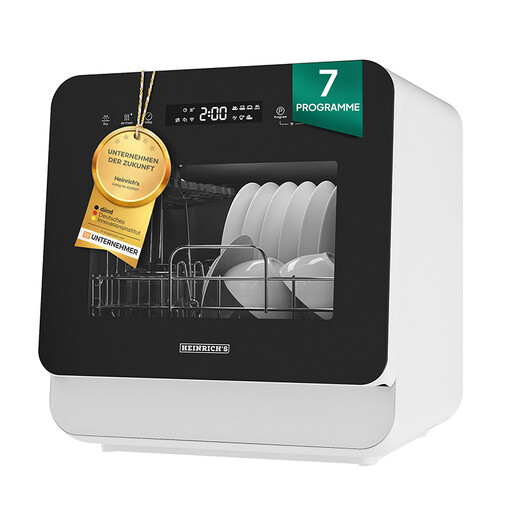 Image unavailable
Heinrich's HTG 8855 countertop dishwasher, 3 place settings
Best suited to very small loads: three place settings may mean frequent cycles if dishes pile up.
Seven programmes and energy class C are listed. Check the dimensions, water supply and accessories included. Compare the noise level with the model’s label, as the product information gives two different figures.
View on Joybuy
Frequently asked questions
What should I check before choosing a dishwasher format?
Measure the space and check the water supply, drainage and electricity connections. For a built-in or integrated model, also check the cabinet aperture, door system and door front. Miele France notes that a door front may not be supplied.
How can I compare the energy consumption of two models?
Compare the same details on their energy labels: kWh per 100 cycles, litres per cycle, capacity and Eco programme duration. The European Commission lists these details separately; an energy class alone doesn’t tell you how long a cycle takes.
Is the “quiet” claim enough for an open-plan kitchen?
No. Compare the dB value and noise class for the exact model. ADEME states that a difference of three decibels corresponds to almost twice the noise level; an independent test can give you further information about how the appliance sounds in use.
Is the repairability index useful when choosing?
It can help you compare domestic dishwashers: check the index shown for each model you’re interested in. However, it doesn’t replace checking the capacity, installation requirements and energy consumption, and it doesn’t guarantee a particular lifespan.


