Which criteria should you consider first?
Start by looking at how much washing-up you produce between washes. This will help you decide whether an appliance would be useful and what capacity to look for. Next, check the space and installation requirements before comparing the usage information for suitable models.
| Criteria |
What to check |
Who this matters to |
| Time spent washing up |
Consider how long you spend washing by hand and how much builds up between washes, including dishes and pans. |
When washing-up builds up every day, I mainly want to avoid spending my evenings washing and drying it all. Around 31% of consumers put saving time first. |
| Capacity and size |
Measure the available space and look at the basket layout. According to Que Choisir, 45 cm models generally offer 9 to 10 place settings, compared with 12 to 17 for 60 cm models. |
In a narrow kitchen, I need to fit the appliance in without having to run extra cycles for the dishes I usually use. This balance between space and capacity comes first for around 25% of consumers. |
| Installation |
Check the water supply, drainage and electricity supply using the instruction manual. For an integrated model, also measure the recess and check the door panel. |
Before choosing a size for my fitted kitchen, I need to know whether the appliance can actually be installed there. Installation feasibility is the priority for around 25% of consumers. |
| Energy and water use, and noise |
Compare models with a capacity suited to your household. As ADEME points out, the energy label shows details including energy use in kWh per 100 cycles and water use in litres per reference cycle. Also check the noise level and the consumables required. |
With an open-plan kitchen or frequent cycles, I want to take account of water and electricity use, noise and the products needed. Around 19% of consumers make these their main concern. |
Dishwashers for different spaces
These Joybuy models let you compare two countertop sizes, two 60 cm freestanding appliances and a 60 cm integrated model. Compare their stated capacity with the dishes you use, then check the dimensions and installation requirements of the model you’re interested in.
 Image unavailable
Heinrich's HTG 8840 Schwarz, 6-place-setting tabletop dishwasher
Worth considering if you’re looking for a tabletop appliance for smaller loads and have a suitable space for it.
The product name states 6 place settings, 7 programmes, a D energy rating and 47 dB. Measure the space you have in mind and check the connections in the manual before choosing this size.
View on Joybuy
 Image unavailable
Hotpoint H4FD641A, 60 cm freestanding dishwasher, 14 place settings
Worth considering if your household produces larger loads and you have room for a freestanding appliance.
The product name states 14 place settings, 60 cm, a C energy rating and 41 dB. Also check the height, depth and connections at the intended location.
View on Joybuy
 Image unavailable
Indesit D2F HK26 S, 60 cm freestanding dishwasher, 14 place settings
Worth considering if you’re looking for a freestanding model for family-sized loads and have enough width available.
The product name states 14 place settings, 60 cm and an E energy rating. Check the depth required and the basket layout for your pans and dishes.
View on Joybuy
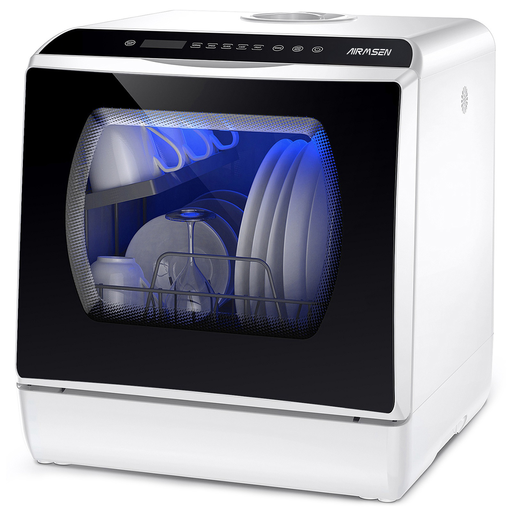 Image unavailable
AIRMSEN, countertop dishwasher with a 5 L tank
Worth considering if space is limited and a permanent water supply would be difficult to arrange.
The product name mentions a built-in 5 L tank and 5+1 wash cycles. Using the tank does not remove the need to drain wastewater, so check where the drain hose can go.
View on Joybuy
 Image unavailable
Samsung DW80H72YBB0U1, 60 cm integrated dishwasher, 13 place settings
Worth considering for a fitted kitchen if the recess and cabinet door are suitable for this model.
The product name states 13 place settings, 60 cm and a B energy rating. Before ordering, compare the recess measurements, door panel and hinges with the model’s manual. Also check the stated noise level for the version on offer.
View on Joybuy
Frequently asked questions
Should you wait until the dishwasher is full?
Wait until you have a suitably full load, but don’t overload the baskets. ADEME recommends running the appliance when full and avoiding pre-rinsing. Follow the manufacturer’s loading instructions too, so the water can circulate freely.
What should you compare on the energy label?
Compare the capacity, energy rating, kWh per 100 reference cycles, litres per cycle, Eco programme duration and noise level. As ADEME explains in its guidance on energy-use units, reference figures help you compare models. Your actual consumption will also depend on the programmes you choose and how you use the appliance.
Does a small dishwasher avoid the need for connections?
Not necessarily: the water supply and drainage requirements depend on the compact model you choose. Check its manual, where you’ll place the plug and how wastewater will drain. Even an appliance with a tank needs a way to drain wastewater.
Does an integrated dishwasher come with a kitchen door panel?
Don’t assume that the door panel is included. Que Choisir notes that an integrated model may require a separate matching door. Check what’s supplied, as well as the recess dimensions, hinge system and fitting requirements for the model you choose.
What should you do if the electrical installation seems unsuitable?
Have the circuit and intended location checked before installation rather than assuming that any available socket will do. If you have concerns about the existing installation, ask a qualified electrician to assess the work needed for the appliance you’re considering.


