Homes without a fitted kitchen
If you’d rather not modify your kitchen units, a freestanding dishwasher is worth considering. Measure the space and check access to water, drainage and electricity before comparing capacity and noise levels.


To replace washing dishes by hand every day, first choose a size that suits the space available and the amount of washing you do: a freestanding model if you don’t have a dedicated housing unit, an integrated model if your kitchen units are designed for one, or a slimline or tabletop model if your load and available space call for it. Then check the connections, usable capacity and figures on the energy label, which are based on the Eco programme. Don’t assume that size alone determines energy consumption.
If you’d rather not modify your kitchen units, a freestanding dishwasher is worth considering. Measure the space and check access to water, drainage and electricity before comparing capacity and noise levels.
A 45 cm or tabletop model can free up space, provided it fits the dishes you use regularly. Think about your pans and serving dishes too, then check how the model takes in and drains water.
In a fitted kitchen, an integrated model needs to match the housing unit and door panel provided. If your kitchen opens onto a living area, compare the noise level declared for each specific model too: the installation type alone won’t tell you how noisy it is.
Worth considering: if you have space for a standalone appliance and no dedicated housing unit.
Bear in mind: its overall dimensions and the need for suitable water, drainage and electrical connections.
Worth considering: if your kitchen has a housing unit and you want the appliance to blend in with your units.
Bear in mind: the housing unit, door panel and plinth must all be compatible, as well as the connections.
Worth considering: if you don’t have the space or need for a 60 cm appliance.
Bear in mind: a smaller capacity may mean more frequent washes. With a tabletop model, you’ll also need to arrange the water supply and drainage, depending on the model.
Once you’ve chosen a size, compare models with a similar capacity and consider how you load and use your dishwasher.
| Priority | What to check | Your needs |
|---|---|---|
| Water and energy | On the EU energy label described by the European Commission, compare the class, energy use per 100 cycles, water per cycle and Eco programme duration. These figures don’t automatically reflect the performance of a quick or intensive programme. | I want to cut down on the daily washing-up without choosing on the energy class letter alone; the Eco programme duration also needs to suit my routine. |
| Capacity and racks | Compare the number of place settings with the amount you usually wash, and check there’s room for larger dishes and pans. UFC-Que Choisir says that 45 cm models with 9 place settings can suit a small family, although they may need to run every day. | I’m interested in a smaller model if I can fit my larger items in without having to run it more often. |
| Installation | Measure the height, width and depth, as well as the access route and door clearance. Check the manual for connection requirements; UFC-Que Choisir notes that an integrated model must be fitted into a purpose-built housing unit. | I want to be sure the appliance will actually fit in my kitchen and that the water supply and drain are accessible. |
| Noise | Compare the noise emissions in dB and the noise class shown on the label for the exact model, rather than judging noise by its width or installation type. | In an open-plan kitchen, I want to know the declared noise level before placing the appliance near my living area. |
| Repairability | In France, dishwashers have a repairability index out of 10, according to the government departments responsible for the ecological transition. Also check the service and parts available for the exact model. | If two appliances meet my space and capacity requirements, I’d like to compare how easy they are to repair. |
The European Commission says that the dishwasher energy label also shows water per cycle, energy use per 100 cycles, Eco programme duration, capacity and noise. So a single letter doesn’t tell you everything about day-to-day use.
Compare the full labels of appliances with a similar capacity and check that the Eco programme duration suits you.
Depending on the model, you may need to connect it to a water supply or fill a tank; you’ll also need somewhere for the waste water to drain. UFC-Que Choisir notes that a tested tabletop model needs a water supply and drain, or a nearby sink.
Check how the version you’re considering is supplied with water and where its drain hose goes, then measure your worktop and access to the sink.
The stated number of place settings doesn’t tell you whether your pans and larger dishes will fit in the racks. UFC-Que Choisir notes that a 45 cm model with 9 place settings may need to run every day for a small family.
Compare the rack layout with your bulkiest items and how often you want to run a wash.
Two appliances suited to the same kitchen may offer different repair options. According to the government departments responsible for the ecological transition, dishwashers in France have a repairability index out of 10.
Note the index and look up the service and parts available for the exact model before making your choice.
These examples can help you identify different sizes and details to check. The specifications mentioned apply to specific models, not every appliance from that brand.
Worth a look if you’re after a 60 cm freestanding model with stated dimensions, water consumption and noise levels.
A brand to explore if you’re looking for slimline 45 cm dishwashers.
Explore the range if you’re choosing between freestanding, integrated and fully integrated models.
Whirlpool’s French spare-parts shop can help you look into maintenance for a specific model.
These Joybuy options include 60 cm freestanding models, an integrated model and a tabletop appliance. Start with the installation type that suits your kitchen, then compare the stated specifications for each model.
 Image unavailable
Worth considering as an alternative to hand-washing if you have room for a freestanding appliance and regularly wash 14 place settings. The product details list 7 cycles; check the dimensions, connections and Eco energy label before comparing consumption.
 Image unavailable
For larger everyday loads, compare its 14 place settings with the dishes you actually use. This white version is listed at 41 dB and energy class C; check the full energy label and measure the space, especially if your kitchen is open-plan.
 Image unavailable
This grey model is another freestanding option with 14 place settings for everyday washing. Its product name lists energy class E; compare the full energy label, rack layout and dimensions with your needs before choosing.
 Image unavailable
This energy class B integrated model is designed for a kitchen with a compatible housing unit. Before buying, check the manual against the unit dimensions, door panel and connections; also compare the figures on its Eco energy label.
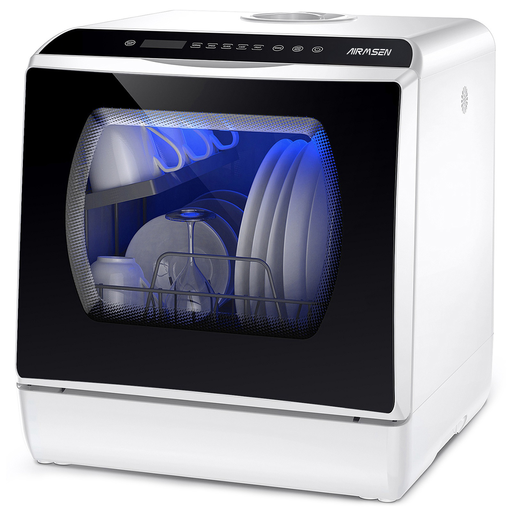 Image unavailable
Worth a look if a tabletop appliance better suits the space you have. The name of this version lists a built-in 5 L tank and 5+1 cycles; check how much room you’ll need for dishes, filling and drainage. Even with a tank, you’ll still need to arrange somewhere for the waste water to go.
Compare the energy class, energy use per 100 cycles, water per cycle, Eco programme duration, capacity and noise. The European Commission explains that the consumption figures shown for dishwashers relate to the Eco programme, so they don’t tell you what to expect from another programme.
Yes, for a standard installation: Bosch describes connections to water, electricity and drainage. Check the manual for the model you choose; a tabletop appliance with a tank may take in water another way, but you’ll still need to arrange drainage.
It can be, if its capacity and racks suit the dishes you use regularly. UFC-Que Choisir says a model with 9 place settings can work for a small family, although it may need to run every day. So check there’s room for pans and larger dishes too.
No: the water supply and drainage requirements depend on the model. UFC-Que Choisir mentions a tabletop appliance that needs a water supply and drain, or a nearby sink. If you choose a version with a tank, check where to fill it and where to direct the waste water.
Check the dishwasher’s repairability index out of 10, as published by the government departments responsible for the ecological transition, then look up servicing options and parts using the exact model number. The index can help you compare models, but doesn’t guarantee that a particular part will be available.