First, choose a format that fits the space available and suits your kitchen’s water supply, drainage and electrical connection. A countertop model handles smaller loads without needing dedicated floor space; a freestanding 45 cm model needs a place on the floor, while an integrated model only makes sense if you already have a compatible housing unit and door front. Then compare suitable appliances for your everyday dishes by checking their noise levels and consumption figures for the Eco programme.
Who are these formats for ?
Small home with no dedicated floor space
If you have room for an appliance on your worktop but can’t create a housing unit, consider a countertop dishwasher for smaller loads. Que Choisir describes models that hold six place settings and sit on a worktop ; check the water supply and drainage requirements for each one, even if it has a tank.
Home with a narrow space on the floor
A 45 cm freestanding model may suit you if width is limited but you have space near the connections. Models in this format claim to hold nine to ten place settings : compare this capacity with your everyday dishes and how often you’re happy to run a cycle.
Fitted kitchen you want to keep
If you want to keep your existing units, first check whether you have a compatible housing unit, door front and connections. Que Choisir distinguishes integrated models, which fit into a purpose-built housing unit, from freestanding models, which are already finished on their visible sides.
What should you check before choosing ?
In an existing kitchen, first rule out formats that won’t fit in the intended space, then compare capacity with your everyday dishes. Noise and consumption figures can help you choose between models that suit your kitchen.
| Criterion |
What to check before buying |
Consumers concerned |
| Space and connections |
Measure the available space, door clearance and hose route. Check the instructions for the water supply, drainage and electrical socket requirements of the exact model. |
If I don’t want to alter my units or connections, the appliance needs to work in my kitchen as it is. Around 36 % of consumers put this compatibility first. |
| Capacity and size |
Compare the stated place-setting capacity with the space available for your dishes and pans, as well as the basket layout. |
When dishes pile up after meals, I want a load size that suits my needs without taking up more space than necessary. Capacity would be the priority for around 29 % of consumers. |
| Noise |
For similar capacities, check the dB(A) rating and noise class on the label. |
In an open-plan kitchen or a small home, I want to be able to run a cycle without disturbing anyone nearby. Noise would come first for around 21 % of consumers. |
| Consumption and maintenance |
Compare kWh per 100 cycles, litres per cycle and the Eco programme duration ; also check the maintenance requirements. |
If I use the appliance frequently, I want to understand its consumption on the reference programme and what maintenance it involves. Around 14 % of consumers would prioritise this. |
Mistakes to avoid
-
Assuming a compact model needs no connection
A countertop format doesn’t tell you how the appliance is supplied with water. For example, Candy says the CP 6E51LW connects directly to the water supply; other models use a tank. Both types still need to drain.
Check the instructions for your chosen model to find out how to fill and drain it, and what hoses and electrical connections it needs.
If your existing connections aren’t suitable, you may need adaptors or plumbing alterations.
-
Choosing an integrated model without a compatible housing unit
An integrated model is designed to fit inside a kitchen unit : it won’t directly replace a freestanding appliance in an open space.
Measure the housing unit and check the door fixing, front panel and connections before choosing this format. Otherwise, consider a freestanding model.
The door front, fitting it and adapting the plinth may also need to be part of your project.
-
Going by place-setting capacity alone
The stated figure doesn’t tell you whether your pans, serving dishes or tall glasses will fit. A smaller appliance may also mean running more frequent cycles if your daily load exceeds its capacity.
Make a note of the dishes you use in a day, then check the interior layout of the model you’re considering.
-
Comparing energy use without checking the reference cycle
The consumption figures on the label relate to the reference programme : they don’t necessarily reflect the cycles you’ll use most often. Que Choisir also highlights the importance of noise in an open-plan kitchen.
Compare energy use, water consumption, Eco programme duration and noise levels across appliances with similar capacities.
Brands to consider by format
Candy
The CP 6E51LW is an example of a countertop model for a small kitchen : Candy describes it as a six-place-setting model that connects directly to the water supply.
- The model mentioned sits on a worktop.
- Check whether its six-place-setting capacity and drainage method suit your needs, and refer to its instructions.
Beko
The BDFS26040X is an example of a 45 cm freestanding model : Beko states that this model holds ten place settings.
- A format to consider when width is limited.
- It needs floor space and suitable connections ; these features don’t apply to every Beko model.
Bosch
The SPS4EMI11E is a 45 cm freestanding model. Bosch gives its dimensions as 845 × 450 × 600 mm, in height, width and depth order.
- Precise dimensions to check against a narrow space.
- Allow room for the door to open and access to the connections too : width alone doesn’t confirm that the appliance will fit.
Miele
The G 5990 SCVi SL is an example of a fully integrated 45 cm dishwasher. Miele states that this model has a noise level of 43 dB.
- A format to consider if you already have a suitable housing unit and noise is an important factor for you.
- Check the door front and how it is fixed : an integrated model isn’t installed like a freestanding appliance.
Countertop models available on Joybuy
Consider these compact models if you have a suitable worktop and wash smaller loads. Their inclusion here doesn’t mean they all fill or drain in the same way : check the instructions for each one before deciding where to put it.
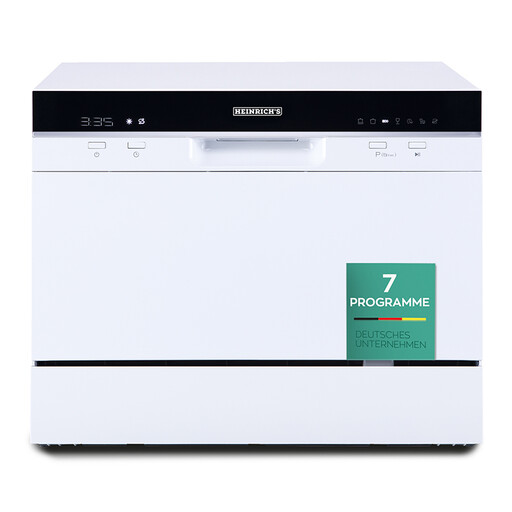 Image unavailable
Heinrich's HTG 8840 Weiss, countertop dishwasher
A countertop format to consider for smaller loads, provided you have a suitable space and connections.
Stated capacity : six place settings. The title lists seven programmes, 47 dB and an energy rating of D.
Measure the available space and check the instructions for the water supply, drainage and electrical connection.
View on Joybuy
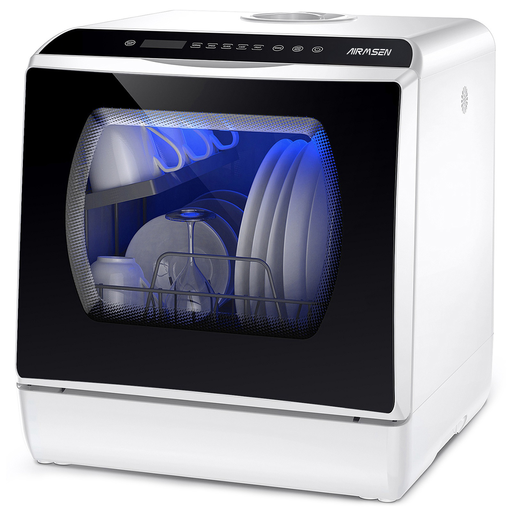 Image unavailable
AIRMSEN, countertop dishwasher with a 5 L tank
Worth considering if you want to place a small appliance on a worktop without a direct water supply at that spot.
The title lists a built-in 5 L tank and 5 + 1 wash cycles.
Check the usable capacity, dimensions, drainage method and noise level for the space you have in mind.
View on Joybuy
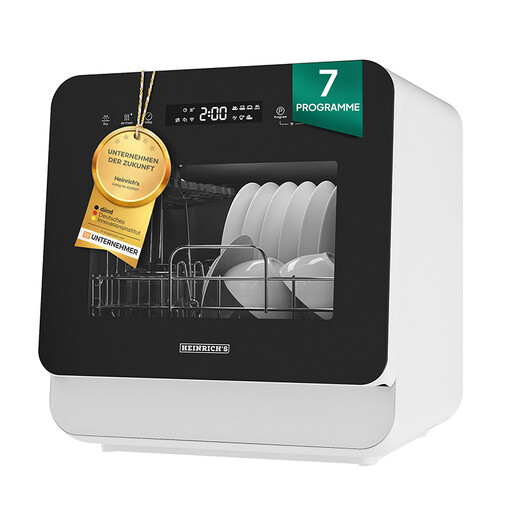 Image unavailable
Heinrich's HTG 8855, mini countertop dishwasher
Its stated capacity of three place settings makes it suitable for smaller loads ; check that this is enough for your everyday dishes.
The title lists seven programmes, 56,3 dB and an energy rating of C.
Check the dimensions and exact filling and drainage requirements before deciding where to put it.
View on Joybuy
 Image unavailable
Comfee' CDWMTO201D(W), countertop dishwasher
The built-in tank may suit a space without a direct water supply, provided you can arrange drainage.
The title lists a 5 L tank, 6 + 3 programmes and an energy rating of D.
Check that your dishes will fit inside, along with the noise level and consumption figures if these will help you decide.
View on Joybuy
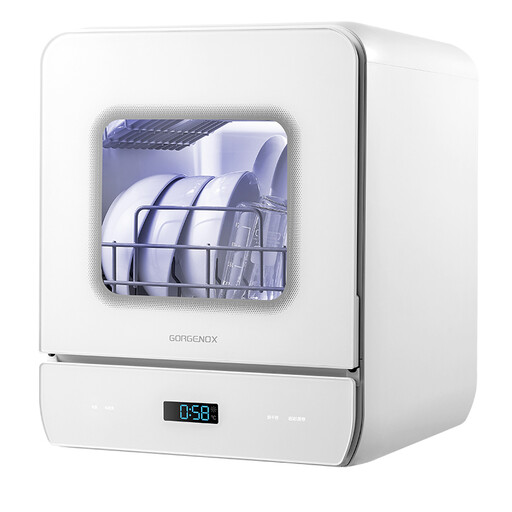 Image unavailable
GORGENOX DW5-D40A, countertop dishwasher
This countertop model claims to hold three place settings : check that this is enough for your usual meals.
The title also mentions drying and a water-softening system.
Check the instructions for the dimensions, filling and drainage requirements before choosing a spot for it.
View on Joybuy
Frequently asked questions
What connections does a standard dishwasher need ?
A standard installation needs a water supply, a waste-water outlet and an electrical connection, as Que Choisir points out. Check that the space is stable and that the connections are accessible too ; if any need to be added or altered, ask a suitably qualified professional to assess the installation.
Does a countertop dishwasher always avoid the need for a water supply ?
No : countertop describes where the appliance sits, not how it fills. Candy says the CP 6E51LW connects directly to the water supply, while Comfee' lists a built-in 5 L tank for the CDWMTO201D(W). In both cases, check the instructions for the exact model to find out how it drains.
How do you compare the noise levels of two models ?
Compare their noise levels in dB(A) and noise classes on the label, ideally for appliances with similar capacities. Que Choisir notes that this matters particularly in an open-plan kitchen ; also consider how close the appliance is to your living areas and when you’re likely to run a cycle.


