A newly set-up home without a fitted kitchen
A freestanding appliance means you don’t need a fitted space or a matching cabinet door. If you’re planning to move, check that the dimensions and connections will also suit your next home.


In a kitchen without a fitted space, start by considering how much room you have and how much washing-up you need to do. A 60 cm freestanding dishwasher is a good choice if you have enough floor space; a 45 cm model takes up less width, while a compact tabletop model is suited to smaller loads. Freestanding models don’t need a matching cabinet door, but they do need the right connections in your home. If you want to install one under a worktop, check that the model and its dimensions are suitable.
A freestanding appliance means you don’t need a fitted space or a matching cabinet door. If you’re planning to move, check that the dimensions and connections will also suit your next home.
A compact tabletop model may be an option if your worktop can accommodate it. Bear in mind that capacity will be more limited, and check its water supply and drainage requirements.
If your water supply, drainage and electrical connections are suitable, a 45 cm freestanding model could be a good solution when space is tight. Also measure the depth and allow enough clearance to open the door.
Measure the space and check the connections before comparing the capacity of different types. According to Que Choisir, a freestanding model doesn’t need a matching cabinet door, but you’ll still need to prepare for its installation.
| Factor | What to check | What matters to shoppers |
|---|---|---|
| Connections | Make sure your home has a suitable water supply, drainage and electrical connection. Promotelec states that the socket for a dishwasher must be on a dedicated circuit. | If I want to install a permanent appliance without discovering that work needs doing when it arrives, checking the connections is my first priority. Around 45% of shoppers put this compatibility first. |
| Space and capacity | Measure the width, height and depth, and check that the door can open fully. Compare the stated capacity with your dishes and pans, not just your plates. | In a small kitchen, I need to fit the appliance in without choosing a capacity that’s too small for my usual washing-up. This is the top priority for around 33% of shoppers. |
| Installation flexibility | Check that the appliance can be installed without a matching cabinet door. If you want to fit it under a worktop, make sure the instructions allow for this setup. | After moving into a new home, I’d prefer an appliance that isn’t tied to the kitchen units and that I could consider moving. Around 22% of shoppers prioritise this flexibility. |
A standard freestanding dishwasher doesn’t need a matching cabinet door, but it does need a suitable water supply, drainage and electrical connection.
Before ordering, measure the space and, if you’re unsure, ask someone to check the connections in your home.
If the existing connections aren’t suitable, you may need a plumber or electrician to carry out some work.
The term ‘freestanding’ doesn’t guarantee that a model can be installed under a worktop.
Check the instructions to see whether the top is removable, and confirm the final dimensions, ventilation requirements and door clearance.
With a smaller capacity, you may need to run more cycles if your pans, dishes and plates won’t all fit in the same load.
Think about the washing-up you get through over several days. If you have enough width and the right connections, compare 45 cm models too.
Bosch offers freestanding dishwashers, including 60 cm models, for kitchens without a matching cabinet door.
Whirlpool’s freestanding range includes 60 cm models sold in France.
Miele offers freestanding dishwashers that can be installed independently of your kitchen units.
These Joybuy models include 60 cm freestanding dishwashers and compact tabletop models. For 60 cm models, only plan to install one under a worktop once you’ve confirmed that the instructions allow it. For compact models, check that there’s room on your worktop and review the connection requirements for the specific model.
 Image unavailable
Worth considering if you have 60 cm of width available and regularly need to wash a large amount of crockery.
The product name specifies 14 place settings and an energy rating of E. If you want to install it under a worktop, check the instructions for details on removing the top, the final dimensions and the required clearance.
 Image unavailable
This size is suited to a household with room for a 60 cm appliance and looking for a stated capacity of 14 place settings.
The product name specifies a noise level of 41 dB and an energy rating of C. Before installing it under a worktop, check the model instructions, its height in this setup and the clearance needed for the door.
 Image unavailable
This freestanding model may suit you if you don’t have a matching cabinet door to fit and want a stated capacity of 14 place settings.
The product name lists 7 cycles. Measure the space and check the instructions before considering an under-worktop installation or removing the top.
 Image unavailable
This tabletop model is worth considering if a floor-standing appliance would take up too much room and you have space for it on your worktop.
The product name specifies 6 place settings, 7 programmes, a noise level of 47 dB and an energy rating of D. Check the dimensions, your worktop’s load-bearing capacity, and the water and drainage connections required.
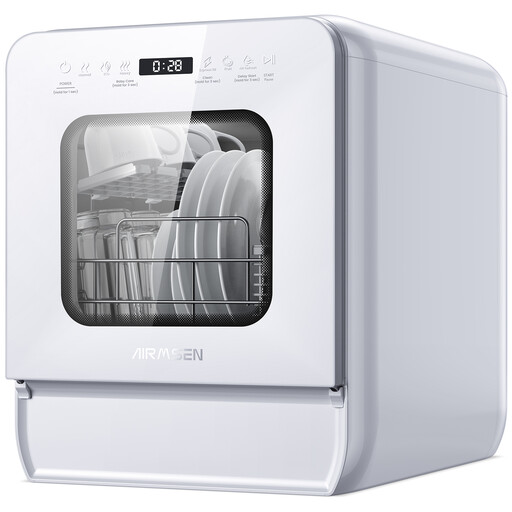 Image unavailable
The built-in tank may appeal if you don’t have a permanent water supply near your worktop.
The product name lists 9 programmes and an energy rating of D. Check the exact dimensions and usable capacity before buying. Even in tank mode, the dishwasher still needs an electrical supply and a suitable way to drain wastewater.
You’ll need a suitable water supply, drainage and electrical connection. Bosch lists all three in its installation instructions; Promotelec states that the dishwasher socket must be on a dedicated circuit. Before delivery, check that your home has the right connections.
Don’t use one to get around the lack of a suitable socket. Bosch’s guidance recommends plugging the appliance directly into the socket, without an extension lead or multi-socket adaptor. If the socket you plan to use isn’t suitable, ask someone to check your home’s electrical installation.
No. Depending on the model, the tank may mean you don’t need a permanent water supply, but the appliance still needs electricity and its wastewater must be drained as described in the instructions. Also check that it will be stable on your worktop and that there’s enough space around it.
Not necessarily. Electrolux says its installers connect appliances to suitable existing installations, but don’t carry out carpentry, plumbing or electrical work. Check the terms of the service you choose and make sure the necessary connections are ready before the installer arrives.