What should you check before choosing?
Start with the available connections and space, then choose a capacity that suits the amount of washing-up you produce. Features for everyday use can then help you choose between models that fit your kitchen.
Compact model with a water tank
Consider this if: you can’t use a fixed water supply and have only a small amount of washing-up to do per cycle.
The trade-off: a water tank doesn’t remove the need to plan for drainage. A smaller capacity may also mean running more cycles or washing some items by hand.
Standard freestanding model
Consider this if: you have floor space and accessible connections for an appliance of your chosen size.
The trade-off: a freestanding model doesn’t need to be fitted into a unit, but it still needs a water supply.
Built-in or fully integrated model
Consider this if: your kitchen redesign includes a compatible unit, a suitable door panel if needed, and the required connections.
The trade-off: your choice will also depend on the unit’s dimensions and installation requirements, not just the space occupied by the appliance.
| Priority |
What to check |
What I need |
| Connections |
Check the instructions for the exact model to find out what it needs for the water supply, drainage and electrical supply. For an appliance with a water tank, check the route for waste water separately. |
I want to be able to install the appliance in my kitchen without assuming that “freestanding” means “no connections needed”. |
| Space and capacity |
Measure the height, width and depth, then allow room for the door to open. Compare the stated capacity in place settings with the amount of washing-up you need to do. |
The appliance needs to fit in its space and hold enough washing-up for my household. |
| Energy use and noise |
ADEME says the energy label includes information such as kWh per 100 reference cycles, litres of water per reference cycle and the noise class. Compare figures measured on the same basis, as well as the duration of the Eco cycle. |
In an open-plan kitchen or a small home, noise matters to me as much as the stated energy and water use. |
| Planned work |
Find out whether installation would alter a rented home or affect communal areas in a co-owned building. Get any required permissions before changing the connections. |
I’d rather know what the work involves before choosing a model that depends on it. |
Dishwashers available on Joybuy
This selection includes compact countertop models with water tanks and larger-capacity freestanding models. The right choice depends on the space available, how much washing-up you have and whether you can supply and drain water to and from the appliance.
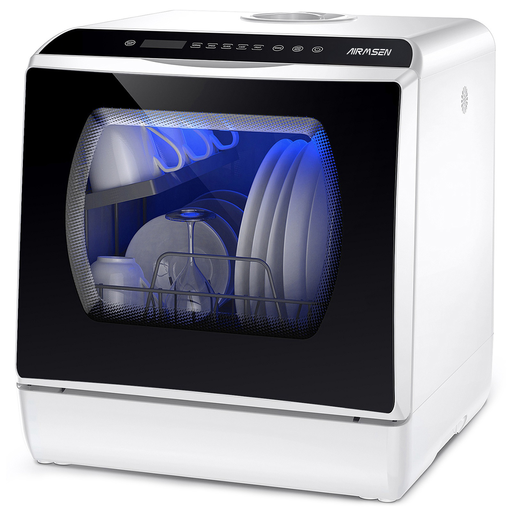 Image unavailable
AIRMSEN countertop dishwasher, 5 L tank
The 5 L tank makes this model worth considering if you can’t use a fixed water supply. The product name lists 5+1 wash cycles. You’ll also need a stable surface and somewhere to direct the drain hose during each cycle.
Before buying, check the model’s instructions to make sure it’s compatible with your available electrical supply.
View on Joybuy
 Image unavailable
Samsung DW60M6050FS freestanding dishwasher, 14 place settings
This freestanding model is suited to a kitchen where the water supply and drainage can be connected. It has a stated capacity of 14 place settings, and the product name lists 7 cycles. Measure the space and door clearance before choosing this size.
Check the DW60M6050FS instructions for connection requirements and the electrical specifications.
View on Joybuy
 Image unavailable
Hotpoint H4FD641A freestanding dishwasher, 14 place settings, 60 cm
With a stated width of 60 cm and a capacity of 14 place settings, this model needs enough floor space for a standard-size appliance. The product name lists a noise level of 41 dB; check the measurement conditions before comparing this figure with another model.
Make sure the H4FD641A has a water supply, drainage and electrical connection that meet the requirements in its instructions. If setting these up involves building work, check which permissions apply first.
View on Joybuy
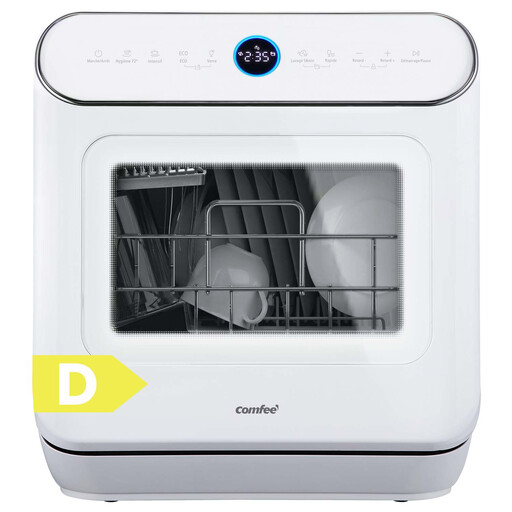 Image unavailable
COMFEE CDWMT305WD mini dishwasher, 3 place settings
The stated manual-fill option may suit you if you want to avoid a permanent water supply for a small countertop appliance. It has a stated capacity of 3 place settings, and the product name lists 7 programmes.
Before setting aside space for it, check the CDWMT305WD instructions to find out how to drain waste water and what electrical supply it needs.
View on Joybuy
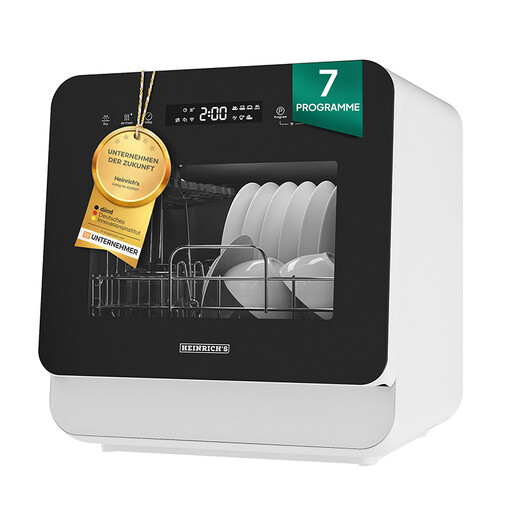 Image unavailable
Heinrich's HTG 8855 mini dishwasher, 3 place settings
This countertop model is listed as having capacity for 3 place settings and can be used with or without a direct connection to the water supply. Its name lists 7 programmes and a noise level of 56.3 dB.
Check its dimensions in the instructions before choosing a spot for it. Also check where the waste water will drain and what the electrical requirements are.
View on Joybuy
Frequently asked questions
Can a freestanding dishwasher work without a water supply or drainage?
Freestanding doesn’t mean that an appliance works without connections. The Beko DVN05C30W instructions specify a water supply, drainage and an electrical connection. Check all three in the instructions for the model you’re interested in.
Does a mini dishwasher with a water tank mean you don’t need to plan for drainage?
Not for the Bob model described by Daan Tech: its built-in 3.9 L tank can replace a fixed water supply, but its hose must carry waste water to a sink or another drainage system. Also check the available space and electrical supply.
Can I add a connection in a rented home?
If the work would alter the rented property or its fittings, get the landlord’s written consent first. ANIL advises that this is required for alterations; explain exactly what work you’re planning before you begin.
When do you need authorisation in a co-owned building?
If the planned work affects communal areas or the exterior of the building, Article 25 of the law of 10 July 1965, in the version in force since 18 June 2025 and published on Légifrance, requires co-ownership authorisation for the work concerned. Before starting, check with the building manager exactly what your plans would affect.
Which figures on the energy label should I compare?
Compare the energy class, kWh per 100 reference cycles, litres of water per reference cycle, the duration of the Eco cycle and the noise information. ADEME lists these details on the label; make sure the measurements are based on the same criteria when comparing two appliances.


