People who may move home
A freestanding dishwasher has its own finished exterior, so it doesn’t need a kitchen cabinet door. This gives you the option of moving it elsewhere later, provided the connections in your new home are suitable.


If your home doesn’t have a fitted kitchen, start by checking the available connections, the space you’ve measured and how much washing-up you generate. A slimline freestanding model is a good choice if you need capacity for around 9 to 10 place settings; a compact countertop model suits lighter use, while an under-worktop installation requires you to confirm that the top panel on your chosen model is removable.
A freestanding dishwasher has its own finished exterior, so it doesn’t need a kitchen cabinet door. This gives you the option of moving it elsewhere later, provided the connections in your new home are suitable.
If you’re short on width but still have a fair amount of washing-up, consider 45 cm freestanding models. Que Choisir describes 9-place-setting models that may suit a small family, sometimes with daily use. A countertop compact takes up less space but has a more limited capacity.
Before choosing a plumbed-in appliance, locate the water supply, electrical socket and waste outlet. A compact model with a water tank may change how you fill it, but you’ll still need to arrange drainage according to the model’s instructions.
First work out where the appliance can run, then compare its capacity and dimensions with your everyday needs.
Consider this if: you have the necessary connections and want the capacity of a 45 cm model without taking up as much width as a wider model.
Bear in mind: the depth, height and door swing may still be restrictive, despite the narrower width.
Consider this if: you have a small amount of washing-up and a suitable spot on your worktop.
Bear in mind: its more limited capacity and the need for a way to drain it, even if it has a water tank.
Consider this if: you want to place the appliance under a worktop while keeping the flexibility of a freestanding model if you move home in future.
Requirement: the exact model must explicitly allow its top panel to be removed and fit within the available height.
| Priority | What to check | What I need |
|---|---|---|
| Installation | For a plumbed-in appliance, locate the water supply, electrical socket and waste outlet it needs. For a compact model with a tank, check the filling and drainage arrangements in its instructions separately. | I want to be able to use the appliance where I’ve chosen to put it, without assuming that a water tank also solves the drainage issue. |
| Dimensions | Compare the height, width and depth with the space you actually have. Allow for getting the appliance into position, the hoses at the back and enough clearance to open the door. | In a narrow kitchen, I need to check more than just the advertised 45 cm width. |
| Capacity | Check the number of place settings and whether there’s room for the dishes you usually wash. Que Choisir lists 45 cm models with 9 place settings that suit a small family, although you may need to run them every day. | A compact model may be enough if I have small loads; otherwise, I’d rather look at the capacity of a slimline freestanding model. |
| Under-worktop installation | Confirm that the top panel can be removed from the exact model you’re considering. Then measure the available height and make sure you can still access the connections. | I want to slide the appliance under the worktop now, without assuming that every freestanding model can be installed this way. |
| Use and noise | According to ADEME and the European Commission, the label shows information including energy use in kWh per 100 cycles, water use per cycle, Eco programme duration, capacity and noise. Compare the same measures across models. | If my kitchen opens onto a living area, noise and programme duration also matter when I’m choosing. |
A plumbed-in appliance needs a water supply, an electrical connection and a waste outlet, as Que Choisir points out. Even if it has a water tank, the wastewater needs to be disposed of in a way that’s suitable for the model.
Locate the connections and read the instructions for the model you’re considering before deciding where to put it.
A slimline freestanding model may still be too deep or too tall for the space, or get in the way when its door is open.
Measure the space, the route for getting the appliance into position, the room needed for the hoses and the door swing. Then compare these measurements with the model’s specifications.
A freestanding appliance’s finished exterior doesn’t mean that its top can be removed for an under-worktop installation.
Look for explicit confirmation that the top panel is removable on the model you’ve chosen, and check its height in this configuration.
The label also shows water use, Eco programme duration and noise. These details can all matter when you’re choosing an appliance to install near a living area.
Compare kWh per 100 cycles, litres per cycle, Eco programme duration, capacity and noise level on the same basis.
These examples highlight features to compare on specific models. Don’t assume that every range from a brand has the same features.
Worth considering for a slimline freestanding model if dimensions, energy use and noise are among your priorities.
Worth considering if you’re looking for a 45 cm dishwasher with a stated capacity of 10 place settings.
Worth considering if you want a 45 cm freestanding model with a stated depth of less than 60 cm, as in the model listed here.
This option is for anyone looking for a countertop compact for a small space. Consider its capacity and drainage method alongside how often you wash dishes and where you plan to put it.
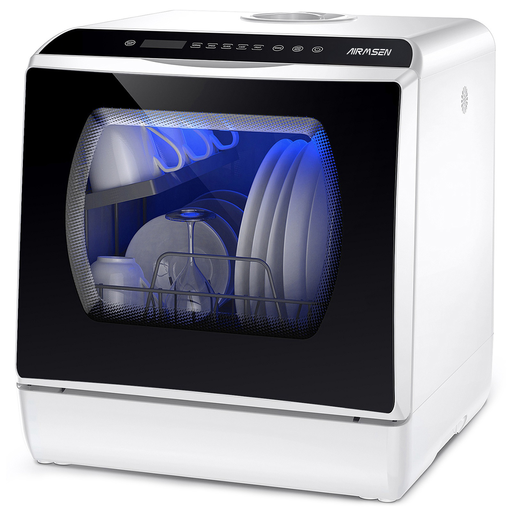 Image unavailable
This countertop model may suit you if space is limited and manual filling works for your chosen location.
The product name states that it has a built-in 5 L tank, 5+1 wash cycles and a double-tempered glass door. Its stated capacity of 4 place settings should suit the amount of washing-up you generate.
Have a suitable container ready to collect the wastewater. Before buying, check the required voltage and plug type, as well as the Eco programme information and noise level if these matter to you.
A plumbed-in model needs a water supply, an electrical connection and a waste outlet, according to Que Choisir. Check that all three are accessible from the intended location.
No. The tank may change how you supply water to the appliance, but you’ll still need to deal with drainage. Check the model’s instructions for its filling and drainage methods.
It may be suitable if its capacity matches the amount of washing-up and how often your household runs a load. Que Choisir lists 9-place-setting models that suit a small family, potentially with daily use.
Only if this is confirmed for the exact model you’ve chosen. Then check the available height with the top panel removed and make sure the connections remain accessible.
Compare the energy rating, kWh per 100 cycles, water use per cycle, Eco programme duration, capacity and noise. ADEME and the European Commission list these as information shown on the energy label for household dishwashers.