What should you check before buying?
In a kitchen without a dedicated appliance space, first work out where the dishwasher could go and what connections are available. Then check that its capacity suits the amount of crockery you usually wash. The formats below require different setups.
Freestanding
Consider this if: you have floor space and access to the necessary connections, but no cabinet door is planned.
The trade-off: as Que Choisir notes, the exterior finish is already in place, but the appliance takes up floor space and still needs connecting.
Compact countertop
Consider this if: you have a suitable worktop and usually have a small load to wash.
The trade-off: Que Choisir features compact models with a capacity of six place settings for smaller homes. Depending on how much crockery your household uses, this capacity may mean running cycles more often.
Integrated
Consider this: only if a suitable cabinet space and compatible door are already in place or genuinely planned.
The trade-off: fitting the appliance into your cabinetry means checking the door system, and it still needs to be connected.
| Factor |
What to check |
Who is this for? |
| Installation |
Locate the water inlet, waste outlet and electrical supply, then measure the access route from your chosen spot. Que Choisir says these three connections are required for a standard dishwasher. |
Without a dedicated cabinet space or door, I want to know whether the appliance will work where there’s room for it, rather than assume the connections are ready. Around 45% of consumers in this situation put installation feasibility first. |
| Space and capacity |
Measure the width, depth and height, as well as the space needed to open the door. Compare the stated place-setting capacity with how often you do the washing up. |
With limited floor space, I’m looking for an appliance that fits in my kitchen without being too small for my crockery. Space and capacity are the main concern for around 33% of consumers in this situation. |
| Everyday use |
For the exact model, compare the water use in litres per cycle, energy use in kWh per 100 cycles and noise level in dB, using the same basis. ADEME explains the units used for the stated consumption figures. |
In an open-plan kitchen, I want to take noise and running costs into account, while also considering how many cycles I’ll need. For around 22% of consumers in this situation, everyday convenience is the priority. |
Brands to compare by model
These ranges offer some points of comparison for freestanding models. The features mentioned relate to specific models, not every appliance from each brand.
Bosch
Bosch offers freestanding dishwashers in 45 cm and 60 cm widths, so you can compare the size and capacity you’re looking for.
- According to Bosch Electroménager France, a 45 cm model may suit a small kitchen, while a 60 cm model caters for different capacity needs.
- These range details don’t replace checking the dimensions and energy label figures for the specific model you choose.
Beko
Beko’s freestanding BDFN26530X is a useful model to compare if you have floor space for a 60 cm appliance.
- Beko France gives this specific model a capacity of 15 place settings.
- This capacity doesn’t resolve questions about available space or connections.
Miele
Miele’s G 5740 SC SL is a 45 cm freestanding model worth considering if you’re looking for a narrower floor-standing appliance.
- Miele France lists a stated noise level of 44 dB for this model.
- Check its full dimensions and capacity, as well as the connections required for your chosen spot.
Siemens
The Siemens SN23HI36VE provides specifications you can compare with those of other freestanding dishwashers.
- Siemens Électroménager France lists water use of 9.5 L per cycle and a noise class of C for this model.
- Compare these figures with those of the model you’re considering, and check its installation requirements separately.
Freestanding and compact models on Joybuy
These models offer two ways to equip a kitchen without a dedicated cabinet space: set aside floor space for a freestanding dishwasher or use part of your worktop for a compact one. Choose according to the space available, the connections and how much washing up you need to do. Their inclusion here doesn’t mean they’re necessarily compatible with your kitchen.
 Image unavailable
Indesit D2F HK26 S, 60 cm freestanding, 14 place settings, grey
Worth considering if you have floor space for a 60 cm model and are looking for a stated capacity of 14 place settings.
The model name indicates an energy rating of E. Check the connections and door clearance in your kitchen.
View on Joybuy
 Image unavailable
Hotpoint H4FD641A, 60 cm freestanding, 14 place settings, white
Worth comparing if you have floor space available and a capacity of 14 place settings suits the amount of washing up you do.
The model name indicates a noise level of 41 dB and an energy rating of C. Check the dimensions, connections and clearance before installation.
View on Joybuy
 Image unavailable
Samsung DW60M6050FS, freestanding, 14 place settings, grey
Worth considering for a kitchen with floor space available and a need for 14 place settings.
The model name mentions seven cycles. Check the instructions to confirm whether it can be installed freestanding or under a worktop, along with the required clearance and connections.
View on Joybuy
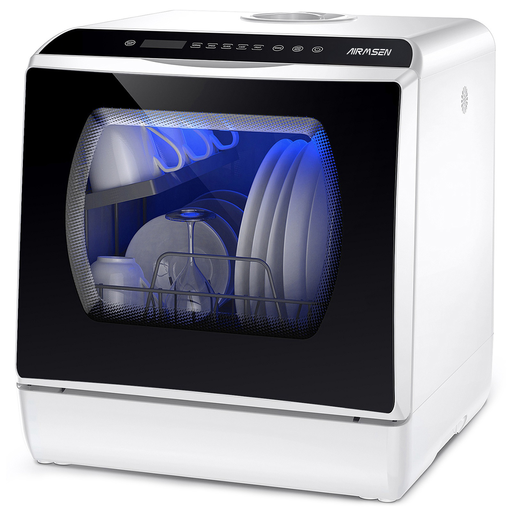 Image unavailable
AIRMSEN, countertop dishwasher with 5 L tank
Worth considering if you have a suitable worktop and want to look at a compact model with an integrated tank.
The product name lists five wash programmes plus an additional function. Check the instructions for filling, draining and power requirements, as well as capacity, before choosing this format.
View on Joybuy
 Image unavailable
Heinrich's HTG 8840 Schwarz, compact, 6 place settings
Worth comparing if you have worktop space and a capacity of six place settings suits how often you do the washing up.
The model name indicates seven programmes, 47 dB and an energy rating of D. Measure the available space and check the required water inlet and drainage.
View on Joybuy
Frequently asked questions
Do you need to add a cabinet door to a freestanding dishwasher?
No. According to Que Choisir, a freestanding dishwasher already has its own exterior finish. If you’re planning an integrated installation instead, check which door you need and whether it’s compatible with the door system of the model you’re considering.
What should you check before connecting a standard dishwasher?
Check that you have access to a water inlet, an electricity supply and a waste outlet. Que Choisir identifies these three connections as necessary for installation. Also measure the space, the route the hoses will take and the clearance needed to open the door.
Can a “connection-free” mini dishwasher work without a water inlet?
It depends on the model and the water-supply method it’s designed to use. If the appliance has a tank, its instructions should explain how to fill it, drain the wastewater and connect it to the power supply. Also check its capacity and any accessories required.
How do you compare the consumption of two different formats?
Compare the stated figures on the labels of the specific models, taking their capacity and the number of cycles you’d need into account. ADEME lists energy use in kWh per 100 reference cycles and water use in litres per reference cycle. So a lower figure per cycle isn’t enough on its own to tell you which model is best for your needs.


