Kitchen without fitted units
If you want to avoid altering your kitchen units, look at freestanding models. Measure the space and check the water supply, drainage and socket before choosing an appliance.


If washing up by hand takes up too much of your time, start by choosing a format that suits your available space, the amount of washing up and your connections: freestanding for a suitable space, integrated for a compatible niche, or compact for smaller loads. Washing by hand can still be a sensible option if it only takes a short time after each meal; UFC-Que Choisir estimates that a dishwasher is not essential when washing and drying take less than 15 minutes. Before you buy, also compare the energy label information and the installation and maintenance requirements for the specific model.
The best place to start isn’t the number of programmes, but how the appliance will fit into your kitchen and your daily routine.
If you want to avoid altering your kitchen units, look at freestanding models. Measure the space and check the water supply, drainage and socket before choosing an appliance.
An integrated model could suit your plans if the niche, door panel and fixing system are compatible. Check all three for the exact model, as well as the connections.
Compare the amount you actually wash with the space available. UFC-Que Choisir lists 45 cm models with a capacity of 9 place settings as an option for a small family, and compact 6-place-setting worktop models as another space-saving choice.
First decide whether an appliance would make everyday life easier, then rule out formats that won’t fit your kitchen before comparing energy labels and interior layouts.
| Criteria | What to check | What I need |
|---|---|---|
| Time spent washing up | Estimate how long washing and drying take after meals, and how much washing up builds up between washes. UFC-Que Choisir says a dishwasher is not essential if this takes less than 15 minutes after each meal. | Does washing up by hand take enough time to justify the cost, space and maintenance of an appliance? |
| Format and installation | For a freestanding model, check the dimensions and connections. For an integrated model, also check the niche measurements and whether the door panel and fixings are compatible. A compact model needs a stable surface and drainage that meets the instructions. | I want an appliance that fits my kitchen without finding out after ordering that I need to alter the units or install new connections. |
| Capacity | Compare the stated place settings with the amount of washing up between cycles, then check the basket layout for saucepans and large dishes. According to UFC-Que Choisir, 45 cm freestanding models generally hold 9 to 10 place settings, compared with 12 to 17 for 60 cm models. | A compact model would take up less space, but would my dishes and saucepans fit without needing to run more cycles? |
| Water, energy and cycle time | On the label for the exact model, compare its A to G energy rating, kWh per 100 cycles, litres per cycle and Eco programme duration. ADEME explains the units used for the consumption figures; they don’t predict your use of every programme. | I want to understand the consumption for the reference cycle and know whether its duration suits my routine. |
| Noise | Check the noise level in dB and its class on the label, then check which programme any other advertised figure refers to. UFC-Que Choisir highlights how important this is in an open-plan kitchen. | In an open-plan living space, I’d rather compare noise levels before looking at secondary features. |
| Maintenance and repairs | Check how easy it is to access the filter and what maintenance the instructions recommend. For a model covered by the scheme in France, compare its repairability index and find out about repair and after-sales service options. | I want to be able to maintain the appliance regularly and look into repair options if it breaks down. |
An appliance may fit in width but not leave enough room in height or depth, or you may not have suitable connections.
Measure all three dimensions and check the water supply, drainage, socket and installation instructions for the model before ordering.
If plumbing or electrical work is needed, ask what the installation service includes and get confirmation of any additional work.
The rating alone won’t tell you whether the capacity, Eco cycle duration and noise level are right for your household.
Compare the label figures on a like-for-like basis: kWh per 100 cycles, litres per cycle, Eco cycle duration, place settings and dB.
If the capacity is too limited, you may need to run more frequent cycles or find it harder to fit in the items you use every day.
Think about how much washing up you produce over a day or two, including large dishes, then compare a compact worktop model with a 45 cm model if you have the space.
Parts availability alone doesn’t mean a fault will be easy to diagnose or that a repair will be worthwhile in every case.
Check the repairability index for the model in question and find out about after-sales service. If it breaks down, ask for a diagnosis and quote before deciding whether to replace it.
These ranges give you some formats to compare, but they don’t tell you what features each model has or whether it’s included in the selection below.
Bosch offers 45 and 60 cm freestanding and integrated dishwashers in France.
Miele offers freestanding dishwashers and several integrated configurations.
Beko offers freestanding, integrated models with visible control panels, and fully integrated models in France.
This Joybuy selection includes freestanding, compact worktop and integrated models. First compare their format with your available space and the amount of washing up you produce; check the installation requirements and energy label for the specific model you choose.
 Image unavailable
Worth considering if you have space for a 60 cm freestanding dishwasher and produce around 14 place settings of washing up. The product name lists 41 dB and a C rating; check the full dimensions, connections and label for the model before choosing.
 Image unavailable
This worktop model is designed for an amount of washing up that suits its stated capacity of 6 place settings. Its name lists 7 programmes, 47 dB and a D rating. Check that you have room on your worktop, how it connects and the figures on its label before comparing it with another format.
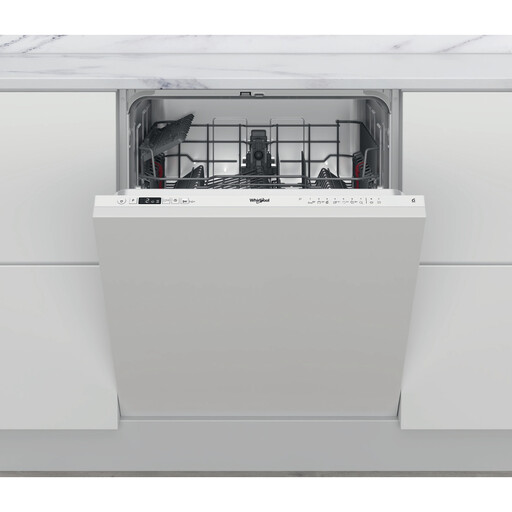 Image unavailable
Consider this for a fitted kitchen if the niche and door panel are compatible with this 60 cm integrated model. Its name lists 14 place settings and an E rating. Check the installation dimensions, fixings and connections before ordering.
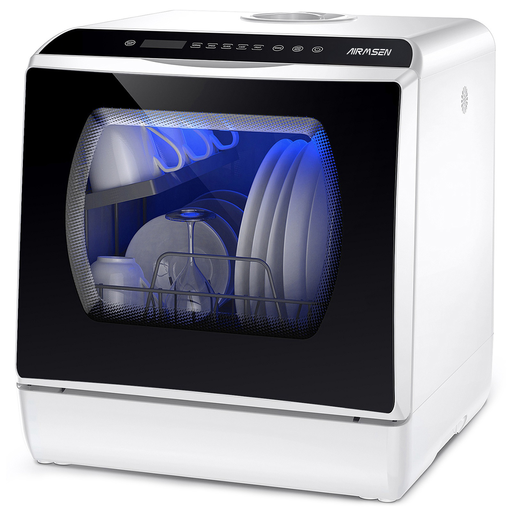 Image unavailable
The integrated tank can be useful where a direct connection to the water supply is difficult. The product name lists a 5 L tank and 5+1 cycles; you’ll still need to arrange wastewater drainage as described in the instructions and check how much worktop space it needs.
 Image unavailable
This 60 cm integrated model is worth comparing if it fits your niche and 13 place settings suit your washing up. Its name lists a B rating. Check the door panel, fixings and connections; for noise, compare the figure on the label rather than figures given for different programmes.
Compare the A to G rating, capacity, kWh per 100 cycles, litres per cycle, Eco programme duration and noise level. ADEME explains that the consumption figures are based on reference cycles: they help you compare models, but won’t predict exactly how much each cycle you run will use.
No, you can’t draw that conclusion without comparing the same amount of washing up and the way it’s washed. How full the dishwasher is and which programme you choose also matter. To assess an appliance, start with the litres per cycle shown on its label and how often you expect to use it.
Choose based on the space you have and how much washing up builds up, rather than simply how many people are in your household. UFC-Que Choisir lists 45 cm models with a capacity of 9 place settings as suitable for a small family, and compact 6-place-setting worktop models as space-saving; also check that your large dishes fit in the baskets.
Yes. According to the French Ministry for Ecological Transition and the decree of 22 April 2022, household dishwashers are among the product categories covered by the French repairability index. Check the rating for the specific model: it doesn’t guarantee that a particular repair will be easy or inexpensive.
For household dishwashers covered by the European rules outlined by the European Commission, certain parts, including door hinges and seals, spray arms, filters and baskets, must remain available for 10 years after the product is withdrawn from the market. This doesn’t mean every repair will be free or cost-effective.