Who needs to make this choice?
The amount of washing up, the space available and whether you can connect an appliance all affect your decision. These scenarios can help you work out what to check before choosing a format.
Households with lots of washing up every day
Plates, glasses and dishes pile up after meals. If you want to spend less time washing up by hand, compare the stated capacity with your cookware and the layout of the racks. Que Choisir also highlights the importance of cleaning performance, drying and running costs when choosing an appliance.
Households with limited kitchen space
Limited width may point you towards a 45 cm appliance, while some compact models can sit on a worktop. Que Choisir’s comparisons cover these formats for different loads. Measure the space before deciding what capacity you can manage.
Households where installation still needs checking
Having a free space doesn’t necessarily mean you can install a dishwasher there. Check the water supply, drainage and electrical supply. For a built-in model, also check the cabinet and door panel. Bosch and Electrolux remind customers that connections depend on the existing setup, and some work may need to be arranged separately.
What should you check first?
Start with the available space and connections, then estimate how much washing up you usually have. This will help you compare a standard, 45 cm or compact appliance without ruling out hand washing too soon.
Standard dishwasher
Consider this if: washing up piles up regularly and your kitchen has a suitable space and connections.
Bear in mind: check the space it takes up, including room for the door to open and access for delivery.
45 cm dishwasher
Consider this if: the available width limits your options, but you’d still like to machine-wash your everyday dishes.
Bear in mind: its usable capacity may mean running frequent cycles. Que Choisir notes that models with a capacity of 9 place settings may be used daily, for example.
Compact dishwasher
Consider this if: a worktop is the only realistic place for it and you have a limited amount of washing up.
Bear in mind: check that your usual dishes fit inside and that the water supply and drainage are suitable for your home.
Hand washing
Stick with this if: you have little washing up or haven’t yet confirmed whether installation is possible.
Bear in mind: you’ll still need to spend time washing and drying dishes after meals.
| Consideration |
What to check |
What consumers are looking for |
| Washing-up time and capacity |
Compare the stated capacity and rack layout with your plates, saucepans and larger dishes. |
When washing up piles up after every meal, I want to spend less time washing by hand without leaving my dishes out. Around 36% of consumers would make the ability to handle everyday washing up their top priority. |
| Kitchen space |
Measure the width, depth and height, and don’t forget the door opening and access for delivery. |
In a small kitchen, I need a format that fits the space available, even if it has a more limited capacity. Around 29% of consumers would put this space constraint ahead of other considerations. |
| Running costs |
Check the energy label for the exact model and the Eco programme data. Also factor in detergent and maintenance. |
If I need to run regular cycles, I want to know how much the appliance will use and what maintenance it will need. Around 21% of consumers would make managing running costs their main concern. |
| Whether it’s worth buying and installation |
Assess how much washing up you usually have, then confirm the water supply, drainage and electrical supply before placing an order. |
If I have little washing up or haven’t confirmed installation is possible, I’d rather stick with hand washing for now. Around 14% of consumers would prioritise not having enough need for an appliance or the installation constraint. |
Brands to explore by format
These ranges offer a starting point for comparing different types of installation. A feature listed for one model won’t necessarily apply to other models from the same brand.
Bosch
Bosch offers, among other options, 45 cm freestanding dishwashers to consider if your kitchen has limited width.
- Bosch lists the dimensions of the SPS4EMI17E as 845 × 450 × 600 mm, making it easier to check whether it will fit your chosen space.
- The dimensions and other features of this model don’t represent the entire range. Check the details for the model you’re considering.
Beko
Beko’s range includes 45 cm freestanding appliances, giving you options to compare for size and stated capacity.
- Beko lists some of its 45 cm models as having a capacity of 10 place settings.
- Capacity varies by model. Also check that the racks have enough room for your dishes.
Candy
Candy offers compact tabletop models as well as freestanding dishwashers, making it useful to compare two possible locations in a small kitchen.
- The Candy range includes a tabletop model listed as having a capacity of 6 place settings.
- Check the capacity, dimensions and consumption figures for the exact model you’re considering.
Miele
Miele offers fully integrated, semi-integrated and freestanding dishwashers to compare with your existing kitchen layout.
- This range of installation options lets you consider a setup with a cabinet and door panel as well as a space for a freestanding appliance.
- For an integrated model, check the cabinet, door panel and connection requirements for the exact model.
Dishwashers for different spaces
This selection from Joybuy includes tabletop models and standard-size freestanding and built-in appliances. Compare them with the space available and the amount of washing up you usually have. For every appliance, you’ll still need to confirm that the connections are suitable for your home.
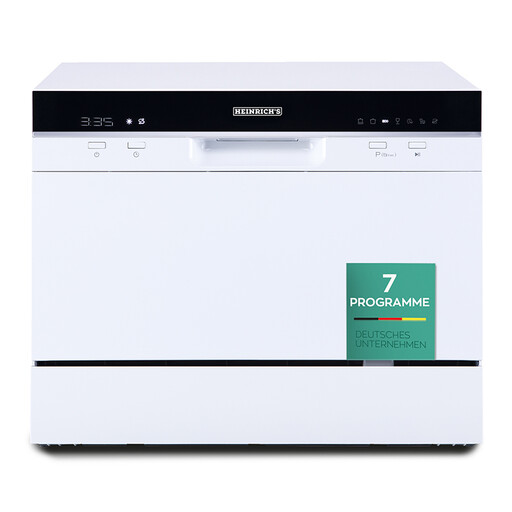 Image unavailable
Heinrich's HTG 8840 Weiss, 6 place settings
Worth considering if a tabletop dishwasher suits your kitchen better than a freestanding model. The product title lists a capacity of 6 place settings, 7 programmes, a D rating and 47 dB. Check the space on your worktop, as well as whether the interior can accommodate your dishes.
View on Joybuy
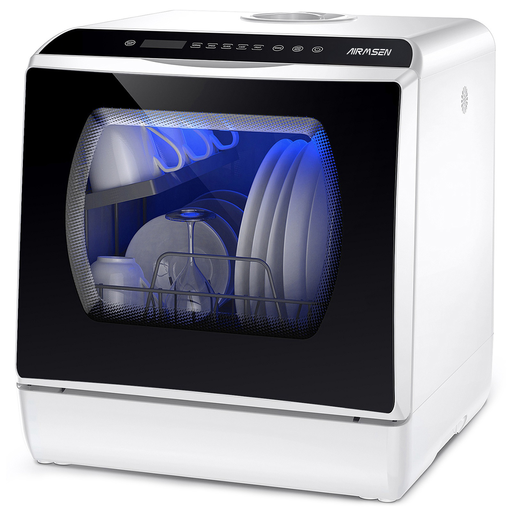 Image unavailable
AIRMSEN countertop dishwasher, 5 l tank
Consider this if you’d like to compare filling a tank with connecting the appliance to a tap. The product title lists a 5 l tank and 5+1 wash cycles. If you use the tank, allow time to fill it and check how the waste water will drain away. Also check that there’s enough room for your dishes.
View on Joybuy
 Image unavailable
Indesit D2F HK26 S, 14 place settings
Compare this model if you have space for a freestanding appliance and regularly have a full load of washing up. The product title lists a capacity of 14 place settings, a width of 60 cm and an E rating. Measure the space and check the door opening, then make sure your larger dishes will fit in the racks.
View on Joybuy
 Image unavailable
Samsung DW60M6050FS, 14 place settings
Worth considering if your kitchen can accommodate a freestanding dishwasher and you regularly have a lot of washing up. The product title lists a capacity of 14 place settings and 7 programmes. Before choosing this model, compare the interior layout with your saucepans and dishes, then check its dimensions and the connections it needs.
View on Joybuy
 Image unavailable
Samsung DW70H72WCB0U1 built-in dishwasher, 13 place settings
Consider this if your kitchen already has a suitable space for a built-in appliance. The product title lists a width of 60 cm, a capacity of 13 place settings and a C rating. Check the installation dimensions, compatible door panel and connections. The product listing recommends installation by a qualified professional.
View on Joybuy
Frequently asked questions
How can I tell if a dishwasher would save me time?
For a week or two, keep an eye on how much washing up you have after meals, including dishes and saucepans. If there’s regularly a lot, compare the usable capacity and racks of different appliances. If you’d often have small loads, weigh this up against carrying on with hand washing. Que Choisir says that, in use, a dishwasher can consume two to three times less water than traditional hand washing, but this doesn’t measure how much time you’d save in your household.
What should I check before installing a freestanding, compact or built-in model?
Before ordering, check the appliance’s dimensions, the available space, the water supply, drainage and electrical supply. For a compact model, check how it fills and drains. For a built-in model, also check the cabinet and door panel. Electrolux says its connection service requires a suitable existing setup and doesn’t carry out plumbing, electrical or carpentry work.
What consumption figures should I compare between two appliances?
Compare the energy labels for the exact models and the figures for their Eco programmes, rather than relying on a general promise of low consumption. The European Commission identifies the Eco programme as the reference for requirements and information applicable to household dishwashers. Your own usage will also depend on the programmes you choose, how often you run a cycle and how you load the appliance.
Is an existing socket enough to confirm that installation is possible?
No. A socket on its own doesn’t tell you whether the electrical supply and other connections are suitable for the appliance you’ve chosen. Check the model’s instructions and, if electrical or plumbing alterations are needed, ask a qualified professional to inspect the installation.


