What should you consider before choosing?
If you want to replace frequent handwashing, start with the amount of washing up you can collect, then check the available space and connections. If these requirements aren’t met, carrying on washing by hand is still an option to consider.
| What matters to you |
What to check |
Who this applies to |
| Daily washing up |
Compare the place settings capacity and the space for pans and larger dishes; check whether you’ll be able to run full loads. |
If plates and utensils pile up every day, I want to avoid washing things as I go or running a half-empty machine. Around 33% of consumers put this need for capacity first. |
| Available space |
Measure the width, depth and clearance needed with the door open; compare the actual capacity of a 45 cm model with a compact one. |
In a small kitchen, I need to be able to fit the appliance without losing space needed for other things. Saving space is the top priority for around 27% of consumers. |
| Fitting in with your kitchen |
Check the housing and appliance dimensions against the door panel, then check the connections and any work that may be needed. |
If my kitchen is fitted, I want to make sure the door and housing are compatible before ordering an integrated model. For around 20% of consumers, fitting in with the kitchen is the main priority. |
| Small loads or installation work |
Consider how often you wash up and check whether the space has a suitable water supply, waste outlet and electrical connection. |
If I don’t produce much washing up or installation would need adjustments, I’d rather check whether I’d use the appliance often enough. Avoiding an unsuitable purchase comes first for around 20% of consumers. |
Dishwashers to consider on Joybuy
These models let you explore freestanding appliances for full loads, built-in models for fitted kitchens and a worktop appliance for smaller loads. Start by choosing a format that suits your available space and connections.
 Image unavailable
Samsung DW60M6050FS, freestanding, 14 place settings
Worth considering if you can collect a large amount of washing up between cycles and have space for a freestanding appliance.
The product title lists 7 programmes. Check the dimensions and connections needed for your chosen location.
View on Joybuy
 Image unavailable
Indesit D2F HK26 S, 60 cm freestanding, 14 place settings
Consider this format if you can collect your daily washing up and your kitchen has room for a 60 cm appliance.
Listed as energy rating E. Compare the figures on the energy label and check the depth and connections before choosing.
View on Joybuy
 Image unavailable
Samsung DW80H72YBB0U1, 60 cm built-in, 13 place settings
Worth considering for a fitted kitchen if the housing, door panel and connections are suitable for this model.
Listed as energy rating B. Check the instructions and energy label to see whether the installation requirements and energy use suit your needs.
View on Joybuy
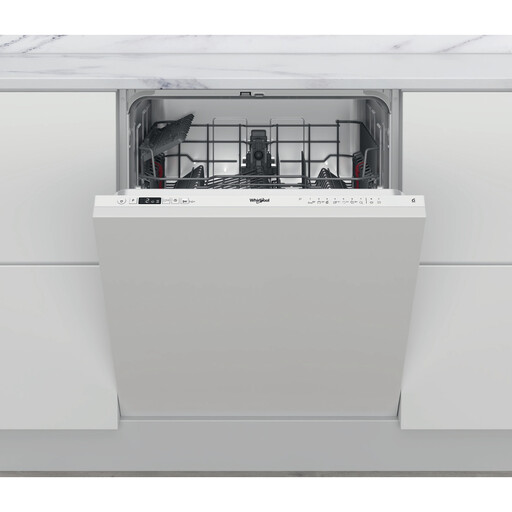 Image unavailable
Whirlpool W2I HD526 A, 60 cm built-in, 14 place settings
Consider this model if you want to run full loads and have a suitable space for a built-in appliance.
Listed as energy rating E. Check the housing dimensions, door panel, connections and energy label figures for this model.
View on Joybuy
 Image unavailable
Heinrich's HTG 8840 Schwarz, worktop, 6 place settings
Worth considering if you have smaller loads and are thinking of installing an appliance on a worktop.
The product title lists 7 programmes and energy rating D. Measure the available space and check access to the water supply and waste outlet; a capacity of six place settings may limit washing larger dishes.
View on Joybuy
Frequently asked questions
How do you compare the energy use of two dishwashers?
Compare the figures on their energy labels: kWh per 100 cycles, litres per cycle, capacity and the Eco programme duration. ADEME explains the units shown, while the European energy labelling regulation bases these measurements on the Eco programme. Your energy use will also depend on how many cycles you run.
Does a dishwasher always use less water than washing up by hand?
No. The result depends on how full the appliance is and how you wash up by hand. UFC-Que Choisir gives a general indication that dishwashers use less water, but this won’t predict every household’s usage. ADEME recommends scraping dishes rather than pre-rinsing them and running full loads.
What should you check before ordering a built-in model?
Measure the housing and check that the door panel, door and connections are compatible with the model, using its instructions as a guide. Also check what the installation service covers: Electrolux says its installers don’t carry out carpentry, plumbing or electrical work.
Does a shorter programme necessarily use less energy?
No. The length of a cycle alone doesn’t tell you whether it uses less energy. The Eco programme is used as the reference on the energy label; compare its water use, energy use and duration, then look at the other programmes separately.


