A dishwasher isn’t essential in a first kitchen. UFC-Que Choisir recommends reconsidering the purchase if you already wash and dry your dishes in under 15 minutes after every meal. If an appliance suits your lifestyle, start by looking at the space available, the connections and the amount of washing-up you produce: choose a freestanding model if you don’t have a dedicated housing unit, an integrated model if you have a compatible housing unit and door, or a compact model for smaller loads when floor space is limited.
Which format is right for you?
For your first dishwasher, whether you can install it matters just as much as the stated place-setting capacity.
A first kitchen without a dedicated housing unit
A freestanding model is worth considering if you have enough floor space and access to water, drainage and electricity. Before deciding where to put it, also check that there’s enough room to open the door.
A small household with a narrow kitchen
Choose a capacity that suits the dishes you build up between washes. UFC-Que Choisir says 45 cm models generally hold 9 to 10 place settings, while Gifam gives 6 place settings as a guide for a countertop compact model.
A fitted kitchen with a space ready for a dishwasher
An integrated model may be an option if the housing unit, door and connections are compatible with your chosen model. UFC-Que Choisir reminds buyers to allow for the cabinet door and its installation.
What should you check before choosing?
First, decide whether you’re still happy washing up by hand. If you want an appliance, compare the different formats with your kitchen and the loads you typically wash.
| What to consider | What to check | Think about your needs |
|---|
| Installation |
Measure the width, depth and height, and check the door clearance. Check the water supply, drainage and electricity: UFC-Que Choisir says all three connections are needed to install a dishwasher. |
If I don’t have a housing unit, I’ll look at freestanding models. If I have a suitable housing unit and door, I can consider an integrated model. For a countertop model, I’ll check the water supply and drainage requirements for the exact model. |
| Capacity |
Compare the stated place-setting capacity and the space for larger utensils. UFC-Que Choisir says 45 cm models generally hold 9 to 10 place settings and 60 cm models 12 to 17; Gifam gives 6 place settings as a guide for a compact model. |
I’ll choose based on the washing-up I produce between cycles, not just the number of people in my household. A small machine could be restrictive if my dishes take up a lot of space. |
| Everyday use |
Check the energy label for consumption in kWh per 100 cycles, water use per reference cycle, the duration of the Eco programme and noise in dB, using the indicators listed by ADEME. Also factor in consumables and any installation work. |
In an open-plan kitchen, noise could affect my choice. If I run only a few cycles, I’ll also want to know how much washing-up the appliance can hold each time. |
| Repairability |
Check the model’s repairability index, then look for information about spare parts and maintenance. The French Ministry for Ecological Transition includes dishwashers among the product categories covered by this index. |
I want to be able to maintain the appliance and assess the repair options, without assuming that its brand alone guarantees future reliability. |
| Washing up by hand |
For a few days, keep track of how long you spend washing and drying up after meals, and how much space the dishes take up. UFC-Que Choisir says a dishwasher isn’t essential if these tasks already take less than 15 minutes after every meal. |
If I don’t produce much washing-up and can get it done quickly, I can stick with washing by hand rather than adding an appliance to my first kitchen. |
What mistakes should you avoid?
-
Choosing the format before measuring the space
Freestanding, integrated and compact models all have different installation requirements. A compact model may need a water supply; an integrated model needs a compatible housing unit and door.
Measure the space, check the door clearance and make sure you can access the connections. Then check the installation instructions for the model you’re considering. If you need new connections, arrange the work before placing your order.
-
Assuming a compact model holds as much as a full-size one
According to UFC-Que Choisir, 45 cm models generally hold 9 to 10 place settings, compared with 12 to 17 for 60 cm models. Gifam gives 6 place settings as a guide for a countertop compact model.
Think about what you actually build up between washes, including saucepans and large dishes, then check the capacity and basket layout.
-
Relying on the energy rating alone
The energy rating doesn’t tell you how much water a cycle uses, how long the Eco programme takes or how noisy the appliance is. Nor does it tell you whether the dishwasher will fit into your kitchen without alterations.
Compare all the information on the energy label and check the installation requirements separately, including the door for an integrated model and the necessary connections.
-
Buying without considering your washing-up routine
An appliance takes up space and needs to be installed. UFC-Que Choisir says a dishwasher isn’t essential if washing and drying up already take less than 15 minutes after every meal.
For several days, note how much washing-up you produce and how long it takes before deciding whether an appliance would be useful.
A few models from well-known brands
These models show the range of formats available; their specifications don’t apply to every model from the same brand.
Bosch
The SPS2HMI02E is an example of a 45 cm freestanding dishwasher.
- Bosch lists dimensions of 845 × 450 × 600 mm and water consumption of 8,9 L per reference cycle for this model.
- Check its capacity and the space available: these specifications apply specifically to the SPS2HMI02E.
Beko
Beko describes the DIS35020 as a fully integrated 45 cm model with a capacity of 10 place settings.
- Its product details list an installation height of 82 to 87 cm.
- The housing unit and door must be suitable for this model. Its slim width doesn’t mean you can skip checking the other dimensions.
Candy
The CP 6E51LS is an example of a compact model designed to sit on a worktop.
- Candy lists a capacity of 6 place settings, dimensions of 550 × 501 × 443 mm and a direct connection to the water supply.
- You’ll need to check access to the water supply and the space available. This model doesn’t have the stated capacity of a 45 cm dishwasher.
Electrolux
According to Electrolux, the ESL2500RO is a 55 cm fully integrated compact model with a capacity of 6 place settings.
- This format lets you consider a compact housing unit instead of installing a model on your worktop.
- Check the housing unit, door and installation instructions before comparing it with a freestanding compact model.
Compact dishwashers available on Joybuy
These countertop appliances are a compact option for a first kitchen where space is limited. Before choosing one, check its capacity and dimensions, as well as the water supply and drainage requirements for the exact model.
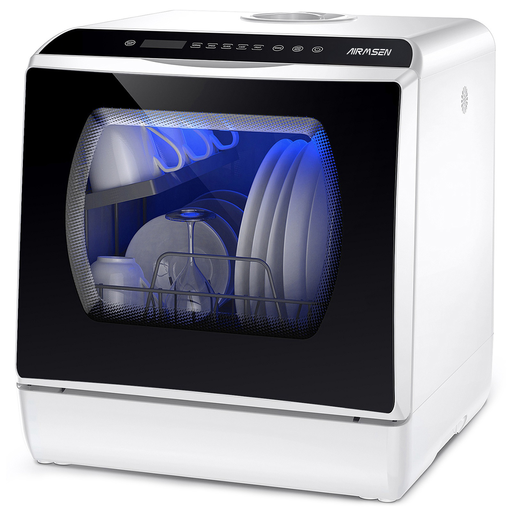 Image unavailable
AIRMSEN countertop dishwasher with 5 L tank
Worth a look if you’re after a compact appliance and want to compare the water supply options. The product title lists a built-in 5 L tank and 5+1 cycles. Check the instructions for drainage requirements and make sure the capacity suits your loads.
View on Joybuy
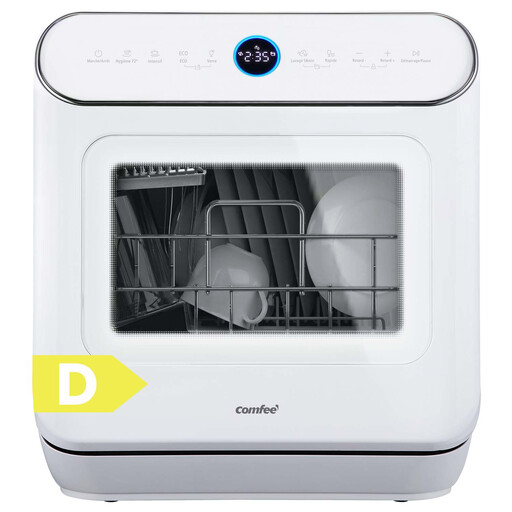 Image unavailable
COMFEE CDWMT305WD, white compact dishwasher
This countertop model is worth comparing if you have smaller loads. Its product title lists 7 programmes, a 24-hour delay start and a D energy rating. Before choosing this format, check the place-setting capacity, water supply and drainage requirements.
View on Joybuy
 Image unavailable
Comfee' CDWMTO201D(W), dishwasher with 5 L tank
The tank listed in the product title may be worth considering when you’re looking at connection options for a compact model. The title also mentions 6+3 programmes and a D energy rating. Check the place-setting capacity and drainage requirements for this model.
View on Joybuy
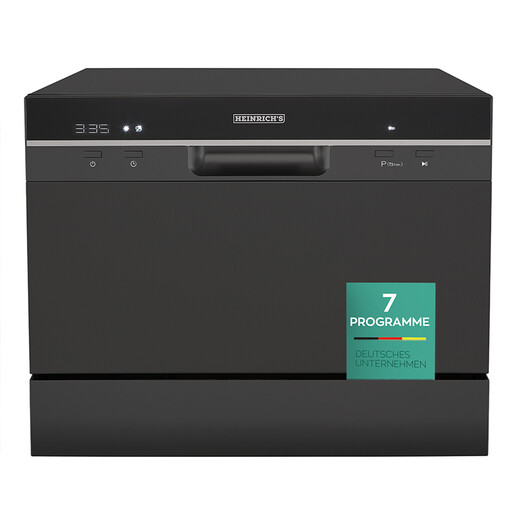 Image unavailable
Heinrich's HTG 8840 Schwarz, compact dishwasher with 6 place settings
Its stated capacity of 6 place settings makes this model worth considering for smaller loads. The product title lists 7 programmes, a D energy rating and 47 dB. Check these details against the energy label and measure the space available on your worktop.
View on Joybuy
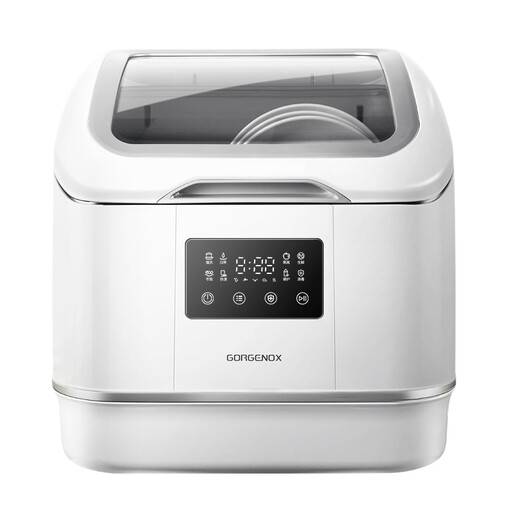 Image unavailable
GORGENOX DW4-D30A, compact dishwasher for 3 place settings
The product title describes a countertop appliance for 3 place settings. Compare this small capacity with the amount of washing-up you usually produce. The claim that it needs no installation work doesn’t explain how water enters or drains from the appliance, so check the connections in the instructions before choosing this model.
View on Joybuy
Frequently asked questions
What connections does a dishwasher need?
UFC-Que Choisir says you need a water supply, an electricity supply and a waste-water outlet. Check that they’re accessible from the space you’ve measured, and follow the installation instructions for your model. If there’s no water supply or drainage, alterations may be needed.
Can a compact dishwasher always work without a water supply?
No. UFC-Que Choisir describes very small models that use a water tank, while Candy says its CP 6E51LS compact model connects directly to the water supply. Check the water supply and drainage requirements for the specific appliance.
What should you compare on the energy label?
When comparing dishwashers, look at energy consumption in kWh per 100 cycles, water use per reference cycle, the duration of the Eco programme and the noise level. ADEME lists these indicators; also make sure the capacity suits your needs.
Does the repairability index apply to dishwashers in France?
Yes. The French Ministry for Ecological Transition includes dishwashers among the product categories covered by the index. It can help you assess how repairable a model is, but it can’t predict whether it will break down or tell you the terms of a particular repair.


