You’re replacing a dishwasher under a low worktop
If you have around 81 to 82 cm of clearance, first check the minimum niche height required for the new model. Its external height alone won’t tell you whether it can be installed.


To find out whether a dishwasher can be integrated under a low worktop, compare the available height, width and depth with the required niche dimensions for the exact model, then check the door panel, door clearance and connections. If you have around 82 cm of clearance, the Candy CI0C7SB0FA may be worth considering, provided the niche meets the dimensions published by PRO&Cie. If no integrated model will fit, consider a worktop dishwasher or a freestanding model elsewhere rather than forcing the installation.
If you have around 81 to 82 cm of clearance, first check the minimum niche height required for the new model. Its external height alone won’t tell you whether it can be installed.
A 45 cm integrated model may be worth considering if its capacity meets your needs. Measure the available height and depth too, then check how much space the door panel and door need.
A compact worktop dishwasher could suit smaller loads if you have a stable spot outside the cabinetry. A freestanding model also needs its own space, with dimensions that suit the appliance.
First, find out whether an integrated installation is possible. Then compare capacity and features only across models that will fit your kitchen.
Consider this: if the niche meets all the required dimensions. PRO&Cie lists a niche size of 81.8 to 87.8 × 45.2 × 57.7 cm for the Candy CI0C7SB0FA.
Bear in mind: Candy lists this fully integrated model as having capacity for 10 place settings. Check the door panel and door clearance separately.
Consider this: if your niche meets the model’s minimum height and you need to adjust the alignment or door clearance around the plinth.
Limitation: Beko lists an installation height range of 82 to 92 cm for the BDIN38440P. Its adjustable feet don’t make it suitable for a lower niche.
Consider this: if no integrated model will fit and you have a stable spot with the necessary connections.
Bear in mind: a compact worktop dishwasher has a different capacity; Candy lists its CP 6E51LW as having capacity for 6 place settings. A freestanding model must also fit the space you choose and shouldn’t be treated as an integrated appliance.
| Priority | What to check | What I need |
|---|---|---|
| Niche dimensions | Measure the available height, width and depth. Compare them with the installation dimensions for the exact model, not just its external height; allow space for the hoses as shown in the manual. | I want to install the appliance under my worktop without finding out that there isn’t enough room in height or depth. |
| Door panel and door | Check the hinge type, the permitted dimensions and weight of the door panel, and the door clearance in front of the plinth. A sliding hinge doesn’t reduce the minimum niche height. | I need to be able to fit my door panel and open the door without it hitting the plinth or floor. |
| Connections | Locate the socket, water inlet, waste outlet and hose route. In France, Promotelec states that the dishwasher socket must be supplied by a dedicated circuit. | Before choosing a location, I need to know whether the appliance can be connected to the existing installation. |
| Everyday use | Once you’ve confirmed the dimensions, compare place settings, kWh per 100 cycles, litres per cycle and noise levels on the labels of the models you’re considering. | I’m looking for a capacity that suits my dishes and want to compare energy, water and noise information on a like-for-like basis. |
An external height of 815 or 816 mm doesn’t tell you the required niche height: installation requirements vary by model.
Measure all three dimensions and compare them with the installation dimensions in the specifications or manual for the exact model.
Adjustable feet only work within the range specified for the appliance. Beko lists an installation height of 82 to 92 cm for the BDIN38440P, so a niche below 82 cm is outside that range.
If your niche doesn’t meet the minimum, look for a model with a lower minimum niche height or consider placing an appliance outside the niche.
A sliding hinge can make it easier for the door to clear some plinths, but it doesn’t guarantee that your existing door panel will fit or that the niche is tall enough.
Check the manual for the exact model for the door panel’s fixing method, permitted dimensions and weight, then check the door clearance in front of the plinth.
Free space inside a cabinet doesn’t confirm that the socket, water inlet and waste outlet are suitable for the installation.
Locate these before delivery. Promotelec states that in France the dishwasher socket must be on a dedicated circuit; if you’re unsure, have the installation checked.
Fully integrated models to consider when the available width is a deciding factor.
An option to compare for a narrow space, with a worktop model also available if the niche isn’t suitable.
Consider its adjustment features and door systems if you need to work around a door panel or plinth.
Worth considering if you’re comparing a 60 cm fully integrated model and its door-panel system.
These worktop dishwashers are worth considering if integrating an appliance into your existing kitchen isn’t possible and you have a stable spot outside the niche. They aren’t a substitute for a model designed to be integrated into the cabinetry.
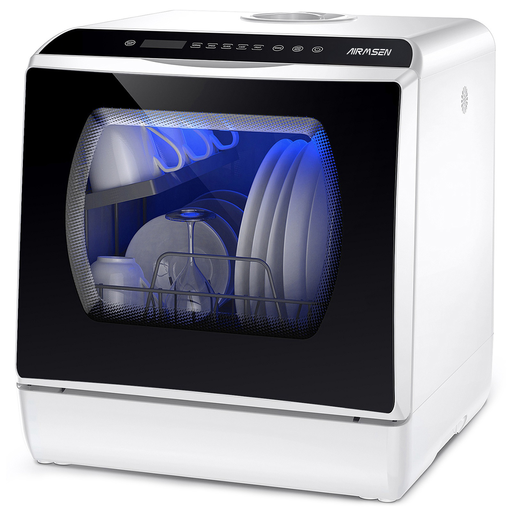 Image unavailable
Consider placing it outside the cabinetry if the niche won’t fit an integrated model. The product title specifies a built-in 5 L tank and 5+1 wash cycles. Check the space it needs, water drainage and power supply before choosing it.
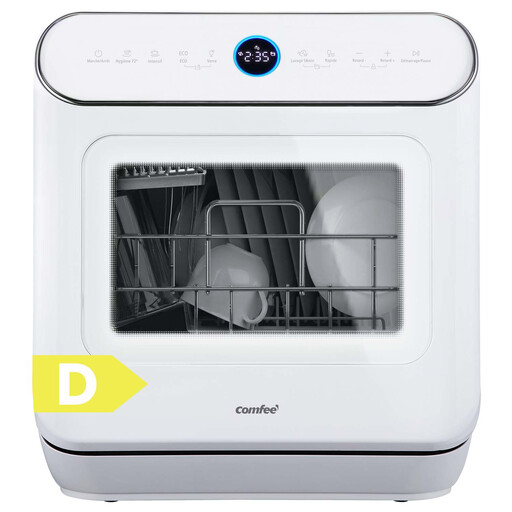 Image unavailable
This worktop model is worth considering if you have a spot outside the niche. The product title specifies 7 programmes, a 24-hour delay start and energy rating D. Check its dimensions, drainage method and whether its power supply is compatible with your installation.
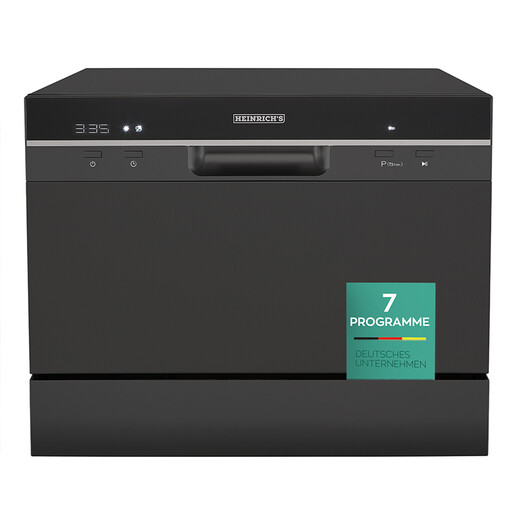 Image unavailable
For use outside the niche, the product title lists capacity for 6 place settings, 7 programmes, 47 dB and energy rating D. Measure the space you have in mind and check the appliance dimensions and connection requirements before buying.
Measure the niche and compare it with the installation dimensions for the exact model. The external height alone isn’t enough: Candy lists the CI0C7SB0FA as 816 mm high, while PRO&Cie gives this model a minimum niche height of 81.8 cm. Check the width, depth and door clearance too.
Not if that height is below the installation range specified for the model. Beko lists a range of 82 to 92 cm for the BDIN38440P, so its adjustable feet don’t mean it can be installed in a lower niche.
Yes. Once you’ve confirmed the niche dimensions, check how the door panel is fitted and its permitted weight, the hinge type and the door clearance in front of the plinth. If the model you choose has a sliding hinge, that alone doesn’t guarantee that your existing door panel will fit.
Find out which circuit supplies the socket intended for the dishwasher: Promotelec states that it must be on a dedicated circuit. Also check the location of the water inlet and waste outlet. If you’re unsure about the existing installation, ask a qualified professional to inspect it.
A worktop model is an option if no niche meets the installation requirements and you have a stable spot elsewhere with suitable connections. Its capacity should suit your dishes: for example, Candy lists its compact CP 6E51LW worktop dishwasher as having capacity for 6 place settings.