What factors should guide your decision?
Start by looking at how much washing-up you have after meals, then check that the type you’re considering will fit the available space and connections.
Freestanding
Choose this if: you have a suitable space and regular loads that match the model’s capacity.
Bear in mind: the appliance will be on show, and its dimensions need to suit the space available.
Integrated
Choose this if: your kitchen has a compatible space and you want the appliance to blend in with your units.
Bear in mind: check the space, cabinet door and connections for the exact model.
Compact
Choose this if: you don’t have room for a standard appliance and your dishes will fit in a smaller-capacity model.
Bear in mind: some models have a reservoir, so they may not need a water supply, but they still need to drain wastewater. A smaller capacity may mean running several cycles.
Washing by hand
Stick with this if: you don’t have much washing-up after meals and can get through it quickly, or there’s nowhere suitable to install an appliance.
Bear in mind: you’ll still have to wash up by hand. An appliance’s standardised consumption figures alone don’t tell you whether it’s right for your situation.
| What matters |
What to check before buying |
Who it matters most to |
| Volume and frequency |
Look at several typical meals and check the capacity and interior layout, not just the stated place setting count. |
If several meals create a regular load, I want to avoid an appliance that’s too small or rarely used. Around 36% of consumers put volume and frequency first. |
| Space and connections |
Measure the available space and door opening; check the water supply, drainage and power supply as detailed in the manual. |
If my kitchen is fitted, I want to confirm that the space and cabinet door are compatible before choosing a model. Around 29% of consumers prioritise integration and installation. |
| Small kitchen |
Check the dimensions, capacity, types of dishes it can take and drain-hose routing for the exact model. |
When space is limited, I’m looking for a model that fits without making wastewater drainage more complicated. Around 21% of consumers prioritise a compact design. |
| Everyday usefulness |
Compare how often you’re likely to run a cycle with the time you spend washing up by hand. Also check the consumption figures for the Eco programme. |
If I don’t have much washing-up and can get through it quickly, I want to know whether the appliance meets a regular need. Around 14% of consumers make the usefulness of the purchase their top priority. |
Joybuy dishwashers by type
These Joybuy models include compact tabletop, freestanding and integrated options. Compare their stated capacities and installation requirements with your meals and kitchen.
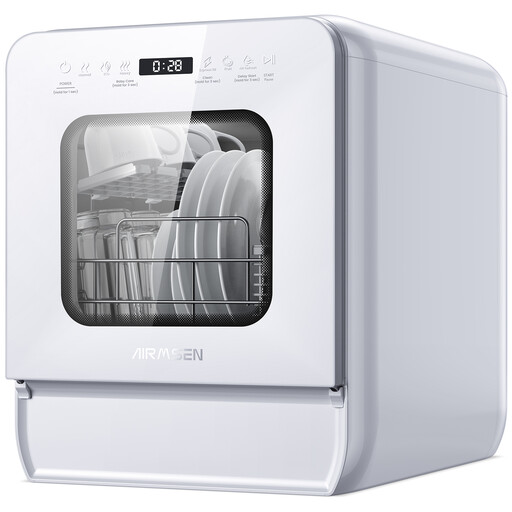 Image unavailable
AIRMSEN tabletop dishwasher, 5 place settings
Worth considering for a small kitchen if a tabletop model suits the space available.
Built-in 5 L reservoir; stated capacity of 5 place settings; stated dimensions of 37 × 50 cm; 9 programmes; energy rating D.
View on Joybuy
 Image unavailable
Heinrich’s HTG 8840 tabletop dishwasher, black
Worth considering for smaller loads if you’re looking for a tabletop appliance and its capacity suits the dishes you usually use.
Stated capacity of 6 place settings; 7 programmes; stated noise level of 47 dB; energy rating D.
View on Joybuy
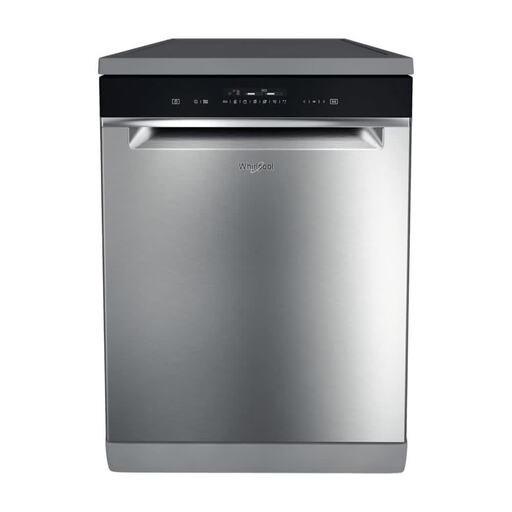 Image unavailable
Whirlpool WFP5O41PLGX freestanding dishwasher
Worth considering for regular loads if you have a suitable space for a freestanding model.
60 cm; stated capacity of 14 place settings; stainless steel finish; energy rating C.
View on Joybuy
 Image unavailable
Samsung DW80H72YBB0U1 integrated dishwasher
Worth considering for a fitted kitchen if the space and cabinet door suit the model. Also check the installation requirements.
60 cm; stated capacity of 13 place settings; energy rating B.
View on Joybuy
 Image unavailable
Comfee CDWMTO201D(W) tabletop dishwasher
Worth considering for a small space if the tabletop design and stated capacity suit the amount of washing-up you have.
Built-in 5 L reservoir; 6+3 stated programmes; energy rating D.
View on Joybuy
Frequently asked questions
Does a reservoir-powered mini dishwasher need a water supply?
Not the Bob model described by Daan Tech, which can use either its reservoir or a water supply. You’ll still need to drain wastewater through the supplied hose. Follow the manual for the version you choose, and don’t assume all compact models work this way.
How do you compare the energy use of two dishwashers?
The European energy label shows, among other things, the kWh per 100 Eco cycles, water use per cycle, capacity, Eco programme duration and noise level. Compare like with like, then consider how often you’ll use the appliance. These figures don’t guarantee savings compared with washing up by hand.
Which connections should you check before installing a freestanding or integrated dishwasher?
Check the model’s manual for the water supply, drain-hose route and power supply, as well as the space available. For an integrated model, also check the space and cabinet door. Bosch recommends connecting its appliances directly to a socket rather than using an extension lead or multi-plug adaptor.
Which programme should you use for your dishwasher?
ADEME recommends running a full load and choosing the Eco programme. The figures on the European energy label are based on this programme; another cycle or a machine that’s often only partially loaded may not deliver the same results.
What protection applies if a new dishwasher bought from a trader is faulty or not as described?
In France, the legal guarantee of conformity applies to goods sold by a trader to a private individual. The Ministry of the Economy and Finance states that you have two years to make a claim under this guarantee. It is separate from any commercial guarantee offered by the manufacturer.


