What should you check before choosing?
First, check whether the appliance can be installed in your studio flat. Then compare its dimensions and capacity with your dishes, and consider whether its features suit your day-to-day routine.
Tank model
Consider this if: there’s no usable water supply, but you can still drain the waste water safely.
Bear in mind: you’ll need to fill the tank by hand and manage the waste water; the details depend on the instructions.
Compact plumbed-in model
Consider this if: your water supply, waste outlet, socket and available space meet the model’s requirements.
Bear in mind: installation depends on your home’s plumbing; check before starting any work if changes are needed.
Washing up by hand
Consider this if: you don’t have many dishes to wash or the appliance would take up space you need in your kitchenette.
Bear in mind: washing up will still be a regular chore; this option alone doesn’t establish which solution uses less water.
| What to consider | What to check | Who this matters to |
|---|
| Water supply and drainage |
If the model needs to be plumbed in, check for a usable water supply, as well as the route and drainage point specified in its instructions. |
Without a usable water supply, I need to be able to fill the appliance another way and drain the waste water safely; around 45% of consumers would prioritise checking this first. |
| Space and capacity |
Measure the space, door clearance and room for the hoses; check that the basket can fit your largest dishes. |
In a narrow kitchenette, I want enough space to use the sink and fit plates in the appliance; space and capacity would be the top priorities for around 33% of consumers. |
| Everyday use |
Check the energy label for electricity use per 100 cycles, water use per cycle, Eco programme duration and noise level. |
In a single-room home, I consider the noise during a cycle and the resources used at my usual washing frequency; around 22% of consumers would put these factors first. |
The European Commission says dishwasher energy labels include details such as energy use per 100 cycles, water use per cycle, Eco programme duration, capacity and noise emissions. These details help you compare models, but they don’t replace checking whether the appliance can be installed in your home.
Brands to consider
There are no brands to feature in this section.
Tabletop dishwashers on Joybuy
These tabletop models are for studio flats where there’s space for an appliance. Some feature a tank, while another is designed to be plumbed in. Check the water supply and drainage requirements for each model before choosing.
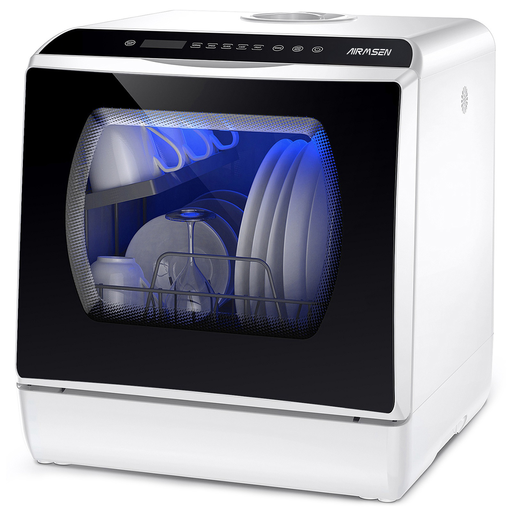 Image unavailable
AIRMSEN tabletop dishwasher, 5 L tank
Worth considering if it’s difficult to use the water supply in your studio flat. The product name specifies a built-in 5 L tank and 5+1 wash cycles; you’ll also need a suitable drainage route. Check the dimensions and electrical requirements before installation.
View on Joybuy
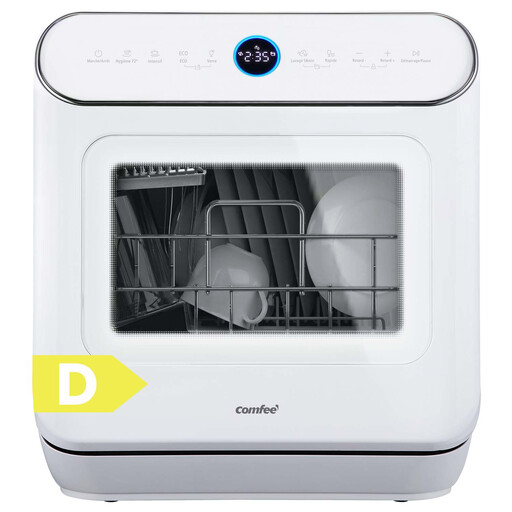 Image unavailable
COMFEE CDWMT305WD white tabletop dishwasher
For a kitchenette where a tabletop appliance could be a good fit. The product name lists 7 programmes, an automatic door and energy class D. Check the instructions for filling and draining, and make sure there’s enough room for the dishes you want to wash.
View on Joybuy
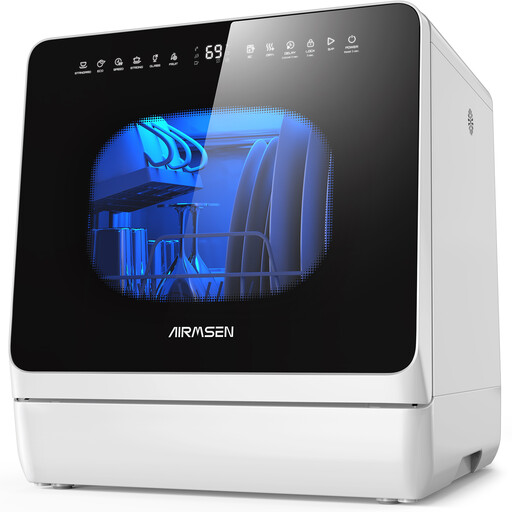 Image unavailable
AIRMSEN tabletop dishwasher, 8 programmes
Worth a look if you’re after a tabletop appliance with a choice of programmes. The product name specifies 8 programmes and a built-in water softener. Check the dimensions, water supply method and drainage rather than assuming how it installs from the words “no connection required” alone.
View on Joybuy
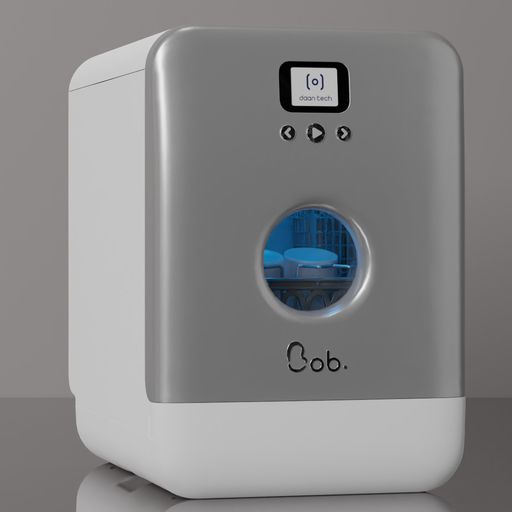 Image unavailable
Bob Mini, 3 place settings, metallic grey and white
Worth considering if you don’t have many dishes to wash and the appliance fits in your kitchenette. The product name specifies a capacity of 3 place settings; check that larger items will fit, and confirm the water supply and drainage requirements for this particular model.
View on Joybuy
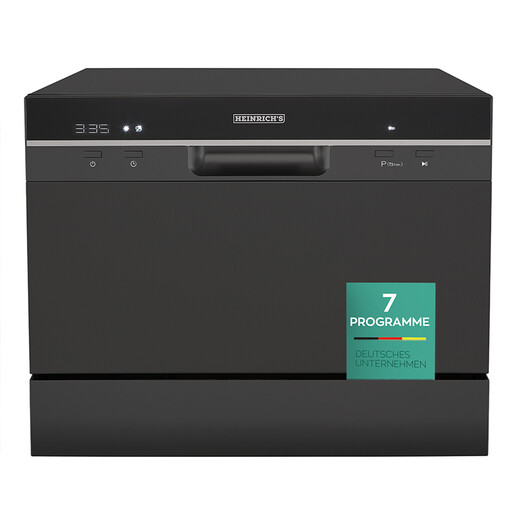 Image unavailable
Heinrich's HTG 8840 Schwarz, 6 place settings
Worth considering if your kitchenette can accommodate a plumbed-in model and you want to wash up to 6 place settings, as stated in the product name. Check the external dimensions, connections and hose route against your setup.
View on Joybuy
Frequently asked questions
Can a tank dishwasher work without a water supply?
Yes, if the model is specifically designed to be filled by hand: Daan Tech describes this option for its appliance with a 4 L tank. You’ll still need to follow the instructions for draining the waste water. Check the requirements separately for any other model.
Can you put any compact dishwasher on a worktop?
No. Check that the model is designed for this type of placement, then measure the space it needs, the door clearance and the route for the hoses. “Compact” can also refer to built-in appliances: Electrolux France, for example, lists a 55 cm, 6-place-setting model that needs a suitable installation.
What should you look for on the energy label in a studio flat?
As well as the energy class, check electricity use per 100 cycles, water use per cycle, Eco programme duration, capacity and noise level. The European Commission lists these details on dishwasher energy labels. Compare them with how often you wash up, but don’t mistake them for confirmation that the appliance can be installed in your home.
What should you check before using the appliance for the first time?
Follow your model’s instructions for the electrical connection, any water supply and drainage. Check that the cables and hoses aren’t trapped. If you need to alter your home’s installation or have any concerns about safety, check the terms of your tenancy agreement and ask a qualified professional for advice.


