Households that quickly build up a pile of washing-up
If plates, cutlery, pans and dishes soon fill the sink, compare the place settings capacity and interior layout. Also check that the appliance will fit in your kitchen.


If washing-up is piling up every day and your kitchen has a suitable space, a standard dishwasher offers more room than a slimline model. For smaller loads or a cramped kitchen, consider a slimline or table-top appliance instead. If plumbing connections or available space are an issue, handwashing is another option to weigh up. In every case, check the capacity, installation requirements, and the model’s energy and noise ratings before you decide.
If plates, cutlery, pans and dishes soon fill the sink, compare the place settings capacity and interior layout. Also check that the appliance will fit in your kitchen.
A slimline or table-top appliance can take up less space, provided its capacity suits the amount of washing-up you usually have. You’ll still need to check its dimensions and water supply requirements.
If your kitchen opens onto your living space, the noise level matters just as much as the space available. Compare the label ratings and check the plumbing connections before placing your order.
Start with the amount of washing-up you need to do, then check the space and connections available. Energy use and noise levels can help you choose between appliances that are suitable for your kitchen.
Consider this if: your household quickly fills a dishwasher and you have a suitable space for one.
Bear in mind: it needs more width; an integrated model also requires a compatible housing unit and door panel.
Consider this if: you have less washing-up or limited space, as long as you choose a capacity that’s right for you.
Bear in mind: there’s less room for larger dishes, and you may need to run it more often if your washing-up increases.
Consider this if: you have very little washing-up or it’s not possible to install an appliance in your kitchen.
Bear in mind: before comparing water use, think about your own washing-up habits.
| Criteria | What to check | Your needs |
|---|---|---|
| Capacity and size | Compare the place settings shown on the label, the dimensions and the space available for larger dishes. E.Leclerc’s guide generally associates 45 cm models with 9–10 place settings and 60 cm models with 12–14 place settings. Check the capacity of the specific model you’re considering. | If I’m adding pans and dishes to the plates every day, I want to avoid a capacity that means I have to run too many cycles. In a small kitchen, the space it takes up matters too. |
| Water and electricity | On the EU label described by ADEME and the European Commission, compare litres per cycle and kWh per 100 cycles, using the same Eco programme as the basis. Consider these figures alongside the capacity, rather than assuming that width alone determines consumption. | I want to be able to compare energy and water use before regular use. In the 2025 Energy Information Barometer by France’s national energy ombudsman, 85% of the 2,000 households surveyed in mainland France in September 2025 said energy bills took up a significant share of their budget. This result does not measure their dishwasher purchasing criteria. |
| Noise | Compare the noise level in dB and the noise class on the labels of the models you’re considering. UFC-Que Choisir highlights how important this is in an open-plan kitchen. | My kitchen opens onto my living space, so I’d rather know the advertised noise level before planning to run cycles in the evening or while I’m at home. |
| Installation | Measure the space and allow for the room needed to open the door. Check the water inlet, waste connection and plug against the instructions. For an integrated model, also check the housing unit and door panel. | Before choosing an appliance, I need to know whether it will fit in my kitchen and whether the connections can be installed. |
A narrower appliance may hold less washing-up and need to run more often if dishes pile up. Its width alone also doesn’t tell you how much water or electricity it uses.
Compare the place settings capacity, litres per cycle and kWh per 100 cycles shown on the label, then consider them in relation to the washing-up you usually have.
An incompatible housing unit or door panel could prevent the appliance from being fitted. Electrolux says its installers may not carry out carpentry, plumbing or electrical work.
Measure the housing unit, the clearance under the worktop and the space needed to open the door. Check the door panel and connections before choosing your appliance and installation service.
If your kitchen needs adapting, plan to arrange this separately from delivery.
A cycle running near your living space may be disruptive, depending on your routine and layout. UFC-Que Choisir specifically highlights noise as a factor to consider in an open-plan kitchen.
Compare the dB rating and noise class on the label instead of relying on a general “quiet” claim.
This selection includes standard freestanding and integrated dishwashers, as well as a mini table-top dishwasher. Compare their capacities and check the installation requirements before choosing: these sizes are designed for different amounts of washing-up.
 Image unavailable
This freestanding model is suited to a household that regularly builds up a pile of washing-up. Its title lists 14 place settings and 7 programmes. Check the dimensions, door clearance and connections in your kitchen.
 Image unavailable
The advertised capacity of 14 place settings suits households that quickly build up a pile of washing-up. The title lists a width of 60 cm and an energy rating of C, but another product dimension is given as 67.5 cm. Confirm the external dimensions before setting aside space for it, and check the connections too.
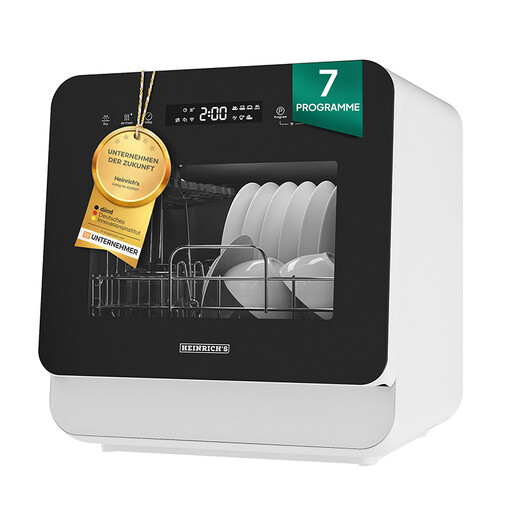 Image unavailable
This mini table-top dishwasher is worth considering for smaller amounts of washing-up, rather than for regularly washing large dishes. Its title lists 3 place settings, 7 programmes and 56.3 dB, and says it can be used with or without a water connection. Check its dimensions, water supply requirements and energy and water ratings before installing it.
 Image unavailable
This freestanding model is worth considering if your everyday washing-up calls for a capacity of 14 place settings. Its title lists a width of 60 cm and an energy rating of E. Check the clearance needed to open the door, the connections and the kWh per 100 cycles on the model’s label.
 Image unavailable
This integrated model is suited to a kitchen with a compatible space. Its title lists a width of 60 cm, 13 place settings and an energy rating of C. Check the housing unit dimensions, door panel and door type, then compare the water and electricity use on the label.
Compare the same information for each model: energy rating, kWh per 100 cycles, litres per cycle, place settings capacity and noise level. ADEME and the European Commission explain these figures on the EU energy label. You should also consider how much washing-up you usually have.
No. Its width alone isn’t enough to tell you that it uses less. Compare the litres per cycle and kWh per 100 cycles on the labels of the specific models, then check whether their capacity suits your everyday washing-up.
Measure the space and the clearance needed to open the door, then check the water inlet, waste connection and plug against the model’s instructions. For an integrated model, also check the housing unit and door panel. Whirlpool describes the connections required, while Electrolux says its installers may not carry out the work needed to adapt your kitchen.
Yes. If the dishwasher will run near your living space, compare the dB rating and noise class of the models you’re considering. UFC-Que Choisir lists noise as an important factor in an open-plan kitchen, and ADEME explains where to find this information on the label.
You can’t tell from the choice between handwashing and using an appliance alone: the amount of washing-up and your habits both matter. If you can install a dishwasher, compare the litres per cycle on its label with how you actually wash dishes by hand. Don’t assume that a compact model necessarily uses less.