What should you check before choosing?
First, measure the space and check the connections. Then make sure the capacity and noise level suit the way you’ll actually use the appliance.
| What to consider |
What to check |
Based on my needs |
| Format and location |
Measure the width and depth, and allow enough room to open the door. UFC-Que Choisir distinguishes between mini worktop models and freestanding appliances measuring 45 or 60 cm. Check the dimensions of the specific model you’re considering. |
I’m short on floor space, but I might be able to make room on the worktop. Without a fitted kitchen, I’d rather look at freestanding options. |
| Usable capacity |
Compare the stated number of place settings with your plates, serving dishes and pans. UFC-Que Choisir lists mini models with 2 or 3 place settings, and 45 cm freestanding models with 9 to 10. |
A narrower model appeals to me, but I don’t want to run several cycles to wash up after multiple meals. |
| Noise |
Compare the noise emissions in dB on the energy labels of the models you’re considering. The European Commission says this information is included on dishwasher energy labels. |
In my open-plan kitchen, the appliance will run close to where I spend time. A simple ‘quiet’ claim isn’t enough for me. |
| Installation |
For a standard appliance, check that you have access to water, electricity and a drain, as explained by Bosch Home Appliances. For a mini model with a tank, read the instructions to plan how to fill and drain it. For an integrated model, check the housing space and cabinet front too. |
Before I order, I need to know where the hoses will go and how the appliance will be powered. Having a space for it isn’t enough on its own. |
| Usage information |
The European Commission explains that the label includes information such as water use per cycle and energy use per 100 cycles of the Eco programme. In France, the Ministry of the Economy says that dishwashers are covered by the repairability index. |
I want to compare models on a like-for-like basis and consider how they’ll be used and how repairable they are, not just how much space they take up. |
A guide to the brands
There are no brand profiles to show in this section.
Compact models available from Joybuy
These worktop models may suit you if you’re looking for a dishwasher for a small kitchen. Their inclusion here doesn’t replace comparing them with a freestanding, 45 cm or integrated model if the space you have and your needs make those options suitable.
 Image unavailable
Comfee' CDWMTO201D(W), white worktop dishwasher
Worth considering if you have space on your worktop: the product title lists a built-in 5 L water tank and 6+3 programmes. Check the instructions for drainage, positioning and water supply requirements. If you have an open-plan kitchen, compare the noise level on the energy label too.
View on Joybuy
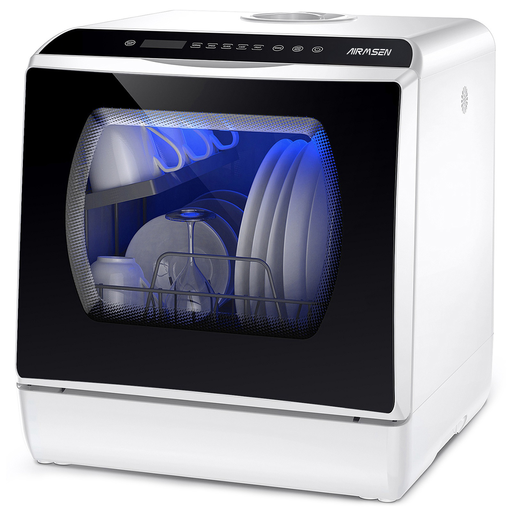 Image unavailable
AIRMSEN worktop dishwasher with 5 L water tank
Worth considering if a built-in tank would make it easier to position the appliance. The product title lists 5+1 cycles. You’ll still need to plan for drainage and a power supply, so check the instructions for details, along with the noise level on the energy label.
View on Joybuy
 Image unavailable
Heinrich's HTG 8840 Schwarz tabletop dishwasher
Its stated capacity of 6 place settings is worth comparing with your usual load if a smaller mini model won’t be enough. The product listing states 47 dB; if you have an open-plan kitchen, compare this figure with the energy label. Check the dimensions and connections needed for your chosen spot too.
View on Joybuy
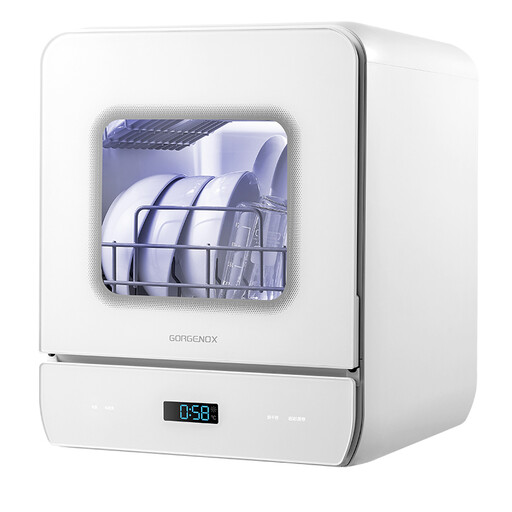 Image unavailable
GORGENOX DW5-D40A, worktop dishwasher with 3 place settings
This model is listed for 3 place settings, making it suitable for a small amount of washing-up. Compare its capacity with your usual serving dishes and pans. Before setting aside space for it, check its dimensions, how it’s filled and drained, and its noise level on the energy label.
View on Joybuy
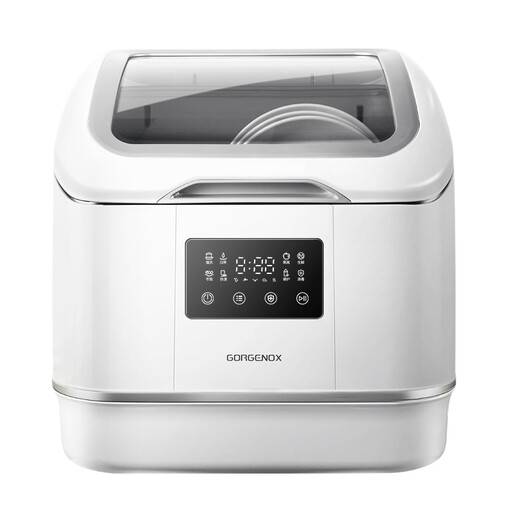 Image unavailable
GORGENOX DW4-D30A, worktop dishwasher with 3 place settings
The stated capacity of 3 place settings means it’s best suited to a small daily load. The title suggests it doesn’t need installation, but the product information also mentions a tap connection and hose drainage. Check the instructions to clarify what’s required before deciding where to put it. Check its dimensions and noise level on the energy label too.
View on Joybuy
Frequently asked questions
What connections does a standard dishwasher need?
Check that you have access to water, electricity and a suitable drain. Bosch Home Appliances lists these as the three connections needed for installation. Then check the hose lengths and positioning requirements in the instructions for the model you’re considering.
Does a mini dishwasher with a water tank need plumbing?
Some mini models with 2 or 3 place settings use a water tank, as described by UFC-Que Choisir, but you’ll still need to check how they drain and how they’re powered. Read the instructions for your chosen model to find out exactly how to fill it and whether any connections are needed.
How can you compare noise levels in an open-plan kitchen?
Compare the noise emission level in dB on the energy labels of models that fit your space. The European Commission says dishwasher energy labels include this information, making it more precise than a marketing claim such as ‘quiet’.
What should you compare on the energy label?
For dishwashers, the European Commission says the label includes information such as capacity, noise, water use per cycle and energy use per 100 cycles of the Eco programme. Compare these figures for models with a capacity that suits your household, rather than judging by format alone.
Is an integrated dishwasher suitable for a small kitchen without fitted units?
An integrated model is worth considering if you have a compatible housing space, the right connections and plans for a cabinet front. Without these, a freestanding model may be easier to position. Bosch Home Appliances recommends using a professional for integrated installation.


