What should you check before choosing?
In a small kitchen without built-in space, first rule out any formats that can’t be installed, then compare capacities to find one that suits your usual load of dishes. A plumbed-in countertop model and one with a water tank have different water-supply requirements, but both need a way to drain waste water.
| Criteria |
What to check |
What matters to consumers |
| Available space |
Measure the width, depth and height, as well as the clearance needed to open the door where you plan to put the appliance. |
If I need to keep a walkway clear or preserve part of the worktop, the appliance’s overall footprint matters more than its capacity. This would be the top priority for around 29% of consumers. |
| Everyday capacity |
Compare the stated place-setting capacity with your usual loads and check there’s room for larger utensils. |
When dishes pile up every day, I want to avoid running multiple cycles or always washing pans separately. Around 36% of consumers would put capacity first. |
| Connections |
Check the water supply, drainage route and power supply. For a model with a water tank, check how to fill it and drain the waste water, too. |
Without an accessible water supply or suitable drainage, I need to know whether the appliance can actually work in my home. For around 21% of consumers, installation feasibility would be the top priority. |
| Energy use and noise |
For the exact model, compare kWh per 100 cycles, litres per cycle, Eco programme duration and dB. |
In an open-plan kitchen, I pay attention to noise and cycle duration once I’ve established that the appliance will fit and has enough capacity. These practical considerations would be a priority for around 14% of consumers. |
ADEME states that the energy figure in kWh per 100 cycles and the water figure in litres per cycle refer to the reference cycle. So compare the labels for specific models. Don’t judge energy use by width alone, or assume that a dishwasher always uses less water than washing by hand.
Countertop dishwashers on Joybuy
These countertop appliances are worth considering if you want to preserve floor space in a kitchen without built-in space. Their capacities and water-supply options vary, so check the footprint, drainage and connections for each one before choosing.
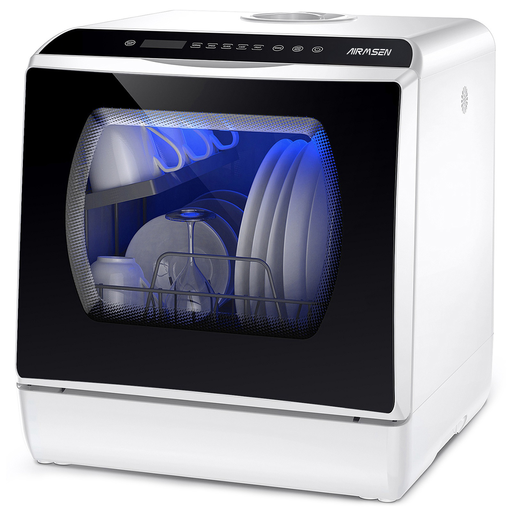 Image unavailable
AIRMSEN countertop dishwasher, 5 L tank
Worth considering if a fixed water supply is the main obstacle, provided you have a way to drain the waste water. The product name specifies an integrated 5 L tank and 5 + 1 wash programmes. Before buying, check how much worktop space it needs and the Eco programme’s specifications.
View on Joybuy
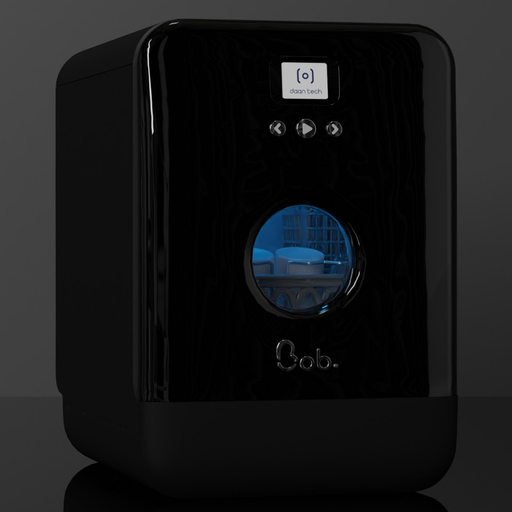 Image unavailable
Bob Deep Black dishwasher
Consider this model for smaller loads if you have room on your worktop. Check the water connection and drainage point for this version: don’t assume that options listed for other Bob versions automatically apply to this one.
View on Joybuy
 Image unavailable
Heinrich's HTG 8840 Schwarz countertop dishwasher, 6 place settings
The stated capacity of 6 place settings may suit a household whose small loads are larger than those handled by a mini appliance. Before setting aside worktop space, check the overall dimensions, required connections and figures on its energy label.
View on Joybuy
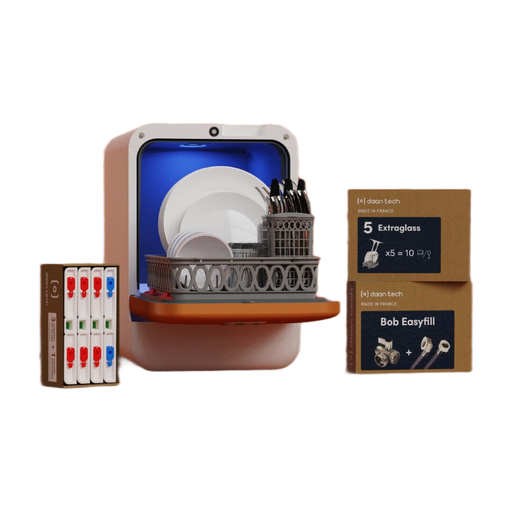 Image unavailable
Bob All-Options Pack White/Copper dishwasher
Consider this version for smaller loads if you have space on your worktop. Check that its capacity suits the utensils you usually wash, then read the water-supply and drainage instructions for this pack before planning the installation.
View on Joybuy
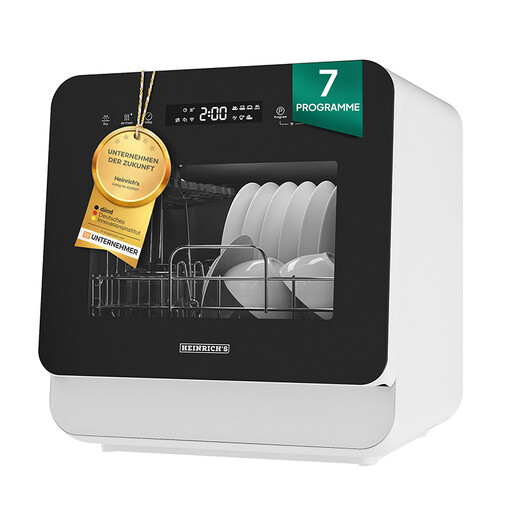 Image unavailable
Heinrich's HTG 8855 mini countertop dishwasher, 3 place settings
The stated capacity of 3 place settings is designed for modest loads. The product name says it can be used with or without a water connection. Before buying, confirm the configuration you need, the dimensions and the route for the drain hose.
View on Joybuy
Frequently asked questions
Can a countertop dishwasher work without a water supply?
Yes, some models with a water tank can, but not all countertop appliances do. Daan Tech says the Bob Carafe has an integrated 4 L tank, while Candy France lists the CP 6E51LS as connecting directly to a water supply. In both cases, you’ll need suitable drainage.
What should I compare on the energy label?
Compare the capacity in place settings, energy use in kWh per 100 cycles, water use in litres per cycle, Eco programme duration and noise level, as well as the energy rating. ADEME explains that the water and energy figures refer to the reference cycle. Other programmes or partial loads may change your actual consumption.
Can you plug a dishwasher into any kitchen socket?
No. Promotelec states that a dishwasher must be plugged into a dedicated circuit. Check the appliance’s electrical instructions too, and ask a qualified professional to assess an unsuitable installation. Don’t attempt to make changes yourself.
Does installation include any work that may be needed?
Don’t assume that any necessary work is included in an installation service. Electrolux France’s pre-installation guide says its installers connect the appliance to existing compliant installations, but don’t carry out joinery, plumbing or electrical work. Check the terms of your chosen service before delivery.
Does a dishwasher always use less water than washing by hand?
No. That doesn’t hold true for every load or washing method. The European Commission says an efficient dishwasher can use 9 L to wash up to 15 place settings. This figure doesn’t represent every small appliance or how much water you’ll use washing by hand. Compare the reference-cycle figure for the model you’re considering with how you plan to use it.


