First, rule out any size that won’t fit in your kitchen or work with your existing connections. A compact countertop model can handle smaller loads if its water supply and drainage arrangements suit you; a slimline 45 cm model gives you more room for dishes if you have space for a freestanding appliance. A standard 60 cm model is worth considering if you have the space and enough dishes to fill it. Otherwise, washing up by hand remains an option.
Who are these sizes suitable for?
You cook often but don’t have room for a freestanding appliance
A compact countertop model depends on the available surface, its depth and how it gets its water supply. The tabletop models from Candy and Joybuy show that water supply arrangements can vary.
You have a slim space and the necessary connections
A 45 cm dishwasher can handle a daily load without taking up as much width as a 60 cm model. Check the depth and height too: Bosch lists the dimensions of one 45 cm model as 845 × 450 × 600 mm.
You already have a suitable space for a full-size appliance
A 60 cm model is worth considering if the connections are in place and you regularly have enough dishes to fill it. For an integrated model, compare the appliance dimensions with those of the housing space and planned cabinetry.
How do you compare the options?
In a small kitchen, the first thing to decide is whether you can install an appliance without making permanent changes. You can then compare compatible models by capacity and the information on their energy labels.
Compact countertop model
Consider it if: there’s no room for a freestanding appliance and your daily load is fairly small.
Bear in mind: capacity is limited, and water supply arrangements vary by model. Compact doesn’t necessarily mean connection-free.
Slimline 45 cm model
Consider it if: you have space on the floor and the necessary connections, but not enough width for a 60 cm model.
Bear in mind: a narrower width doesn’t mean you can skip checking the depth, height and space for larger dishes.
Standard 60 cm model
Consider it if: there’s already a suitable space and you have enough dishes to make use of a large capacity.
Bear in mind: it takes up more width; an integrated model must also fit the housing space and cabinetry.
Washing up by hand
Stick with it if: there’s no stable place for an appliance with the necessary installation conditions, or your loads are too small for your needs.
Bear in mind: you’ll still need to wash the dishes every day; this choice doesn’t indicate how your household’s consumption compares.
| Factor |
What to check before buying |
What matters to shoppers |
| Space |
Measure the width, depth and height, as well as the door clearance. For an integrated model, compare the dimensions of the housing space too. |
If the appliance blocks a walkway or stops a cupboard door opening, it won’t solve the problem of washing up in my small kitchen. Space could be a priority for around 31% of consumers. |
| Everyday capacity |
Compare the stated place settings and basket layout with the saucepans, frying pans and dishes you use regularly. |
When I cook every day, I want to be able to fit my dishes in without choosing an oversized appliance. Around 25% of consumers might rank a suitable capacity as their top priority. |
| Connections |
Check whether the exact model uses a water inlet or a tank, as well as its drainage and plug requirements. Make sure installation won’t require permanent alterations. |
If I can’t do any work in my kitchen, the water supply and drainage arrangements determine whether I can use the appliance. This could be the main concern for around 25% of consumers. |
| Noise and consumption |
Compare the dB, litres per cycle and kWh per 100 cycles on the energy label. According to ADEME, consumption figures are based on the reference programme. |
When my kitchen is next to my living room, I want to know how noisy the cycle is and what consumption figures are listed before I choose. Around 19% of consumers might prioritise this information. |
Mistakes to avoid
-
Assuming every compact model works without a water inlet
Candy specifies a direct connection for its CP 6E51LS, while the Comfee CDWMTO201D (W) listed on Joybuy has an integrated 5 L tank. So the word ‘compact’ doesn’t tell you everything you need to know about installation.
Read the manual for the model you’re considering and check the water supply, drainage, plug and stability of the surface separately.
A model filled by hand means an extra regular task; a connected model depends on the connections available.
-
Measuring only the width
A slimline dishwasher can still have a considerable depth and height. If the door can’t open fully or the housing space isn’t suitable, installation may not be practical.
Measure all three dimensions and the door clearance, then compare them with the manufacturer’s installation diagram. For an integrated model, check the cabinetry and existing connections too.
-
Choosing a capacity based only on the number of place settings
Examples listed by Candy, Whirlpool and Bosch range from 6 place settings for a compact model to 10 for some 45 cm models and up to 14 for standard models. This figure alone won’t tell you whether your larger dishes will fit in the baskets.
Think about the bulkiest items from a typical day’s meals and check that they’ll fit, as well as whether the baskets can be adjusted on the model you’re considering.
-
Treating a sound description or quick programme as a like-for-like measurement
The energy label includes information such as noise, litres per cycle and kWh per 100 cycles for the reference programme. These figures won’t necessarily reflect your consumption when using a different programme.
Compare the figures on the labels of the models you’re considering and think about which programmes you’ll actually use.
Brands to help you compare different sizes
Bosch
Bosch’s listed models make it easy to compare 45 cm and 60 cm appliances, including their dimensions and installation types.
- The product details for the SPS4EMI17E and SBH4HVX14E give precise dimensions to help you measure your space.
- The specifications of one Bosch model won’t necessarily apply to another. Check the product details and energy label for the model you choose.
Candy
Candy offers tabletop, slimline and standard models, making it useful for comparing capacities and installation requirements.
- Candy describes the CP 6E51LS as a 6-place-setting tabletop compact model with a direct water connection.
- Don’t assume other compact models use the same water supply. Check the consumption figures and programmes for each model in its own documentation too.
Whirlpool
Whirlpool’s documentation includes examples of slimline dishwashers and details of the connections they require.
- Whirlpool lists the WSFO3T223P as 45 cm wide, with 10 place settings, 43 dB noise and 9 L of water on the Eco cycle.
- These figures apply to this specific model; claims made by the brand about the benefits of its technologies aren’t an independent comparison.
Dishwashers to consider on Joybuy
These models illustrate two options, depending on the space you have: compact countertop models for smaller loads and standard freestanding appliances for larger loads, provided you have a suitable space. Measure the area and check the connections before choosing.
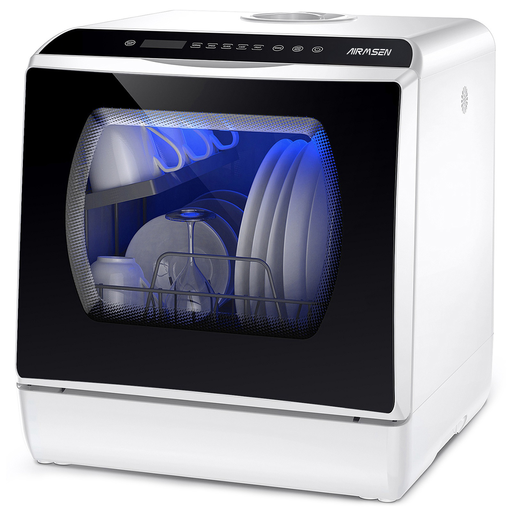 Image unavailable
AIRMSEN countertop dishwasher, 5 L tank
Worth considering for a small kitchen if the surface it sits on and the way it drains suit your needs.
The product name lists an integrated 5 L tank and 5 + 1 wash cycles. Check how much space it needs, whether it can fit your dishes, and the noise and energy figures on the label.
View on Joybuy
 Image unavailable
Heinrich's HTG 8840 black tabletop dishwasher, 6 place settings
Worth considering if you want a 6-place-setting tabletop model and have the necessary connections.
The product name lists 7 programmes, 47 dB noise and energy class D. Check its full dimensions, hoses and energy label before deciding where to put it.
View on Joybuy
 Image unavailable
Samsung DW60M6050FS freestanding dishwasher, 14 place settings
Worth considering if a standard-size appliance will genuinely fit in your kitchen and you regularly have enough dishes to make use of its 14-place-setting capacity.
The product name lists 7 cycles. Measure the space and door clearance, then check the connections and figures on the energy label.
View on Joybuy
 Image unavailable
Indesit D2F HK26 S freestanding dishwasher, 14 place settings
Worth considering for a larger load if you have the space and connections for a freestanding appliance.
The product name lists a width of 60 cm and energy class E. Check the depth, height, door clearance and kWh per 100 cycles on the energy label.
View on Joybuy
 Image unavailable
Hotpoint H4FD641A freestanding dishwasher, 14 place settings
Worth considering if your kitchen can accommodate a standard-size model and you have enough dishes to make use of its capacity.
The product name lists a width of 60 cm, 41 dB noise and energy class C. Confirm the noise and consumption figures on the energy label, along with the dimensions and connections required.
View on Joybuy
Frequently asked questions
Do compact dishwashers always work without a water inlet?
No: the water supply depends on the model. Candy lists the CP 6E51LS as having a direct connection, while the Comfee CDWMTO201D (W) listed on Joybuy has a 5 L tank. Check the drainage and installation requirements for the model you choose too.
What connections do I need for a slimline or standard model?
A connected dishwasher needs a suitable water inlet, drainage and plug nearby. Whirlpool says these requirements apply to both freestanding and integrated models; check the manual for your chosen model for details of the fittings, hoses and installation requirements.
Can I buy an integrated model without a suitable housing space?
Don’t choose an integrated model until you’ve confirmed that the housing space and cabinetry match its installation diagram. Check the existing connections too: an installation service won’t necessarily include carpentry, plumbing or electrical work.
How do I compare water and energy use, and noise?
Compare the energy labels of the models you’re considering rather than relying on marketing descriptions alone. ADEME says energy is shown in kWh per 100 cycles and water in litres per cycle. These figures relate to the reference programme and won’t necessarily reflect a quick or intensive cycle.


