Who is it for?

People living in a studio or one-bedroom flat with an open-plan kitchen

When the appliance shares your living, working or sleeping space, its stated noise level, noise class and cycle timing matter just as much as its footprint. ADEME and UFC-Que Choisir highlight the importance of this factor in an open-plan kitchen.

Small households with space for a 45 cm model or a worktop appliance

A lack of width or floor space does not mean you can skip checking whether the stated capacity will prevent overly frequent cycles, or confirming which connections are actually available.

Renters or households with an existing kitchen space

Whether you choose a freestanding or integrated model, the compatibility of the cabinet, dimensions, water supply, drainage and electrical connection should guide your decision before appearance becomes a priority.

Buying priorities

Countertop compact

Consider it: if the worktop is the available space and the amount of crockery between washes remains limited.

Check: a compact model is not automatically self-contained: filling, drainage, support stability and capacity vary by model.

45 cm or 60 cm freestanding

Consider it: a 45 cm model when width is restricted, or a 60 cm model if the available space and daily load justify it.

Check: width alone tells you nothing about the consumption, noise or capacity of the specific model.

Integrated

Consider it: if your kitchen already has a compatible housing unit and you want the appliance integrated beneath the worktop.

Check: the housing dimensions, depth, door front, fixing points and access to connections must all match the model.

Priority What to check Your needs
Noise in the living space Compare the noise level in dB and the noise class on the energy label. Also check the cycle you are most likely to use. According to UFC-Que Choisir, a difference of 3 dB represents a doubling of sound intensity. I want to be able to run a cycle without excessively disturbing rest, working from home, conversations or everyday life.
Suitable capacity Match the number of place settings to the meals, utensils, saucepans and containers you accumulate. Check the basket layout and the usable dimensions for bulky items. The machine needs to handle my usual washing-up without requiring too many cycles or leaving some items to be washed by hand.
Connection and drainage Read the installation instructions for the exact model. Check the water inlet, drainage, socket and hose routing; a built-in tank does not automatically remove the need for drainage. I am looking for an installation that is compatible with my kitchen, without unsuitable electrical DIY work or unexpected modifications.
Clear consumption information Compare the kWh per 100 cycles, litres per reference cycle and duration of the Eco programme between models with similar capacities. The energy label also shows the noise level. I want to compare different formats without relying on an energy class or marketing claim in isolation.

Mistakes to avoid before buying

  • Taking the word “quiet” at face value without comparing the data

    Marketing labels do not provide a consistent basis for comparison. In an open-plan kitchen, compare the dB rating and noise class: the sound may be noticeable during meals, conversations or working from home.

    Note this information from the label of each shortlisted model and think about when you will run the Eco programme or your most frequently used cycle.

  • Assuming a compact model can be installed anywhere

    Connected dishwashers require a suitable water supply, drainage and electrical connection. A model with a built-in tank may reduce the need for a water inlet, but it does not automatically eliminate the need for drainage.

    Before ordering, check the water supply, drainage, socket and hose routing in the model’s instructions. Do not alter the electrical or plumbing installation without an appropriate solution.

    Depending on the configuration, a connection, compatible adaptor or professional installation may be required.

  • Choosing solely according to the available width

    A narrow appliance may suit a small space, but its capacity, baskets, consumption and cycle duration still need to be considered together. A machine that is too small may lead to additional cycles.

    For a few days, observe the amount of washing-up produced between cycles, including saucepans and boxes, then compare capacity, baskets, litres per cycle and kWh per 100 cycles.

    More frequent cycles may increase your use of water, energy and detergent.

  • Forgetting running costs and after-sales service

    Beyond the purchase price, installation, consumables, maintenance and consumption all form part of the cost of owning a dishwasher. UFC-Que Choisir lists these among the expenses to factor in.

    Add these items to your budget, keep your proof of purchase and delivery, and compare any commercial extended warranty with the applicable legal guarantee.

    Detergent, rinse aid, dishwasher salt, maintenance, potential installation and energy and water consumption all contribute to the cost of use.

Brands to compare by the format you need

Bosch

In France, Bosch offers countertop compact models, 45 or 60 cm freestanding models and 45 cm integrated models, making it possible to compare several installation types within one range.

  • The specifications for some models state their dimensions, consumption and noise class.
  • The brand’s claims about quietness or performance should be checked against the label and specifications for the exact model.

Beko

Beko is worth considering when comparing 45 cm and 60 cm freestanding dishwashers where width and capacity are the main criteria.

  • The brand gives examples offering up to 10 place settings in a 45 cm model and up to 15 place settings in a 60 cm model.
  • These capacities apply to the listed references: check the water supply, drainage and electrical connection in the instructions for the model you select.

Miele

Miele can be compared when considering 45 cm or integrated options where noise, installation and basket features are key factors.

  • Some French specifications state dB ratings and installation details.
  • The manufacturer’s statements about service life or performance do not replace checking the housing and the model’s specifications.

Siemens

Siemens is worth considering when comparing freestanding and integrated models, particularly when installation flexibility or fitting beneath the worktop is a starting point.

  • The manufacturer presents freestanding models as more flexible to install and integrated models as designed to fit beneath the worktop.
  • The housing dimensions, door front and connections must be confirmed for both the kitchen and the model concerned.

Joybuy options for compact use

These Joybuy options are compact countertop dishwashers for a small kitchen and a low volume of washing-up. Compare their capacity, stated noise level and connection requirements with your actual installation.
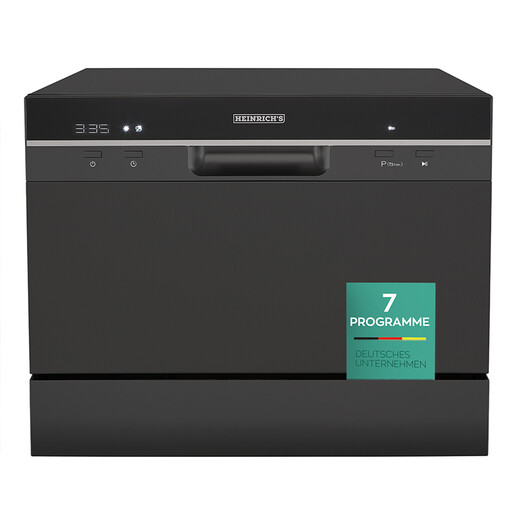
Heinrich's HTG 8840 6-place-setting countertop dishwasher

Heinrich's HTG 8840, 6 place settings

This countertop format is described as suitable for a small kitchen and a household that can manage with a capacity of 6 place settings.

The specifications state 47 dB, 49 kWh per 100 cycles, 6.5 L per cycle, seven programmes, a delay-start function and automatic door-opening drying. Check the available space, door clearance, tap, drainage, socket and energy label for the exact model.

Joybuy
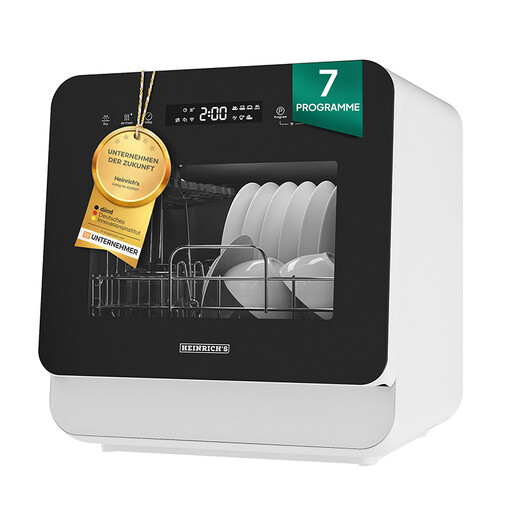
Heinrich's HTG 8855 mini 3-place-setting countertop dishwasher

Heinrich's HTG 8855, 3 place settings

This mini dishwasher is described as suitable for a very small amount of washing-up, for example for one person or occasional use on the worktop.

The specifications state a 5 L tank or direct connection, a capacity of 3 place settings, seven programmes, 4.2 L per wash and 56.3 dB. Manual filling, drainage, electrical compatibility and dimensions must be confirmed in the model’s instructions.

Joybuy

Frequently asked questions

Does a mini countertop dishwasher always work without a water inlet?

No. The connection depends on the model: some can be connected to a water supply, while others have a built-in tank. Even with a tank, check the drain hose connection and the instructions provided with the appliance.

How can you assess a dishwasher’s noise level in an open-plan kitchen?

Compare the noise level in dB and the noise class shown on the energy label. ADEME states that classes A and B are particularly quiet; UFC-Que Choisir explains that a difference of 3 dB represents a doubling of sound intensity. Distance, the room’s acoustics and when you use the appliance also remain important.

Is a 45 cm dishwasher big enough for a small household?

It may be sufficient if its capacity and baskets match the washing-up accumulated between cycles. Examples from French product ranges offer up to 10 place settings in a 45 cm model and up to 15 place settings in a 60 cm model, but these figures do not apply to every model: remember to factor in saucepans, boxes and utensils too.

What consumption information is shown on the energy label?

For dishwashers, the energy label shows the energy-efficiency class, kWh per 100 cycles, water consumption per reference cycle, capacity, the duration of the Eco programme, and the noise level and class. This labelling is governed by Delegated Regulation (EU) 2019/2017.

What legal protection applies after buying from a professional seller in France?

According to the French Ministry of the Economy, the legal guarantee of conformity can be claimed for two years for a new or second-hand product bought from a professional seller. A commercial extended warranty does not replace this legal guarantee and should be considered separately.