What should you check before choosing?
Start with your usual load and the available space, then compare usage information for appliances that can accommodate your dishes.
| Criteria | What to check | What I need |
|---|
| Capacity |
Count the dishes you use in a day and check the basket layout for larger items. UFC-Que Choisir gives a typical capacity of 12 to 17 place settings for a 60 cm model and 9 to 10 for a 45 cm one; it also features compact models with a capacity of 6 place settings. |
I want to fit my plates, glasses and pans without running unnecessary extra cycles or regularly leaving the appliance almost empty. |
| Space and connections |
Measure the width, height and depth, and allow for clearance. Check the water supply, drainage, electrical socket and floor stability against the model’s instructions; Whirlpool covers these points in its installation advice. |
The appliance needs to fit in my kitchen and connect up safely, without improvisation. If that isn’t possible, I’ll stick with washing up by hand for now. |
| Water and energy |
According to ADEME, the energy label shows electricity use in kWh per 100 standard cycles and water use in litres per cycle. Compare these figures with the capacity and eco-cycle duration of appliances that meet the same needs. |
I want to understand the stated energy and water use, and know whether the eco-cycle duration suits my household’s routine. |
| Noise |
Check the noise level in dB and its class on the energy label. Compare models with a suitable capacity rather than relying on the word “quiet”; UFC-Que Choisir highlights how important this is in an open-plan kitchen. |
With an open-plan kitchen or one close to a bedroom, I want to choose a noise level that suits the times I run the dishwasher. |
| Maintenance |
Check the manual for instructions on adjusting the water softener to suit your water hardness, as well as for routine maintenance. Whirlpool explains that there is no single water-softener setting that works for all water types. |
I can plan for the necessary settings and maintenance instead of judging the appliance on its programmes alone. |
Which brands and models should you compare?
These manufacturer models give you an idea of the available sizes and installation types. Their features won’t apply to every appliance from the same brand.
Bosch
Bosch offers slimline and standard built-in models, making it easier to compare the space they need in your kitchen.
- According to Bosch’s product information, the SPV4EMX17E is 448 mm wide and the SMV4HVX14E is 598 mm wide; both have a stated depth of 550 mm.
- These dimensions apply to these two models only. Check the dimensions of the model you choose and follow its installation instructions.
Whirlpool
Whirlpool offers 45 cm and 60 cm models, which you can compare with the width available in your kitchen.
- Whirlpool describes the WH6IB10BS7LA0 as a 45 cm built-in model, with a capacity of 11 place settings and a noise level of 42 dB.
- These figures apply to the WH6IB10BS7LA0 only; check the specifications and installation instructions for any other model.
Electrolux
Electrolux built-in models include both partially integrated designs with a visible control panel and fully integrated models with a concealed front.
- Electrolux describes the EES47310IX as a semi-integrated model with a capacity of 13 place settings, and the EES28400L as fully integrated, with a capacity of 14 place settings.
- Electrolux does not list either of these models as suitable for raised installation. Also check the cabinet opening and any furniture panel required for your chosen model.
Miele
Miele’s range includes slimline and standard freestanding appliances.
- Miele gives capacities ranging from 9 to 14 place settings across the models in this range.
- This range does not describe every model. Check the individual product details for its width, capacity and installation requirements.
Dishwashers to consider on Joybuy
These options are for households considering either a standard dishwasher for larger everyday loads or a compact model for smaller amounts of washing up and limited space. Check the product details and your installation before choosing.
 Image unavailable
Hotpoint H4FD641A, freestanding, 14 place settings, 60 cm
Worth considering if your household regularly fills a standard dishwasher. The product name lists a noise level of 41 dB, a C energy rating and a white finish. Measure the full space and check the connections before buying.
View on Joybuy
 Image unavailable
Samsung DW60M6050FS, freestanding, 14 place settings
Consider this for everyday loads that call for a capacity of 14 place settings. The product name lists 7 cycles and a grey finish. Check the dimensions, clearance and connections required for installation.
View on Joybuy
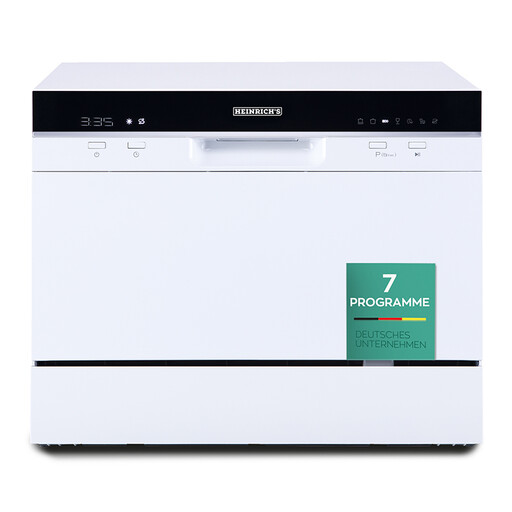 Image unavailable
Heinrich's HTG 8840 Weiss, compact, 6 place settings
A countertop model to consider for smaller amounts of washing up. The product name lists 7 programmes, a noise level of 47 dB and a D energy rating. Check that you have enough space, as well as the water supply and drainage requirements.
View on Joybuy
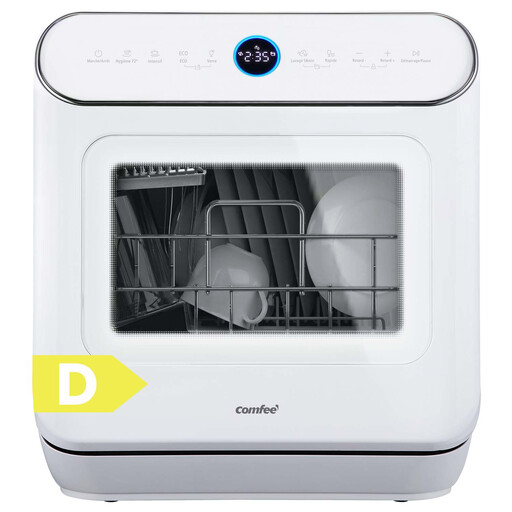 Image unavailable
COMFEE CDWMT305WD, compact, 3 place settings
Worth considering for very small loads when space is limited. The product name lists 7 programmes, a delay start of up to 24 hours and a D energy rating. The description mentions a tank that you fill by hand; check that this setup and the drainage work for your kitchen.
View on Joybuy
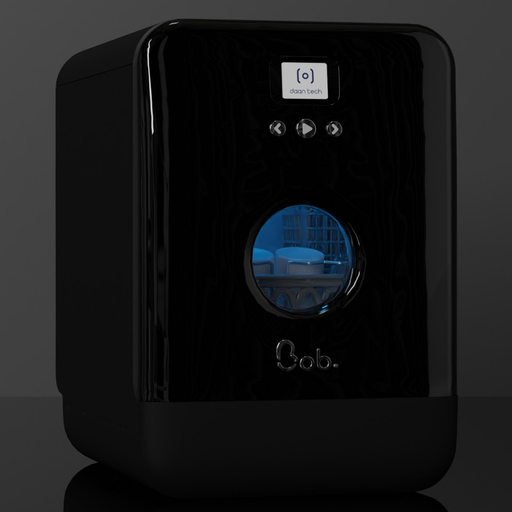 Image unavailable
Bob the Eco-Compact, Deep Black
A compact model to consider if you wash only a few dishes per cycle. Check that its capacity and loading space suit your dishes; the product details specify access to a compatible cold water tap and drainage.
View on Joybuy
Frequently asked questions
How do you choose between 60 cm, 45 cm and a compact model?
Start with the dishes you use each day and the width available. UFC-Que Choisir gives a typical capacity of 12 to 17 place settings for a 60 cm model and 9 to 10 for a 45 cm one, and features compact models with a capacity of 6 place settings. Then check that your usual dishes will fit in the baskets of the model you’re considering.
What should you check before installing a dishwasher?
Check the dimensions of the space, the water supply, drainage, electrical socket and floor stability. Whirlpool highlights these installation requirements; the instructions for your chosen model set out the connections you need to follow.
What should you compare on the energy label?
Compare appliances suited to the same load, looking in particular at kWh per 100 standard cycles, litres of water per cycle, capacity and noise. ADEME lists these as key details on the energy label; also check whether the eco-cycle duration suits your routine.
How should you take noise into account in an open-plan kitchen?
Compare the noise level in dB and its class on the energy labels of appliances with a suitable capacity. UFC-Que Choisir highlights how important noise is in an open-plan kitchen; a marketing claim such as “quiet” is no substitute for these figures.
Should you adjust the dishwasher to suit your water hardness?
Yes, if the model has an adjustable water softener: follow its instructions and set it according to your water hardness. Whirlpool explains that there is no preset setting that works everywhere.


