Who is a dishwasher right for?
How useful an appliance will be depends as much on how quickly your washing-up builds up as it does on the space available for installation.
Households with lots of washing-up every day
If you find yourself washing up by hand after every meal, an appliance can take care of regular loads, provided you have enough dishes to fill it. ADEME recommends not pre-rinsing and waiting until the dishwasher is full.
Small kitchens
A slimline or compact model may be worth considering if there isn’t room for a larger appliance. Be sure to measure the space and check that the capacity suits the amount of washing-up you usually build up.
Kitchens with an appliance recess
An integrated or semi-integrated model may fit into your existing units if the recess, door panel, hinges and connections are suitable for the model you choose. Check the installation diagram before ordering.
What should you check before choosing?
Start with the space available and how much washing-up you usually have. This helps you rule out unsuitable sizes before comparing features.
Freestanding
Consider this if: you don’t have a recess to fit out or want more flexibility with your kitchen layout.
Bear in mind: if you plan to fit it under a worktop, check the model’s dimensions and, where applicable, whether its top can be removed.
Integrated or semi-integrated
Consider this if: you have a dedicated recess and want the appliance to line up with your kitchen units.
Bear in mind: check that the door panel and hinges are compatible, and factor in the door fitting and any professional installation.
Compact
Consider this if: there isn’t room for a full-size appliance and you don’t usually have much washing-up.
Bear in mind: capacity is more limited. Also check where it can be installed and what connections the model needs.
| Criteria |
What to check |
What you need |
| Capacity |
Compare the number of place settings with how much washing-up you actually build up. According to Que Choisir, 60 cm freestanding models accommodate 12 to 17 place settings, while 45 cm models accommodate 9 to 10. Always check the capacity of the specific model. |
I want to run full loads without having to wait too long or running out of space after meals. |
| Space |
Measure the width, height and depth, as Bosch recommends. For an integrated model, also check the recess diagram, door panel and hinges, and confirm that the connections are suitable. |
My appliance needs to fit in the planned space, with room for the door to open and accessible connections. |
| Consumption |
Compare energy use per 100 cycles and water use per cycle on the same Eco programme. Also check the programme duration, and don’t compare these figures with those for other cycles. |
For my usual cycles, I want to compare water and electricity use rather than relying on the energy rating alone. |
| Noise |
Compare the stated noise emissions of suitable models. Que Choisir distinguishes between measured noise levels and how disruptive the sound feels in its testing. |
In an open-plan kitchen, noise matters if I run a cycle during a meal, while working or in the evening. |
| Maintenance |
Check the repairability index applicable in France, information about spare parts and the maintenance instructions for the model you’re considering. |
I’d like to know how to look after the appliance and what information will be useful if it needs repairing. |
A guide to some of the brands
The ranges and guides from these manufacturers can help you narrow down the right size. Then check the details for the specific model you’re interested in.
Bosch
Bosch offers freestanding, integrated and compact dishwashers.
- Its guides recommend measuring the width, height and depth of the space.
- For a precise fit, always check the dimensions and installation instructions in the model’s documentation.
Beko
Beko offers 45 cm and 60 cm models. Consider both widths in relation to your kitchen and the amount of washing-up you have.
- You can browse the range by either size.
- Capacity varies by model, so don’t rely on width alone—check the product details.
Whirlpool
In France, Whirlpool offers 45 cm and 60 cm freestanding and integrated dishwashers.
- These categories let you start your search by width and installation type.
- The brand’s installation guide notes that the appliance needs access to a water supply. Check the manual for your chosen model to confirm its connection requirements.
Models for different spaces
These Joybuy options include freestanding dishwashers with a capacity of 14 place settings and a 6-place-setting tabletop model for smaller loads. Compare their capacity with your usual needs, then check the dimensions and connections for each model.
 Image unavailable
Hotpoint H4FD641A freestanding dishwasher, 14 place settings, 60 cm
Worth considering if your household regularly fills a 14-place-setting dishwasher. The model name indicates 41 dB and an energy rating of C. Check the available space and the Eco cycle figures before deciding.
If you use the automatic door opening after a hot cycle, be mindful of the risk of hot steam, particularly around children.
View on Joybuy
 Image unavailable
Samsung DW60M6050FS freestanding dishwasher, 14 place settings
Its capacity of 14 place settings suits a household that can build up large loads, and the product name indicates 7 cycles. Check the available space and connections in the manual before considering installation under a worktop.
View on Joybuy
 Image unavailable
Indesit D2F HK26 S freestanding dishwasher, 14 place settings, 60 cm
This 60 cm model, with a capacity of 14 place settings, is worth considering if you regularly have a lot of washing-up. The product name indicates an energy rating of E. Check the label to compare water use per Eco cycle and energy use per 100 cycles.
Check the manual for the required dimensions and conditions for any under-worktop installation.
View on Joybuy
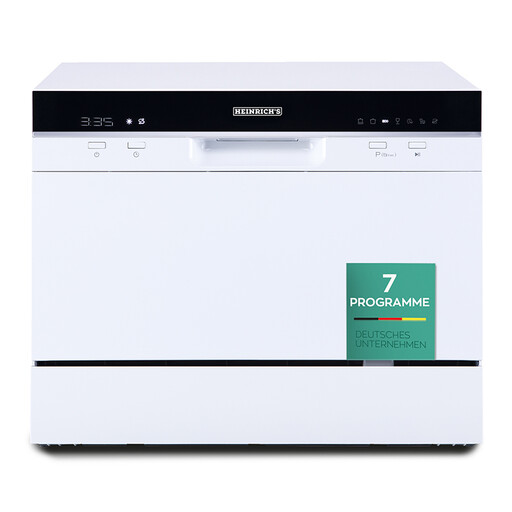 Image unavailable
Heinrich's HTG 8840 Weiss tabletop dishwasher, 6 place settings
This tabletop model, with a capacity of 6 place settings, is worth considering if space and washing-up needs are limited. The product name indicates 7 programmes, 47 dB and an energy rating of D. Measure the surface where it will sit and check the connections it requires.
If you regularly have large loads, consider whether 6 place settings will suit your mealtime routine.
View on Joybuy
 Image unavailable
Whirlpool WFP5O41PLGX freestanding dishwasher, 14 place settings
Its capacity of 14 place settings may suit regular, larger loads, and the product name indicates an energy rating of C. Before deciding whether it will fit your kitchen, make sure you check the actual width in the documentation for this model: the width information is contradictory.
Also confirm the model’s connection requirements before buying.
View on Joybuy
Frequently asked questions
When can a dishwasher make everyday washing-up easier?
It can be useful if washing up by hand is a frequent chore and you can build up enough dishes to fill the appliance. ADEME recommends waiting until it’s full and not pre-rinsing. If your loads tend to be very small, bear that in mind before choosing a large-capacity model.
What should you measure before choosing between freestanding, integrated and compact models?
Measure the width, height and depth of the space. For an integrated model, compare these measurements with the recess diagram and check the door panel and hinges. For a tabletop model, measure the surface where it will sit.
Which connections should you check before buying?
Make sure there’s access to a water supply, a drain and a suitable socket near the installation space. Then check the manual for the exact model to find out what connections and installation it requires.
How do you compare the consumption of two models?
Compare figures based on the same Eco programme: energy use per 100 cycles and water use per cycle. The label also shows the energy rating, Eco cycle duration, capacity and noise level. Consumption may differ on other programmes.
What should you check to assess a dishwasher’s repairability?
In France, dishwashers are among the products covered by the repairability index, according to the ministries responsible for the ecological transition. Check the index for the model you’re considering, then look at the manufacturer’s information on parts and maintenance.


