Who is each size best for?
The number of people in your household is a useful starting point, but the amount of washing-up and your kitchen layout will help you decide which size is right.
Someone living alone or a couple who usually wash by hand
Think about how much washing-up actually builds up between washes, including plates and pans. UFC-Que Choisir recommends compact 6-place-setting models for smaller homes. If that capacity doesn’t suit your routine, consider a 45 cm model too.
Small household with a narrow kitchen
A 45 cm appliance can still be installed on the floor while taking up less width than a 60 cm model. Gifam lists this size as holding 9 to 10 place settings; UFC-Que Choisir notes that a small household may need to run it every day.
Open-plan kitchen or a household sensitive to noise
To compare appliances that fit your kitchen, check the decibel rating and noise class on the energy label, as recommended by ADEME. Also think about when you plan to run each cycle.
What should you check before choosing?
First rule out any sizes that won’t suit your washing-up or the space available. Then compare the labels and manuals of the models on your shortlist.
| Factor |
What to check |
What I need |
| Capacity and size |
Count how much washing-up builds up between cycles, then check how plates and pans fit. Gifam’s guide is 12 to 15 place settings for 60 cm, 9 to 10 for 45 cm and 6 for a compact worktop model. |
I want to avoid a machine that’s too small for my usual meals, without choosing a larger capacity based only on the number of people in my household. |
| Space and installation |
Measure the space and check the manual for the installation requirements: freestanding, or a suitable housing unit and door panel for an integrated model, as well as water inlet, drainage and electricity supply. A compact worktop model still needs its connections checked. |
My kitchen needs to have room for the model I choose and be able to connect it, whether it’s installed on the floor, integrated into the cabinetry or placed on a worktop. |
| Water and energy |
Compare the kWh per 100 cycles and litres of water per Eco cycle on the label. ADEME explains how to read these figures; also consider how many cycles your chosen capacity will require. |
I want to understand how much the appliance will use with my washing-up routine, rather than judging consumption by its width alone. |
| Noise and cycle duration |
Check the decibel rating, noise class and Eco cycle duration on the label, as outlined by ADEME. Make sure the cycle length suits when you plan to run the machine. |
In an open-plan kitchen, or if I run a cycle in the evening, noise and cycle duration matter just as much as capacity. |
| Washing performance and loading |
Check how the racks are laid out against the utensils you use. To assess washing and drying performance, look for independent tests that specify the programme used, if available; UFC-Que Choisir measures these results separately from the figures on the energy label. |
I want to be able to load the plates I use every day and get them properly washed and dried, not just reach a stated number of place settings. |
Which brands should you consider?
These ranges give you some options to compare across different sizes. The features listed relate to the specific models named, not every appliance from that brand.
Bosch
Bosch’s UK range includes 45 cm dishwashers to consider if space is limited, with freestanding models available depending on your kitchen layout.
- Bosch lists the freestanding SPS4EMI17E as measuring 845 × 450 × 600 mm, using 8,7 l of water per Eco 50 °C cycle and having a B noise class.
- Check the manual for the model you choose. Dimensions, features and connection requirements can’t be judged by its 45 cm width alone.
Beko
The freestanding Beko LVV1347W is an example of a 60 cm model to compare with the amount of washing-up and space you have.
- Beko lists a capacity of 13 place settings and a half-load function for this model.
- A Beko manual advises checking before installation that the electricity supply, water inlet and drainage are suitable for the appliance in question.
Miele
The freestanding Miele G 5812 SC Front Active Plus is a specific model to consider if noise levels are part of your decision.
- Miele lists this model as having an A energy rating and a noise level of 42 dB.
- These features don’t automatically apply to other Miele models. Check the dimensions and interior layout of the one you’re considering too.
Electrolux
Electrolux offers, among other options, a 55 cm integrated compact model and a 60 cm fully integrated model. These kitchen layouts are worth distinguishing before comparing capacities.
- For the compact ESL2500RO, Electrolux lists a capacity of 6 place settings, a noise level of 49 dB and water use of 6,5 l per cycle.
- The ESL2500RO is supplied without a furniture door. Check the required housing unit and door panel rather than treating it as a compact model for placing on a worktop.
Joybuy models for your kitchen
This selection includes freestanding and integrated 60 cm models, as well as a compact worktop model. It gives you a chance to explore these options, but if your available space calls for a 45 cm model, you should compare that size too.
 Image unavailable
Samsung DW60M6050FS, freestanding, 14 place settings
Worth considering if you have space for a floor-standing appliance and enough washing-up to make use of its 14-place-setting capacity. The product name lists 7 cycles. Check the manual for dimensions and connections, and make sure the racks suit the plates you use every day.
View on Joybuy
 Image unavailable
Heinrich's HTG 8840 Schwarz, compact, 6 place settings
This tabletop model is worth considering if 6 place settings is enough for the washing-up you want to clean per cycle. Its product name lists 7 programmes, a noise level of 47 dB and a D energy rating. Measure the space on your worktop and check the manual for the water supply and drainage requirements.
View on Joybuy
 Image unavailable
Indesit D2F HK26 S, freestanding, 60 cm, 14 place settings
This 60 cm model is suited to a kitchen with space for a floor-standing appliance and a household that can make use of its 14 place settings. The product name lists an E energy rating. Check the label to compare energy and water use on a like-for-like basis, then consult the manual for connection requirements.
View on Joybuy
 Image unavailable
Samsung DW70H72WCB0U1, integrated, 60 cm, 13 place settings
Compare this model if your kitchen is designed for a 60 cm integrated dishwasher and 13 place settings suits the amount of washing-up you have. The product name lists a C energy rating. Check the installation diagram for the housing unit, door panel and connections, as well as the label for standardised consumption figures.
View on Joybuy
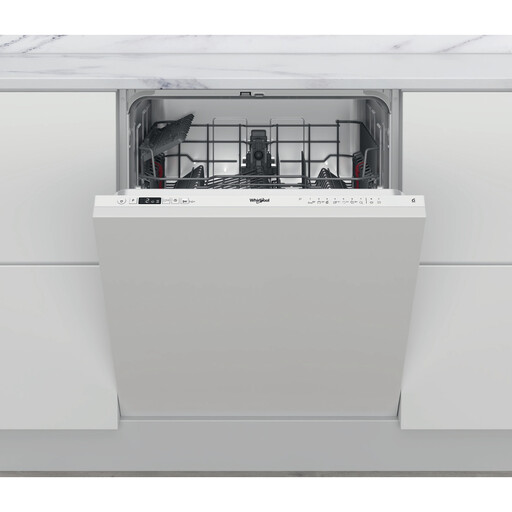 Image unavailable
Whirlpool W2I HD526 A, integrated, 60 cm, 14 place settings
This model is worth considering if your kitchen has a suitable housing unit and you have enough washing-up to fill 14 place settings. Its product name lists an E energy rating. Check the manual against your housing unit, door panel and connections, then consult the label to compare consumption.
View on Joybuy
Frequently asked questions
Is a dishwasher worth it for someone living alone or a couple?
It could be a good fit if enough washing-up builds up between cycles and your kitchen has space for the appliance. Compare the amount you have with your plates and utensils: UFC-Que Choisir recommends compact 6-place-setting models for smaller homes, while its 45 cm models offer a different capacity. The number of people in your household alone won’t settle the question.
Which figures on the energy label should I compare?
Compare the energy rating, kWh per 100 cycles, litres of water per Eco cycle, the duration of that cycle, the number of place settings and the noise level and class. ADEME identifies these units as the key figures to look for on the label. Consider them alongside how many cycles your household expects to run in practice.
Can a compact worktop dishwasher run without connections?
Don’t assume so: check the model’s manual for its water supply, drainage and electricity requirements. Also distinguish between a freestanding compact model and an integrated compact, which may need a housing unit and a furniture door.
When should I get help installing a dishwasher?
Ask someone to check the installation if you’re unsure about the water inlet, drainage, electricity or fitting the appliance into cabinetry, and always follow the manual for the model you choose. Bosch recommends using a plumber for the AquaStop connection it describes. This instruction applies to its system and shouldn’t be taken to apply to every dishwasher.


