If there isn’t enough room for a 60 cm appliance, first consider a 45 cm dishwasher for regular use, or a compact model if you have smaller loads and a suitable surface to place it on. Before choosing, measure the space and check that the door can open fully, then check the connections: the stated width alone doesn’t confirm that a model can be installed.
Which size is right for you?
Household that washes dishes every day
If you have a narrow space but regularly fill the appliance with dishes from several meals, a 45 cm model is worth considering. UFC-Que Choisir says that a 45 cm model with 9 place settings may suit a small family, even with daily use, provided its dimensions and connections are suitable for the kitchen.
Small household with lighter loads
If you don’t have many dishes to wash and have a suitable surface to place the appliance on, a compact model may be enough. Electro Dépôt says these models typically have between 4 and 6 place settings; check the capacity of the specific model, as it may differ.
Household that can rethink the kitchen layout
If you’re considering changing your kitchen to make room for a 60 cm appliance, compare the dishes produced between two cycles with the practical capacity of a 45 cm model. Only choose the standard size once you’ve checked there’s enough space for installation and for the door to open.
What should you check?
Check the space and connections first, then choose a capacity that suits the amount of washing up you produce between cycles.
45 cm dishwasher
Consider this: for regular use when your kitchen can’t accommodate a 60 cm appliance. UFC-Que Choisir specifically mentions 45 cm models with 9 place settings as an option for a small family.
Bear in mind: check the capacity against your largest loads to avoid having to run extra cycles.
Countertop compact dishwasher
Consider this: for smaller loads, if the surface and space around the appliance allow for it to be installed.
Bear in mind: capacity is generally lower. Electro Dépôt’s guide puts typical compact models at between 4 and 6 place settings, although this doesn’t describe every model.
60 cm model
Consider this: if a new kitchen layout can genuinely accommodate this width and you have enough washing up to justify comparing larger appliances.
Bear in mind: this size won’t fit your original space unless you rethink the kitchen layout.
| Consideration |
What to check |
What matters to consumers? |
| Installation |
Measure the height, width and depth; check the door clearance and connections against the model’s diagram. |
If space is tight, I want to be able to install and open the appliance without modifying the units. Around 50% of consumers prioritise this physical fit and the connections. |
| Capacity |
Check the stated place settings and basket layout against the dishes you need to load. |
When several meals quickly fill the machine, I look for enough capacity to avoid extra cycles. Capacity is the main concern for around 30% of consumers. |
| Energy use and maintenance |
For the exact model, compare the figures on the energy label and its repairability index. |
If the appliance is used often, I want to check its energy use and repair options before deciding. This is the top priority for around 20% of consumers. |
Mistakes to avoid
-
Assuming “45 cm” guarantees a perfect fit
The nominal width doesn’t tell you the required height and depth, or whether the door, plinth and pipes will fit. For example, Bosch lists dimensions of 815 × 448 × 550 mm for its fully integrated SPV4EMX17E model; these dimensions don’t apply to other models.
Measure the space in height, width and depth, then compare it with the dimensions and installation diagram for the appliance you’re considering.
If it doesn’t fit, you may need to adapt the unit or installation.
-
Choosing a compact model without counting your dishes
A small appliance may mean more cycles if you produce more dishes between washes than it can hold. Electro Dépôt’s guide of 4 to 6 place settings for compact models is no substitute for checking the specifications of the model you choose.
Compare the dishes from a typical day and a larger meal with the model’s capacity and interior layout.
-
Comparing appliances by width alone
Two appliances of the same width can have different energy use and programmes. ADEME explains that the water consumption shown on the energy label relates to a reference cycle.
Compare the water and electricity figures on the labels of the specific models, using the same units and reference cycle.
-
Treating a built-in model like a freestanding one
A built-in model comes with extra requirements for the cabinet door, plinth and fitting, in addition to the connection checks. Bosch notes that installation requires suitable water and electrical supplies, as well as a suitable waste connection.
Check the housing plan and cabinet door dimensions before choosing the appliance and how it will be installed.
Brands to consider by appliance type
Bosch
Worth considering if you’re looking for a fully integrated 45 cm model for a fitted kitchen.
- Bosch lists dimensions of 815 × 448 × 550 mm for the SPV4EMX17E.
- These dimensions apply to this model only: also check the installation diagram, cabinet door and connections.
Beko
Worth considering if you’re looking for a freestanding 45 cm model without a cabinet door.
- Beko lists models in its 45 cm range with 10 place settings.
- Check the dimensions and specifications of the specific model you choose, rather than relying on information about the range as a whole.
Miele
Worth considering when comparing 45 cm appliances for compact kitchens.
- Miele lists the G 5540 SC SL Active as a freestanding 45 cm model.
- The stated size alone doesn’t confirm that it will fit your space.
Whirlpool
Worth considering if you’re looking at a freestanding 45 cm model and the stated capacity is important to you.
- Whirlpool lists 10 place settings and seven programmes for the WSFO3T223P.
- These specifications apply to this model; check its dimensions and installation requirements before choosing it.
Compact models available on Joybuy
These two countertop appliances are compact options for smaller loads. If you’re considering a 45 cm or 60 cm model instead, check the space and capacity you’ll need for that size separately.
 Image unavailable
Heinrich's HTG 8840 Black, 6 place settings
Worth considering if a 6-place-setting countertop appliance suits the amount of washing up you produce between cycles. The product name lists seven programmes, an energy rating of D and a noise level of 47 dB. Check the dimensions, door clearance and connections required for your space.
View on Joybuy
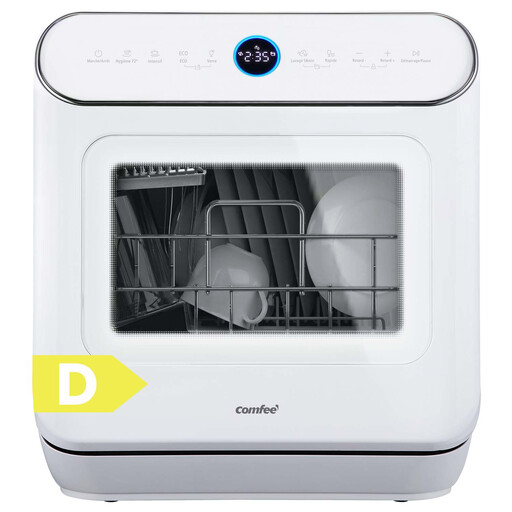 Image unavailable
COMFEE CDWMT305WD, 3 place settings
Worth considering for very small loads: with a stated capacity of 3 place settings, you may need to run frequent cycles if you produce more washing up. The product name lists seven programmes and an energy rating of D. Manual filling is specified for this model; check the instructions for the waste connection, electrical supply and clearance required.
View on Joybuy
Frequently asked questions
What should you measure before buying a slimline dishwasher?
Measure the available height, width and depth, then compare them with the specifications and installation diagram for the specific model. Also check the door clearance, plinth and space for pipes: the “45 cm” size alone doesn’t confirm that it will fit.
Does a countertop dishwasher avoid connection requirements?
No. Water supply requirements vary by model, but you’ll still need a suitable waste connection and electrical supply. Check the instructions for the compact model you’re considering before deciding where to put it.
How do you compare the energy use of two models?
Compare their energy labels using the same measure, including electricity in kWh per 100 cycles and water in litres per cycle. As ADEME points out, the water figure relates to a reference cycle: you can’t work out an appliance’s energy use from its width alone.


