What should you check before choosing a size?
Start with how much washing-up you have and the space actually available, then check the installation requirements and details of the model you’re considering.
| Priority | What to check | Your needs |
|---|
| Capacity and loading |
Compare the place settings, basket layout and space for your largest dishes. Check whether the time it takes to fill the dishwasher fits in with your mealtimes. |
Plates pile up in my kitchen, but I also want to fit my saucepans and serving bowls inside—not just meet a stated number of place settings. |
| Size and location |
Measure the width, height and depth, and check the door opening. According to UFC-Que Choisir, integrated models are available in sizes including 60 cm, advertised for 12 to 17 place settings, and 45 cm, advertised for 9 to 10 place settings. Always check the exact model. |
If a 60 cm model won’t fit in my kitchen, it’s worth looking at a 45 cm one. If space is very limited or my loads are irregular, I can also compare a compact model with continuing to wash by hand. |
| Installation and connections |
Check the water supply, waste outlet, socket and installation instructions. For an integrated model, also check the housing unit, door panel and how it is attached. |
I want to know whether the appliance can be installed in the space available, without assuming that freestanding and integrated models need the same preparation. |
| Water and electricity |
On the EU energy label described by the European Commission, compare the A to G rating, kWh per 100 cycles and litres per cycle for the Eco programme. Check the programme duration too, along with the programmes you’ll use. |
I want to compare figures based on the same programme, then check whether that programme suits my routine rather than assuming its figures apply to every cycle. |
| Noise and protection |
Check the model’s noise level if you have an open-plan kitchen. Look at its product details for protection against leaks or overflows, how it works and any repairability information. |
Noise matters to me in a room that opens onto the living area. I also want to know which protective features are actually included with the model I choose. |
What do the brands have to offer?
These examples show configurations worth comparing; their features don’t automatically apply to other models from the same brand.
Bosch
Bosch offers a range that includes 60 cm freestanding and integrated dishwashers.
- The Bosch product details for the SMS25AW09F give dimensions of 845 × 600 × 600 mm and water consumption of 9,5 L per Eco cycle—useful details to consider for this model.
- These dimensions and features don’t apply to every Bosch dishwasher. Check the details of the model you choose.
Beko
The Beko KDIS28122 is an example of a 45 cm integrated model, advertised for 11 place settings.
- Its product details give a housing height of 82 to 87 cm and list a Watersafe system that shuts off the water supply in the event of an overflow.
- The housing dimensions and protection features listed apply to the KDIS28122. Check them separately for any other model.
Miele
The range shown by Miele France includes freestanding and integrated models in slimline and standard sizes.
- Miele advertises capacities of 9 to 14 place settings, depending on the model, across its range of freestanding dishwashers.
- Size alone won’t tell you about energy use, noise or basket layout. Compare the exact models you’re considering.
60 cm dishwashers on Joybuy
These models are 60 cm options for households with regular loads: four are freestanding and one is integrated. Check their dimensions and connections before choosing one of these instead of a 45 cm model, a compact dishwasher or hand-washing.
 Image unavailable
Indesit D2F HK26 S, freestanding, 60 cm, 14 place settings
For regular loads, consider how the stated capacity of 14 place settings and adjustable top basket will work with your larger utensils. The product details give dimensions of 85 × 60 × 59 cm, a noise level of 46 dB and overflow protection. Check the connections at the installation location and the energy label figures to compare Eco consumption.
View on Joybuy
 Image unavailable
Hotpoint H4FD641A, freestanding, 60 cm, 14 place settings
This 14-place-setting model is worth considering if you have room for a 60 cm freestanding appliance. The product details give dimensions of 600 × 590 × 850 mm, a noise level of 41 dB and automatic door opening. Check the height and clearance required, as well as the energy consumption figures on its label.
View on Joybuy
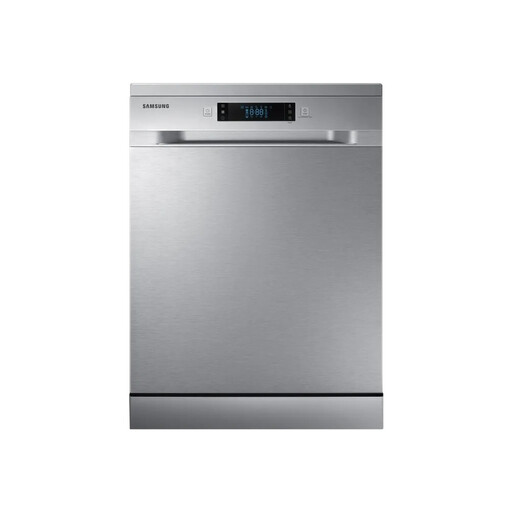 Image unavailable
Samsung DW60M6050FS, freestanding, 14 place settings
If you need room for larger dishes, this model has a stated capacity of 14 place settings, an adjustable basket and a third basket. The product details give dimensions of 59,8 × 60 × 84,5 cm and a noise level of 44 dB. Before comparing its energy use with other appliances, check the Eco programme figures on the label.
View on Joybuy
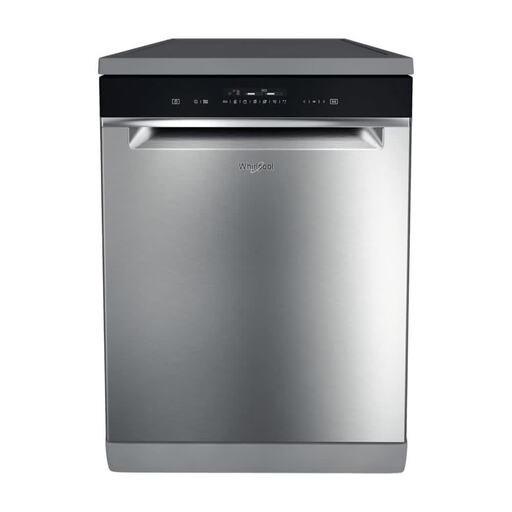 Image unavailable
Whirlpool WFP5O41PLGX, freestanding, 14 place settings
The product details list 14 place settings, a third basket, an adjustable top basket and AquaStop. However, the model is described as 60 cm wide, while another listing gives its width as 67,5 cm. Confirm the exact external dimensions before deciding where to put it. Check the connections required too.
View on Joybuy
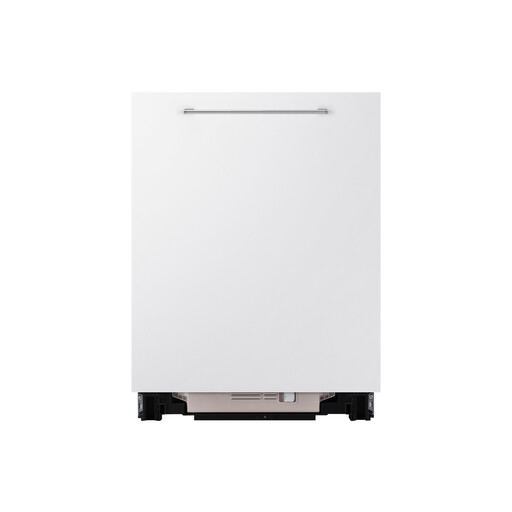 Image unavailable
Samsung DW80H72YBB0U1, integrated, 60 cm, 13 place settings
This 13-place-setting option is for kitchens with a housing unit suited to an integrated model. The product details mention adjustable baskets and a noise level of 44 dB, but refer to both a fixed hinge and a sliding door. Confirm that the door system will work with your door panel before ordering. Check the connections required and the energy consumption figures on the label too.
View on Joybuy
Frequently asked questions
Which connections should you check before buying your first dishwasher?
Check the water supply, waste outlet and power supply at the intended installation location. Bosch lists these three connections as part of the installation requirements. Then check the manual for your chosen model and clarify any work needed before installation.
Does a 45 cm dishwasher always use less energy than a 60 cm model?
Don’t assume energy use from the width alone. For the models you’re considering, compare the kWh per 100 Eco cycles, litres per Eco cycle and capacity shown on the label. Then take into account how often you’ll be able to run a full load.
Can you compare appliances using the Eco programme?
Yes. As the European Commission explains, the energy and water figures on the EU energy label for dishwashers relate to the Eco programme. They don’t necessarily reflect the consumption of other programmes, so check the manual for the ones you plan to use.
Can all utensils go in the dishwasher?
No. Electrolux advises against putting wood, horn, aluminium, tin and copper in the dishwasher, for example. Check the care instructions for your utensils and leave room for hand-washing anything that isn’t suitable for the machine.
How should you factor in repairability?
Check the repairability index shown for the model you’re considering, along with the accompanying information. Weigh it against the other essentials for your kitchen, including dimensions, installation and usable capacity.


