First-time buyer checking what will fit
There’s little room to spare in your kitchen. Before choosing a size, check the available width, height and depth, as well as the water supply, drainage, plug socket and floor stability.


First, choose a dishwasher that can actually be installed: measure the space and check the water supply, drainage and plug socket. A compact countertop model is a good choice if floor space is limited and you have smaller loads. A 45 cm freestanding model is another option if you have a suitable space, while an integrated or semi-integrated model needs a compatible cabinet recess. In an open-plan kitchen, compare the noise figures on the energy label too, but don’t take them as a promise of silence.
There’s little room to spare in your kitchen. Before choosing a size, check the available width, height and depth, as well as the water supply, drainage, plug socket and floor stability.
You want an appliance that takes up little space without having to run a cycle for every small load. Stated capacity varies by model, so compare the number of place settings with the plates, glasses and dishes you usually use.
If the appliance will be running while you’re in the living area, compare the dB(A) figures and noise class on the energy label. Que Choisir highlights the importance of noise in an open-plan kitchen; a ‘quiet’ label doesn’t guarantee that it will feel comfortable in your home.
The right size depends first on the space available and how much washing-up you have. Once installation looks possible, noise, energy and water use, and drying performance can help you narrow down your choice.
Consider it: if you have a suitable worktop and wash smaller loads; some specific models have a water tank.
Bear in mind: capacity is limited depending on the model and, if it has a water tank, you’ll need to fill it and arrange drainage.
Consider it: if you have floor space and the necessary connections, but no cabinet recess for an integrated appliance.
Bear in mind: a narrow width doesn’t necessarily mean a shallow appliance. For example, Bosch states that the SPS4EMW61E is 600 mm deep.
Consider it: if you have a dedicated cabinet recess and want the appliance to blend in with your units; a semi-integrated model has a visible control panel.
Bear in mind: your choice depends on the installation diagram and whether the recess, plinth and door panel are compatible with the specific model.
| Criterion | What to check before buying | Consumers concerned |
|---|---|---|
| Installation | Measure all three dimensions and check the door clearance. Check the water supply, drainage and plug socket, and the cabinet recess for an integrated model. | When space is tight, I want to know whether the appliance and its connections will fit before comparing programmes. Around 31% of consumers would make this their top priority. |
| Noise | Compare the dB(A) figures and noise class on the labels of similar models, and consider which programme you’ll use. | If the cycle runs near the living area, I want to be able to stay there without being bothered by the machine. Around 25% of consumers would put quiet operation first. |
| Capacity and footprint | Compare the number of place settings with your everyday dishes, and check how the racks are laid out to make room for larger dishes. | With limited space, I want to wash my usual dishes without running lots of cycles. This would be the main concern for around 25% of consumers. |
| Energy and water use, and drying | Check energy and water use and the duration of the Eco programme, then look at the drying method used by the model you’re considering. | Once I’ve chosen the right size, I want to understand what the label measures and whether the drying method suits my habits. Around 19% of consumers would put these questions first. |
The figures on the energy label give you a common basis for comparison. Regulation (EU) 2019/2022, published in the Official Journal of the European Union, sets out measures linked to the Eco programme at rated capacity. These figures don’t, by themselves, describe every other programme or the acoustics of your room.
The depth, height, hoses and door clearance could all prevent installation. For an integrated model, the dimensions of the cabinet recess and the model’s installation diagram matter too.
Measure the space in all three dimensions, including the plinth and clearance in front of the door, then check these measurements against the manual before ordering.
In an open-plan room, a marketing term can’t tell you whether the noise will bother you. That also depends on the programme, where the appliance is positioned and the room’s acoustics.
Compare the dB(A) figures and noise class on the labels of similar models, then check which programmes you’ll use.
A stated capacity doesn’t tell you whether your pans, larger dishes and glasses will fit easily in the racks.
Take stock of the dishes you use regularly and check the interior layout of the exact model, including whether it has adjustable racks if you need them.
Regulated energy and water use and duration figures provide a basis for comparing the Eco programme at rated capacity. They don’t describe every quick or intensive cycle.
Use the energy label to compare appliances, then check the programme details for the cycles you expect to use day to day.
The range includes 45 cm freestanding and integrated dishwashers, worth considering if a slim model suits your space.
The BDFS26040XA is an example of a 45 cm freestanding model listed for 10 place settings, suited to a narrow kitchen.
The range includes several installation types, including 45 cm appliances and integrated models.
The G 5990 SCVi SL is an example of a fully integrated 45 cm appliance to consider if you have a compatible cabinet recess.
These countertop models are the worktop option mentioned above. Before deciding whether one is right for your open-plan kitchen, check the available space, drainage and noise figures for the exact model.
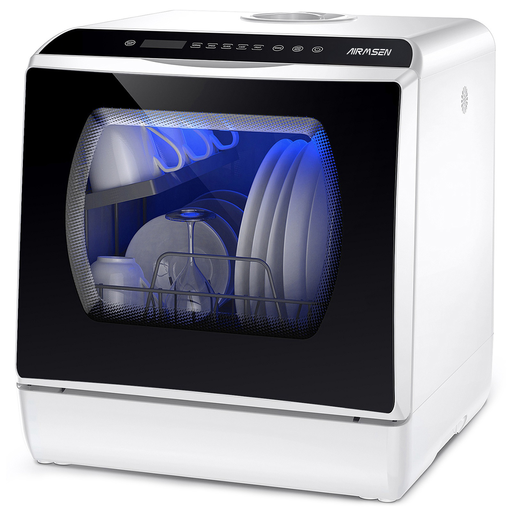 Image unavailable
Worth considering if you’d prefer a countertop appliance with a water tank instead of a floor-standing model.
The listing states that it has 5+1 wash cycles and a tempered glass door. Check the clearance needed around the appliance, the drainage route and its noise figures for your kitchen.
 Image unavailable
A countertop option if you’d like to consider a model with an integrated water tank.
The listing states that it has a 5 L tank, 6+3 programmes and a D energy rating. Check where the drainage hose needs to go and compare the noise figures before buying.
 Image unavailable
Consider this if the stated capacity of a tabletop appliance matters more to you than having the smallest possible model.
The listing states that it has 7 programmes, automatic door-opening drying and a 47 dB noise level. Compare this stated figure with the energy label and measure the space before setting aside worktop room.
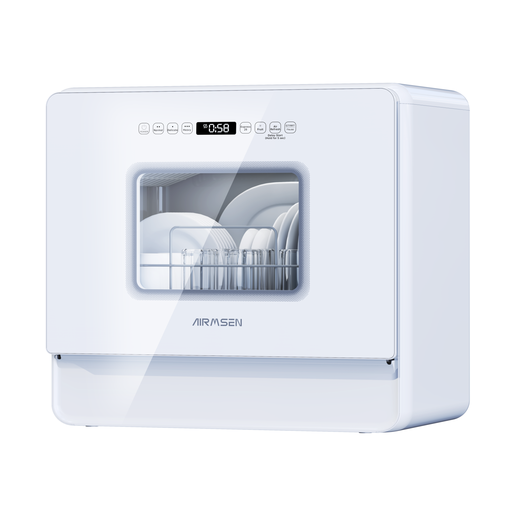 Image unavailable
Worth a look if you want to check the interior layout of a countertop model for the dishes you use regularly.
The listing mentions a two-tier rack, three spray arms and a 12-hour delay start. Check the dimensions, drainage and noise level before choosing it for an open-plan kitchen.
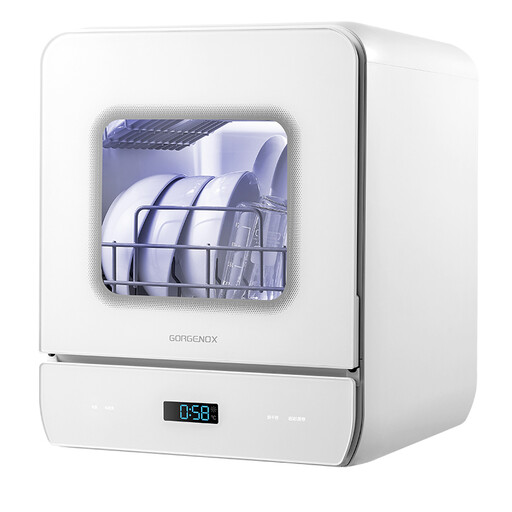 Image unavailable
Worth considering if you have smaller loads of washing-up. The stated capacity of 3 place settings may leave limited room for larger dishes.
The listing mentions hot-air drying. Before buying, check the model’s dimensions, water supply, drainage and noise level.
Measure the available width, height and depth, then allow for the door to open and the hoses to fit. Also check the water supply, drainage, plug socket and floor stability. For an integrated model, make sure the cabinet recess matches the installation instructions.
No: 45 cm refers to the width, not the depth or height required. Bosch states that the freestanding SPS4EMW61E measures 845 × 450 × 600 mm, so measure your space and check the clearances needed for the model you choose.
No single figure can guarantee that a dishwasher won’t bother you in an open-plan kitchen. Compare the dB(A) figures and noise classes on the labels of similar models, then consider where the appliance will go and when you’ll run a cycle. Que Choisir points out that a 3 dB difference corresponds to a doubling of sound intensity, but that alone can’t predict how the noise will seem in your room.
No. For the household dishwashers covered by the rules, regulated measurements used to compare water and energy use and other characteristics are based on the Eco programme at rated capacity, under Regulation (EU) 2019/2022, published in the Official Journal of the European Union. Check the model’s documentation if you expect to use other programmes most of the time.