What should you check before buying?
Worktop compact
Consider it if: you have a suitable space on your worktop and produce relatively few dishes between washes.
Bear in mind: its limited capacity may mean more frequent cycles when dishes and utensils start to pile up.
45 cm freestanding
Consider it if: you can install a floor-standing appliance but don’t have room for a standard 60 cm model. UFC-Que Choisir gives a typical capacity of 9 to 10 place settings for this size.
Bear in mind: a narrower appliance isn’t necessarily cheaper to buy or large enough for lots of utensils.
60 cm freestanding
Consider it if: you have enough width and wash enough dishes to justify a standard-size appliance; UFC-Que Choisir gives a typical capacity of 12 to 17 place settings.
Bear in mind: it takes up more space. If you plan to install it under a worktop, check whether the top can be removed on the model you choose.
Integrated
Consider it if: your kitchen has a suitable housing unit and you want the appliance to blend in with your cabinetry.
Bear in mind: according to UFC-Que Choisir, integrated models are supplied without a door panel, top or side panels, and aren’t designed to stand on the floor on their own. You’ll need to plan for the door panel and installation.
Once you’ve ruled out sizes that won’t fit your kitchen, match the capacity to your mealtime habits, then compare the usage information for the models you’re considering.
| Criterion |
What to check |
Who is it for? |
| Space and size |
Measure the space and door clearance; check the housing unit if you’re choosing an integrated model. |
In a small kitchen, I want to install the appliance without obstructing movement or losing worktop space I need. Around 33% of consumers say available space is their main concern. |
| Capacity |
Compare the stated place settings with your plates, dishes and pans, as well as the interior layout. |
If I cook often, I want to load my utensils without running a cycle after every meal. Capacity would be the top priority for around 27% of consumers. |
| Energy and water use |
For similar capacities, check the kWh per 100 cycles, litres per cycle and the duration of the eco programme on the energy label. |
I want to keep track of the water and electricity I use at my usual washing frequency, without choosing a capacity that doesn’t suit my needs. Around 20% of consumers put running costs first. |
| Noise and integration |
Compare the dB and noise class; for an integrated model, confirm that the housing unit and door panel are compatible. |
In an open-plan or already fitted kitchen, I want to take account of noise during cycles or keep my existing cabinetry. Noise or integration would be the priority for around 20% of consumers. |
ADEME and the European Commission say that dishwasher energy labels show, among other things, energy use per 100 cycles, water use per cycle, capacity, eco programme duration and noise level. Consider these figures alongside each appliance’s capacity: on their own, they aren’t enough to tell you which one will suit your dishes.
Joybuy products by size
This selection includes worktop compact models and a 60 cm freestanding model. Compare the stated capacity with your dishes, then check the dimensions and installation requirements before choosing.
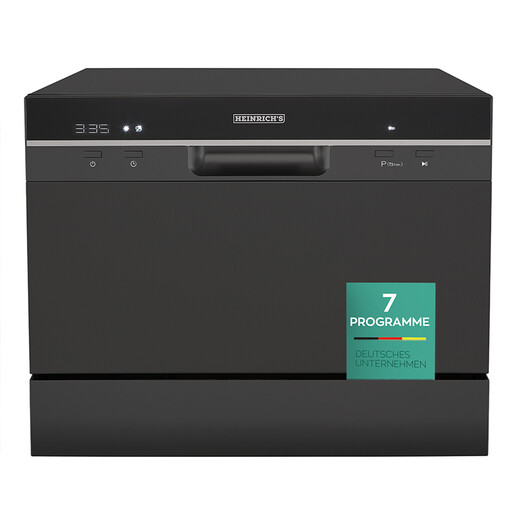 Image unavailable
Heinrich's HTG 8840 Schwarz, worktop dishwasher
Worth considering if you’re looking for a worktop appliance and its capacity suits your dishes and utensils.
Stated capacity of 6 place settings, 7 programmes and a stated noise level of 47 dB. Check the dimensions and connections in the instructions before buying.
View on Joybuy
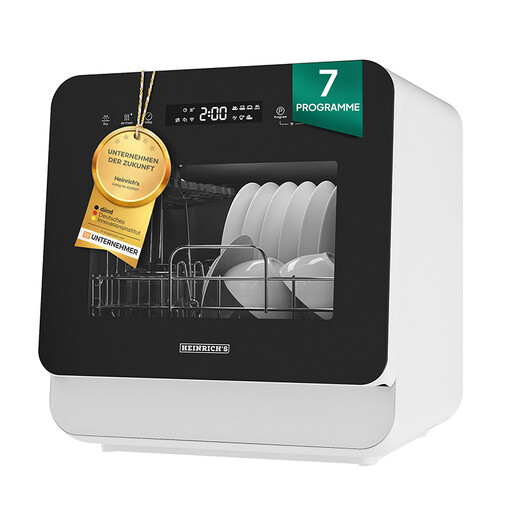 Image unavailable
Heinrich's HTG 8855, mini worktop dishwasher
Worth considering if you have only a small amount of washing up and want to keep to a worktop size.
Stated capacity of 3 place settings, 7 programmes and a stated noise level of 56,3 dB. Check the instructions for the space required and the water supply option that would suit your kitchen.
View on Joybuy
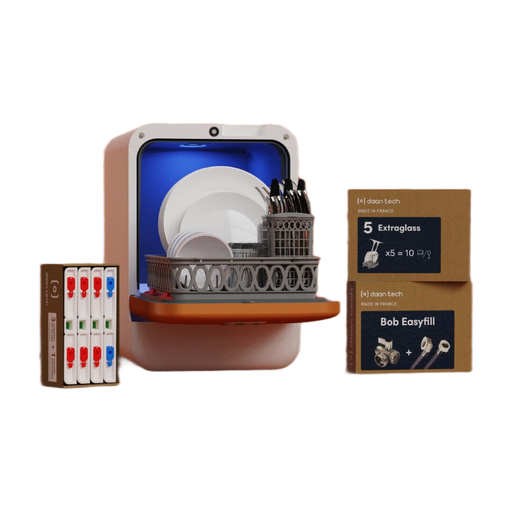 Image unavailable
Bob The Eco-Compact Dishwasher, All-Options Pack, White/Copper
Worth considering among compact models if you want to set aside space on your worktop. Before choosing, check that the model’s capacity, dimensions and connections suit the way you’ll use it.
View on Joybuy
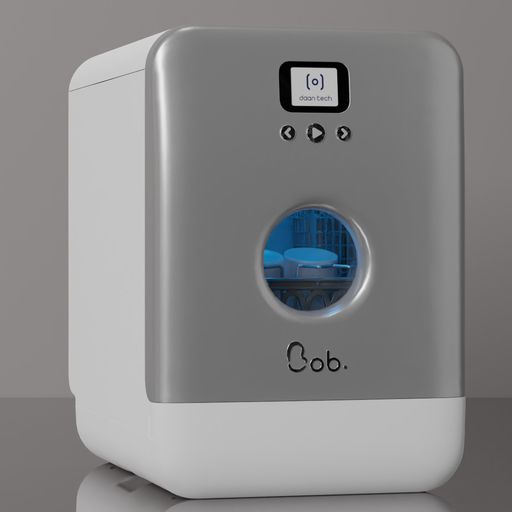 Image unavailable
Bob Mini, 3-place-setting dishwasher, Metallic Grey/White
Worth considering for a small amount of washing up if a worktop appliance suits your kitchen.
The model name gives its width of 34 cm and capacity of 3 place settings. Check the space needed to open the door and the connections specified in the instructions.
View on Joybuy
 Image unavailable
Hotpoint H4FD641A, white freestanding dishwasher
Worth considering if your kitchen can fit a standard-size model and your meals produce enough washing up to make its capacity worthwhile.
Stated width of 60 cm, capacity of 14 place settings and stated noise level of 41 dB. Confirm the installation dimensions and compare energy use in kWh per 100 cycles on the label.
View on Joybuy
Frequently asked questions
Is a dishwasher worth it for one person or a couple?
Yes, if you can set aside a suitable space for it and fill it at a pace that works for you. Count the dishes from meals eaten at home, including dishes and utensils: the number of people in your household alone won’t tell you what capacity you need.
What should you check before installing a compact or freestanding model?
Measure the space and door clearance, and check the model’s instructions for its connections. If you’re arranging installation, check what’s included: Electrolux says, for example, that its installers don’t carry out carpentry, plumbing or electrical work.
Which figures on the energy label should you compare?
Compare the energy class, kWh per 100 cycles, litres of water per cycle, capacity, eco programme duration and noise level. ADEME and the European Commission list these details for dishwashers; consider them alongside the capacity your household needs.
Can you install an integrated dishwasher as a freestanding model?
No: an integrated model is designed to fit into a housing unit and needs a suitable door panel. UFC-Que Choisir says it’s supplied without a door panel, top or side panels, so check that your kitchen is compatible before ordering.


