Who is each size best for?

Studio flat residents without space under the worktop

A countertop appliance may be worth considering if you can still use the worktop, including when the door is open. Make sure there’s also a suitable route for the waste water, even with a model that has a tank.

Renters with a narrow space available

A 45 cm dishwasher can leave your worktop free, provided you check all three dimensions of the space, the connections and any conditions that apply to making changes to the property.

Small households with an open-plan kitchen

If the appliance will run close to your living area, compare its noise level in dB on the energy label as well as checking that its capacity suits your everyday washing-up.

What should you check before choosing?

Countertop model

Worth considering: if you don’t have space under the worktop and can spare some of the worktop itself.

The trade-off: its capacity and the space needed to open the door must work for your washing-up and daily routine.

45 cm size

Worth considering: if you have a suitable floor or under-worktop space and want to keep the worktop clear.

The trade-off: a stated width of 45 cm doesn’t confirm the other dimensions or the connections you’ll need.

60 cm size

Worth considering: if your kitchen layout can accommodate this size and the amount of washing-up makes the chosen model’s capacity worthwhile.

The trade-off: it needs more width than a 45 cm model, but its size alone doesn’t tell you how much energy it will use.

PriorityWhat to checkWhat I need
Space required Measure the height, width and depth, then check the clearances specified for the model. Bosch gives dimensions of 45 × 55,1 × 50 cm for the small countertop models mentioned; these aren’t the dimensions of every freestanding appliance. I want to be able to open the door and still use the sink, storage and food-preparation space.
Water supply and drainage Check the water supply method, drainage route, hose limits and accessories included in the instructions separately. Daan Tech’s guide says Bob has a built-in tank, as well as a drain hose. If there’s no water connection nearby, a tank only appeals to me if I can also fill the appliance and drain the waste water in my kitchen.
Consumption and cycle duration On the energy label, compare the kWh per 100 cycles, litres per cycle and Eco programme duration, taking each appliance’s capacity into account. ADEME and the European Commission explain the information shown on the label. I want to compare figures for the same programme and factor in how many cycles I’ll need for my washing-up.
Usable capacity Check the capacity in place settings, then see whether there’s room for your plates, pans and containers. ADEME recommends waiting until the dishwasher is full before starting a cycle. If an appliance is too small for the items I use every day, I may have to split the washing-up across several cycles.
Noise Compare the noise level in dB and the noise class shown on the energy label, as outlined in the information provided by the European Commission. In an open-plan kitchen, I want to know the stated noise level before deciding where and when to run the appliance.

What mistakes should you avoid?

  • Assuming a tank means no connections are needed

    A tank may remove the need for a water supply, but it doesn’t eliminate the need for drainage. Daan Tech’s guide says Bob needs a drain hose, even when used with its tank.

    Check the instructions for the exact model: make sure you understand how to fill it, the drainage route and limits, and which accessories are included.

  • Relying on the energy rating or width alone

    These details don’t tell you everything about water use per cycle, duration, capacity or noise. The right size also depends on how much washing-up you load.

    Compare the Eco programme figures on the energy label, then estimate how many cycles you’ll need for your routine.

  • Measuring the worktop without allowing for the door to open

    An appliance may fit on the surface but still get in the way of the sink, cupboards or food-preparation space.

    Before you choose, check how much room it takes up, how far the door opens and where the hose will run across your worktop.

  • Assuming the same connection instructions apply to every model

    Connections and installation requirements depend on the appliance and the layout of your home.

    Follow the instructions for the model you’re buying. If you have any doubts about your home’s services or a permanent modification, ask a suitably qualified professional to assess the installation.

Brands at a glance

There are no brand highlights to display.

Dishwashers available on Joybuy

This selection includes countertop models and a standard-sized freestanding model. Compare them based on the space you have, the washing-up you need to load and the connections available. This list doesn’t replace checking whether a 45 cm model would fit your space.
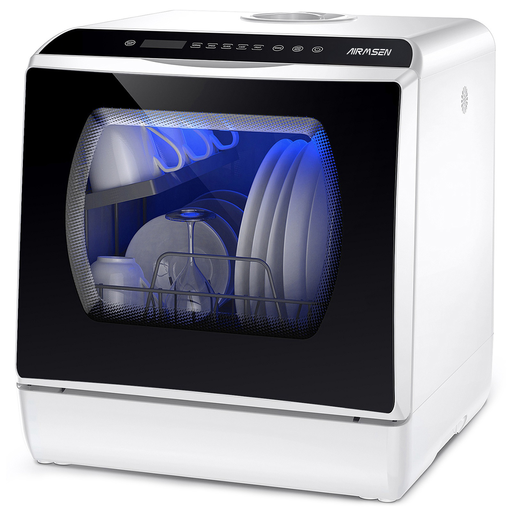
AIRMSEN countertop dishwasher with 5 L tank

AIRMSEN countertop dishwasher, 5 L tank, 5+1 programmes

If you have worktop space but no convenient water supply, the product details list a 5 L tank and the option to connect it to a tap. It has a stated capacity of 4 place settings and dimensions of 45,8 × 42,8 × 42,5 cm. Waste water drains through a hose into a sink or container. Check the route and the limits in the instructions, as well as the energy label and noise level for the model being sold.

View on Joybuy
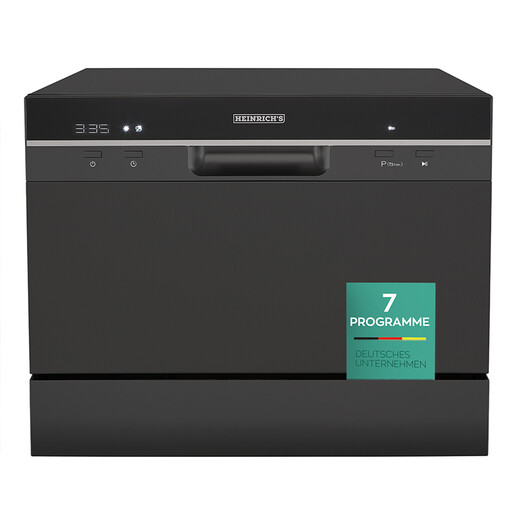
Heinrich's HTG 8840 Schwarz countertop dishwasher

Heinrich's HTG 8840 Schwarz, 6-place-setting countertop dishwasher

For a smaller amount of daily washing-up, the product details list 6 place settings and 7 programmes, including a 215-minute Eco programme. They specify a 1 500 mm inlet hose and a 1 720 mm drain hose. Measure the space needed for the appliance and to open its door, then check the label for the stated consumption and noise figures.

View on Joybuy

Samsung DW60M6050FS freestanding dishwasher

Samsung DW60M6050FS, 14-place-setting freestanding dishwasher

Consider this size if your kitchen can accommodate an appliance measuring 59,8 × 60,0 × 84,5 cm and 14 place settings suit your needs. The product details state a noise level of 44 dB. Check the clearance needed for the door and the connections, then consult the energy label for the model being sold to compare consumption and Eco programme duration.

View on Joybuy
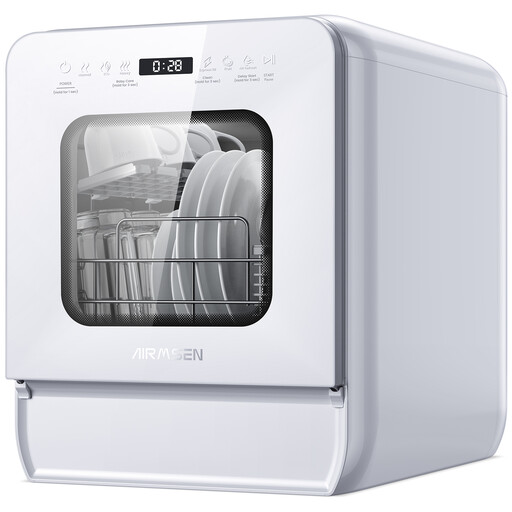
37 cm-wide AIRMSEN countertop dishwasher with 5 L tank

AIRMSEN 37 cm countertop dishwasher, 5 L tank

Its stated width of 37 cm may be worth a look if you have a narrow worktop. The product details list 4 place settings and a choice of a 5 L tank or tap connection. Different depth figures are given, so confirm the overall dimensions and door clearance before setting aside a spot for it. Also check the drainage, noise level and energy label figures.

View on Joybuy
Comfee' CDWMTO201D(W) countertop dishwasher with 5 L tank

Comfee' CDWMTO201D(W), 5 L countertop dishwasher

If you have worktop space but no water supply close by, the product details list a 5 L tank or a tap connection, with stated dimensions of 420 × 435 × 435 mm. They also specify that it can accommodate dishes up to 250 mm in diameter. Check that its capacity suits your washing-up, and consult the instructions to plan the drainage. The energy label lets you compare water and energy use, as well as noise.

View on Joybuy

Frequently asked questions

Can a dishwasher with a tank work without a connection?

It may not need a water supply if the instructions say you can fill the tank, but you’ll still need to check how to drain the waste water. Daan Tech’s guide says Bob uses a drain hose. Check the route, installation limits and accessories for the model you’re considering.

How do you compare the consumption of a countertop, 45 cm and 60 cm model?

Compare the kWh per 100 cycles and litres per cycle for the Eco programme shown on the energy label, then consider them alongside capacity and how many cycles you’ll need at home. ADEME and the European Commission explain these figures. Width alone doesn’t tell you whether an appliance will use less in everyday use.

Is the Eco programme the quickest?

Don’t assume so: check its duration on the model’s label. The European Commission says this is one of the details shown, so you can see whether it suits you when you need your washing-up back quickly.

What should you measure before buying an under-worktop dishwasher?

Measure the available width, height and depth, then compare them with the model’s installation diagram and clearance requirements. Bosch lists widths of 45 or 60 cm for its freestanding appliances, but the nominal width alone doesn’t confirm that an appliance will fit your space.