In a shared home or near your home-working space, choose a dishwasher by comparing its noise level with the times you’ll use it, then matching its capacity to the amount of washing-up you generate. A compact model can help when space is tight, but that doesn’t guarantee it will be quiet. An integrated model needs a compatible housing unit and door panel, while a freestanding model needs a suitable space and connections. Also compare the Eco programme’s duration and energy use on the energy label; don’t assume the other programmes have the same figures.
Who is this guide for?
People working from home near the kitchen
If your workspace is next to the kitchen, a cycle running during the day could coincide with calls or periods when you need to concentrate. Compare the model’s noise level and Eco programme duration before deciding when to run it.
Housemates and households with different schedules
When people work, sleep and eat at different times, noise and capacity both matter: a dishwasher that’s too small may mean running cycles more often. If the model you choose has a delay-start function, it can help you agree a suitable time with the other people in your home.
Households with a small kitchen
If space is limited but the amount of washing-up varies, measure the available space and check the existing connections before choosing between a compact and standard-size model. Then compare the capacity, noise level and Eco programme figures for the exact model, rather than assuming its size tells you how well it performs.
Which criteria should you check first?
First, check that the size will fit in your kitchen and suit the amount of washing-up you generate. Then compare compatible models by noise level, cycle duration and energy and water use.
| Criteria |
What to check |
What matters to shoppers |
| Quiet operation |
Compare the noise class and dB rating for the exact model, then check the Eco programme duration if it will run near a workspace or place to relax. |
If I work or relax near the kitchen, I want to avoid a cycle disrupting that time; around 33% of shoppers would put quiet operation first. |
| Capacity to suit mealtimes |
Check the number of place settings and whether the dishwasher can fit the dishes and cookware you usually use. |
When several people eat at home, I want to load the dishes without running multiple cycles; capacity would come first for around 27% of shoppers. |
| Kitchen compatibility |
Measure the width, height and depth. For an integrated model, also check the housing unit, door panel and hinge. Check the existing connections. |
In a kitchen where space is limited, I need to know whether the appliance can be installed without altering the room; around 20% of shoppers would prioritise compatibility. |
| Energy and water use, and repairability |
Check the kWh per 100 cycles, litres per cycle, Eco programme duration and, in France, the model’s repairability index. |
If the appliance will be used regularly, I want to check its energy and water use and repair options before choosing; this would be the main concern for around 20% of shoppers. |
ADEME recommends reading all the information on the energy label together. The energy and water use figures and programme duration are based on the Eco programme. They offer a useful basis for comparing models, but don’t necessarily describe how the other cycles perform.
Mistakes to avoid
-
Assuming a compact model is always quiet
The size mainly tells you about the space it takes up and its capacity, not how noisy it is. The specifications published by Darty for a compact model and by Whirlpool for a standard-size model show why you should compare the exact appliances rather than assume the same applies to every model in a category.
Check the noise class and dB rating on the label for the model you’re considering, then make sure its capacity suits your dishes.
-
Comparing energy and water use without checking the Eco programme duration
A long Eco cycle can take up a significant part of the day when the kitchen is close to a workspace or somewhere people relax. The figures on the label apply to this programme, not every wash setting.
Consider the Eco programme duration, kWh per 100 cycles, litres per cycle and capacity together. Choose a start time that works for everyone in the household.
-
Ordering an integrated model before measuring the housing unit
The term ‘integrated’ doesn’t guarantee that an appliance will fit your kitchen’s housing unit, door panel and hinge system.
Measure the available space and compare it with the model’s installation diagram. Don’t assume you’ll need to alter your kitchen or plumbing based only on the advertised format.
-
Focusing only on when you start a cycle
In a shared home, a cycle can be disruptive during the day if it coincides with a meeting or someone’s rest time. The duration and frequency of the noise also affect how it fits into shared living.
Choose a noise level that suits how close the appliance is to occupied rooms, and agree when to run it with the other people in your home.
Brands to know
There are no brands to feature in this section.
Dishwashers to consider on Joybuy
These models cover everything from small worktop loads to freestanding options and kitchens with space for an integrated appliance. Compare their capacities and dimensions, then check the noise level and Eco programme figures on the label for the model you’re interested in.
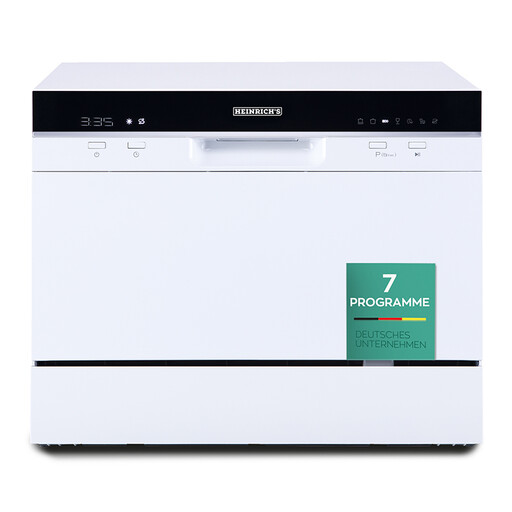 Image unavailable
Heinrich's HTG 8840 Weiss table-top dishwasher
Worth considering for a small kitchen and a modest load, provided you have a suitable spot for it. The product name lists 6 place settings, 7 programmes, a 24-hour delay start and 47 dB. Check the stated noise level and dimensions against the label and the space available.
View on Joybuy
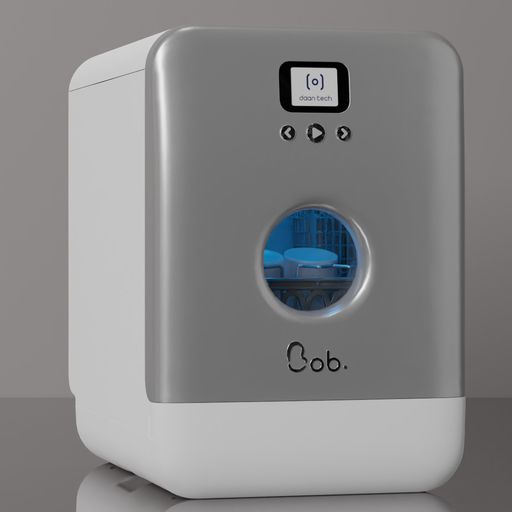 Image unavailable
Bob Mini compact dishwasher, 3 place settings, metallic grey and white
Consider this if your only available space is on the worktop and you wash small loads. The product name lists 3 place settings and a width of 34 cm. Check that the usable capacity suits your dishes, and make sure you have enough space and the right connections. Check the Eco programme figures too.
View on Joybuy
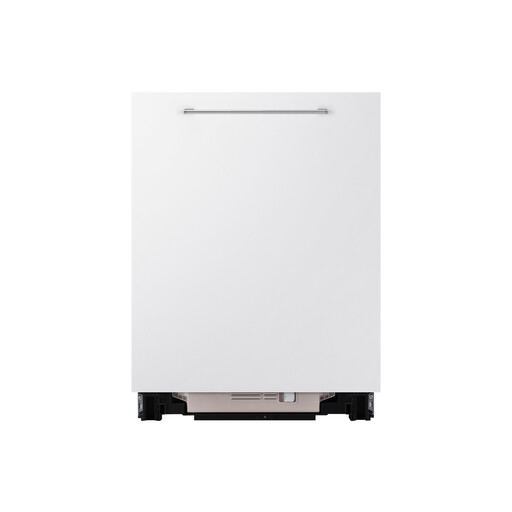 Image unavailable
Samsung DW80H72YBB0U1 integrated dishwasher, 60 cm, 13 place settings
Worth considering for larger shared loads if your kitchen has a compatible housing unit. Before ordering, check the model’s installation diagram, door panel and hinge. Compare the stated noise level for each programme separately, along with the Eco cycle figures.
View on Joybuy
 Image unavailable
Hotpoint H4FD641A freestanding dishwasher, 14 place settings, white
Worth considering for larger shared loads if you have floor space for it. The product name lists a width of 60 cm and a noise level of 41 dB. Check the full dimensions, connections and noise level on the model’s label.
View on Joybuy
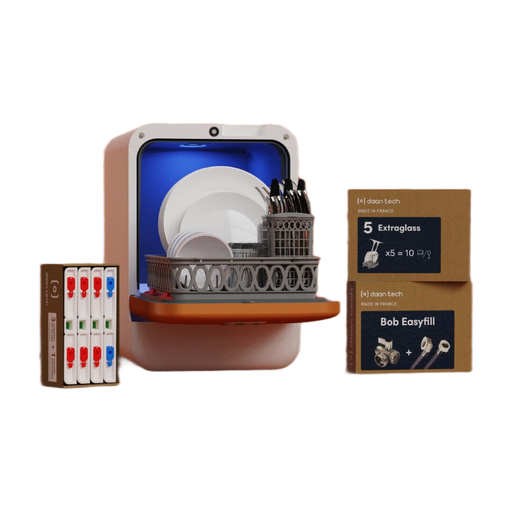 Image unavailable
Bob The Eco-Compact All-Options pack, white and copper
Worth considering for very small loads when worktop space is limited. Check that the capacity suits your dishes, confirm exactly what’s included in the pack, and check the connections and the model’s noise and Eco programme duration information.
View on Joybuy
Frequently asked questions
How do you compare the noise levels of two dishwashers?
Compare the noise class and dB rating on each model’s energy label. ADEME says that classes A and B are particularly quiet. Also consider how long the cycle runs and how close the dishwasher is to anyone working or relaxing.
Can the energy and water use figures be used to compare every programme?
No. The kWh per 100 cycles, litres per cycle and duration shown on the label relate to the Eco programme. European regulations on dishwasher energy labelling make these figures a common basis for comparing models, but they don’t describe a quick or intensive programme.
What should you check before choosing an integrated rather than a freestanding model?
Measure the housing unit and check the door panel and hinge for an integrated model; for a freestanding model, measure the full space available. For both types, check the existing connections and the requirements in the model’s instructions before buying.
Does the repairability index tell you how noisy a dishwasher is?
No. The repairability index tells you how easy the appliance is to repair, not how noisy it is. To compare noise levels, check the noise class and dB rating on the label for the dishwasher you’re considering.


