
Livraison le jour même ou le lendemain

Qualité garantie

Débloquez vos offres de bienvenue: Livraison GRATUITE | Jusqu'à -80 % | 30 jours d'essai gratuits à JoyPlus
Téléchargez l'application
Dull crockery, glasses covered in water spots or a dishwasher that leaves a white film are not necessarily caused by the detergent. Dishwasher rinse aid is used during the final cycle to help water run off and promote more even drying.
You still need to choose the right formula. A product designed for a domestic dishwasher will not necessarily be suitable for a professional machine, while an all-in-one tablet may prove insufficient in very hard water. Here are the criteria to consider before placing your order.
Rinse aid does not remove food residue, so it cannot replace detergent. It is poured into the designated compartment, separately from all-in-one dishwasher tablets, unless the tablet or gel already includes a rinse-aid function.
Pouring rinse aid into the detergent compartment can disrupt the cycle and reduce cleaning performance. Always check your appliance’s symbol and instructions.
Claims such as ‘streak-free’, ‘fast drying’ or ‘dishwasher limescale protection’ highlight a sought-after feature, but the result also depends on water hardness, temperature, the programme selected and the dispenser setting.
Too little product can leave water spots on your dishes. Conversely, using too much may create a film on glasses and plates. It is better to choose a product whose instructions allow you to adjust the dosage to the hardness of your water.
A 5 L rinse aid or 10 L container can make sense in a professional kitchen, restaurant or catering environment. For a household that runs its dishwasher a few times a week, an 800 ml rinse aid or 400 ml bottle will generally be easier to store and handle.
The price per litre is not enough to compare offers. Also consider the recommended dosage per cycle, compatibility with the automatic dispenser and how often it needs to be refilled.
A product designed for an automatic dishwasher must be poured into the designated reservoir. Professional products are designed for machines with short cycles and automatic dosing. They must not be used for hand washing.
For a domestic appliance, look for a statement confirming compatibility with standard dishwashers. If you use dishwasher gel or standard tablets, a separate rinse aid can complement the cycle when the detergent does not include this function.
Water hardness varies from one French local authority to another. Water with a high limescale content encourages white marks to appear on glasses and crockery. The dispenser should be adjusted in line with the machine manufacturer’s recommendations and the information on the label.
Some professional products specify a dosage range, for example 0.2 to 0.5 ml per litre of rinse water. This information allows you to adjust consumption and reduce marks caused by incorrect settings.
A 400 or 800 ml bottle is generally suitable for regular domestic use. The 5 or 10 L containers are more suited to establishments that use a dishwasher at high frequency.
Keep the product closed in a cool, dry place, out of reach of children. Rinse aids may irritate the skin and cause serious eye damage. Wear gloves and read the label when refilling. Never mix different chemical products.
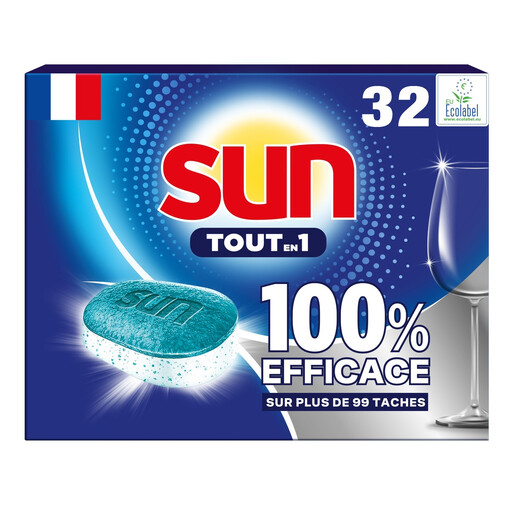
Why this choice suits this profile : This pack of 32 washes is suitable for households looking to reduce the number of products they need to manage. The tablet combines detergent, a rinse-aid function and the limescale protection advertised on the product page.
It avoids the need to buy detergent and rinse aid separately when the water has a normal limescale level. With very hard water, however, check whether adding dishwasher salt is still necessary.
32 doses, use without pre-rinsing according to the product page, dry storage and an advertised phosphate-free formula.
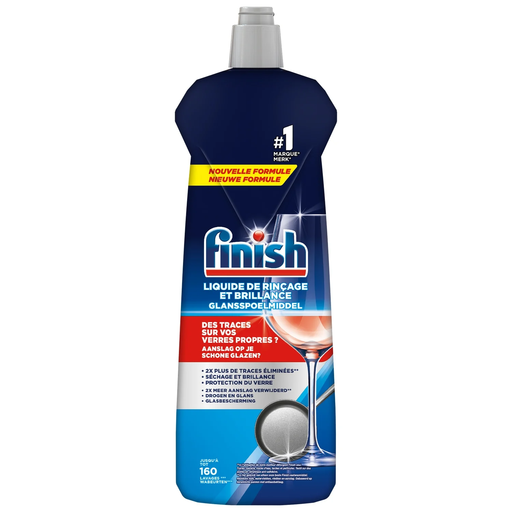
Why this choice suits this profile : With its 800 ml capacity, this bottle is aimed at users looking for sparkling crockery and faster drying, particularly for glasses and cutlery.
The product page states that the dosage should be adjusted to the hardness of the water. This setting reduces the risk of overdosing, which is common when trying to achieve an especially brilliant finish.
800 ml format, advertised protection against water spots and non-ionic surfactants listed in the ingredients.
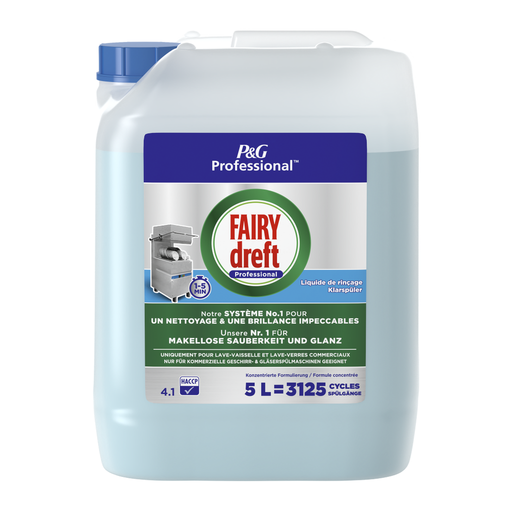
Why this choice suits this profile : This 5 L container is designed for restaurants, hotels, catering establishments and professional kitchens equipped with a dishwasher featuring automatic dosing.
Its use is clearly reserved for professional dishwashers. This indication helps you avoid choosing a small domestic bottle for a machine subjected to repeated cycles.
Professional 5 L format, adjustment according to water hardness and automatic dosing specified on the product page.
We have put together a complete, real-time updated list of products that meet these demanding selection criteria and European safety requirements.
Yes, but it is not always necessary. All-in-one tablets may already include a rinse-aid function. If your glasses remain marked or damp, check the tablet instructions and those for your dishwasher before adding a separate product.
It all depends on the dispenser setting, the reservoir capacity and the number of cycles run. A 400 ml format may be suitable for moderate domestic use, while a 5 L container will be better suited to intensive professional use. The dosage stated on the label remains the key reference.
It can help reduce water marks and certain deposits on crockery, but it does not replace either machine maintenance or dishwasher salt when the latter is required. With very hard water, adjust the settings in line with the appliance manufacturer’s recommendations.