If washing-up is piling up in a shared household, choose a capacity that suits your typical load. A 60 cm model generally offers more room than a 45 cm or compact dishwasher, which are primarily designed for spaces where room is limited. In an open-plan kitchen, also compare the stated noise level in dB and the noise class. Before choosing, check the exact model’s dimensions, connections and consumption figures.
Who are these formats for?
Shared household with daily washing-up
When several people use the dishwasher, place settings and basket layout matter just as much as the space available in your kitchen. UFC-Que Choisir recommends considering these factors when choosing a dishwasher.
Open-plan kitchen where noise matters
If the dishwasher runs while you’re using the living room, compare the stated noise level in dB and the noise class. ADEME explains that this information appears on the energy label, while UFC-Que Choisir highlights how important noise levels can be in this type of space.
Small kitchen with suitable connections
A 45 cm model or compact countertop dishwasher can help when space is limited, provided it has enough capacity for your loads. Measure the available space and check the instructions for the water inlet and drain. UFC-Que Choisir points out that countertop models still need suitable connections.
Which criteria should you prioritise?
For regular use, start by balancing the amount of washing-up against the space available. A 45 cm model gives you a full-size dishwasher when a 60 cm one won’t fit, while a compact countertop model is better suited to smaller loads. A freestanding model needs the right space and connections; an integrated model also needs a compatible housing unit.
| Criterion |
What to check |
Who it matters to |
| Capacity |
Number of place settings and how much room the baskets actually offer for larger items. |
When several people leave washing-up between cycles, I want to be able to load it without having to leave it waiting. Capacity would be the top priority for around 33% of consumers concerned. |
| Noise |
Stated noise level in dB and noise class on the energy label. |
If the living room opens onto the kitchen, I don’t want a cycle to disrupt time spent there. Around 25% of consumers concerned would put quiet operation first. |
| Space and installation |
Available width, height and depth; water inlet, drain and installation instructions. |
In a small kitchen, I need to know that I can install and connect the dishwasher before choosing its capacity. For around 25% of consumers concerned, whether installation is possible would be the priority. |
| Water and energy |
kWh per 100 cycles, litres per cycle and the duration of the Eco programme. |
If I run the dishwasher often, I want to factor in water, electricity and how long the washing-up will be unavailable. Consumption would come first for around 17% of consumers concerned. |
What to check before you buy
-
Relying on a label such as ‘Silence’ alone
In an open-plan kitchen, a range name doesn’t help you compare the noise levels of two dishwashers. ADEME says that the energy label includes a noise level and a noise class.
Compare both figures for the models you’re considering, and check the Eco cycle duration if the dishwasher will run while you’re at home.
-
Choosing the smallest format without estimating your load
A compact or 45 cm model may take up less space, but its capacity could mean running more cycles when several people use the dishwasher.
Estimate how much washing-up builds up between cycles and check whether saucepans and other bulky items will fit in the baskets.
More frequent cycles can also increase water and electricity consumption over the year.
-
Ordering before measuring and checking the connections
A dishwasher that suits your washing-up won’t work if the space, water inlet or drain doesn’t meet the requirements in its instructions. The same checks apply to a compact countertop model.
Measure the available width, height and depth, then check that there’s room for the hoses. For an integrated model, follow the housing unit dimensions specified for the model you’ve chosen.
If the unit, worktop or plumbing needs adapting, this work will be an additional cost on top of the dishwasher installation.
-
Ignoring consumption per cycle
How often you use the dishwasher affects how much water and electricity it consumes over time. A figure per cycle alone doesn’t tell you everything about how a household will use it.
Compare the kWh per 100 cycles and litres per cycle shown on the label, taking the capacity and the number of cycles you expect to run into account.
Brands to consider
Bosch
In France, Bosch offers freestanding, integrated and compact dishwashers, including 45 cm and 60 cm models.
- According to Bosch Électroménager France, some ranges described as quiet operate at between 38 and 42 dB.
- This range doesn’t apply to every model. Check the noise level, dimensions and energy class of the one you choose.
Siemens
The French range includes freestanding and integrated models, with scheduling and monitoring features available on selected models.
- Siemens Électroménager France offers Home Connect for monitoring or managing certain water and energy consumption figures on compatible models.
- Check that the feature is available and compatible, and confirm the drying options and cycle duration for the exact model.
Whirlpool
Whirlpool France offers 45 cm and 60 cm models, as well as different installation types, which you can compare to suit the space available.
- The range of formats makes it easier to compare width and installation type separately.
- Capacity, noise, consumption and the interior layout vary from one model to another.
Electrolux
Electrolux France offers compact dishwashers designed for kitchens where space is limited.
- This range makes a countertop model an option when space under the worktop is limited.
- Check the capacity, dimensions, connections and consumption for each model rather than assuming what they’ll be from its compact format.
Freestanding and compact models on Joybuy
These models cover two options for your household: freestanding dishwashers for regular loads and compact countertop models for smaller loads. Compare their capacity with the washing-up you typically have, then check the dimensions and installation requirements of the model you’re interested in.
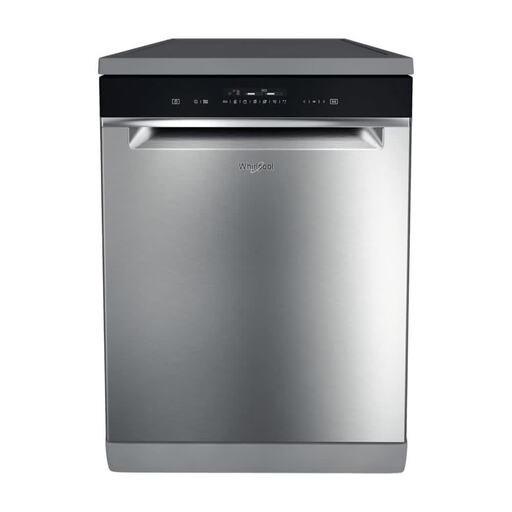 Image unavailable
Whirlpool WFP5O41PLGX, freestanding, 14 place settings
Worth considering if the regular loads in a shared household make capacity a priority.
The title states a width of 60 cm and energy class C. The dimensions listed for this model don’t match that width, so confirm its exact size before deciding where to put it.
View on Joybuy
 Image unavailable
Indesit D2F HK26 S, freestanding, 14 place settings
Consider it for a household with plenty of daily washing-up, if there’s room for a freestanding model in your kitchen.
The title states a width of 60 cm and energy class E. For an open-plan kitchen or frequent cycles, also compare the noise level and consumption figures on the model’s label.
View on Joybuy
 Image unavailable
Hotpoint H4FD641A, freestanding, 14 place settings
Worth comparing for a household whose regular loads make a 60 cm model a good choice.
The title states 41 dB and energy class C. If noise matters in your open-plan kitchen, compare this stated figure and the noise class with those of other models you’re considering.
View on Joybuy
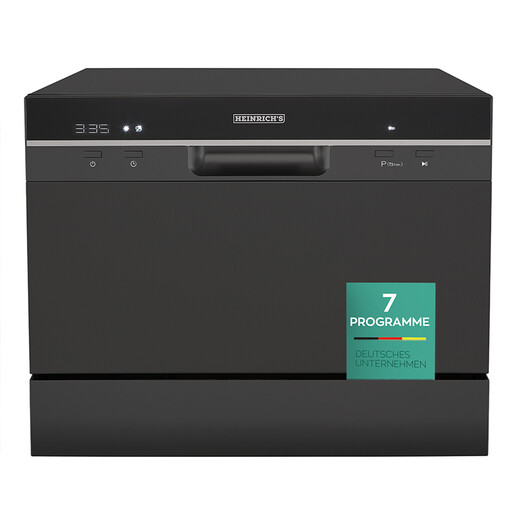 Image unavailable
Heinrich's HTG 8840 Schwarz, compact, 6 place settings
This countertop model is better suited to smaller loads. In a shared household where washing-up piles up, six place settings may mean running more frequent cycles.
The title states seven programmes, 47 dB and energy class D. Measure the available space and check the instructions for the dimensions and connections of this model.
View on Joybuy
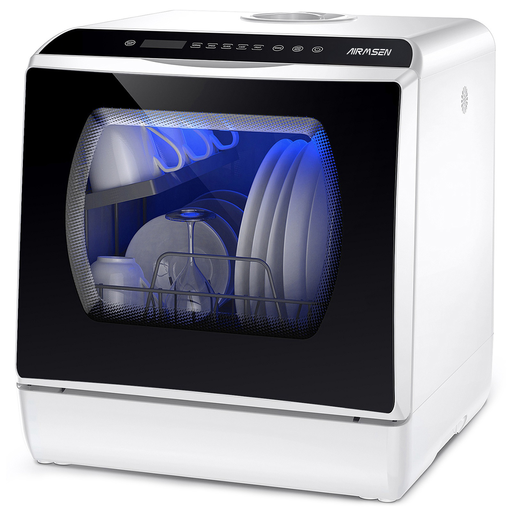 Image unavailable
AIRMSEN, countertop dishwasher with 5 L tank
Worth considering for smaller loads when a permanent installation is difficult, provided you can arrange a way to drain the water.
The title states that it has a built-in 5 L tank and 5+1 wash cycles. Check the space required, the water supply and drainage options, and the stated noise level if it needs to run near the living room.
View on Joybuy
Frequently asked questions
Which figures should you check for a dishwasher in an open-plan kitchen?
First, compare the noise level in dB and noise class of models that suit your capacity needs and available space. ADEME says that noise classes A and B are particularly quiet. Also check the Eco cycle duration if the dishwasher will be running while you’re in the room.
Can a 45 cm dishwasher be enough for a shared household?
Yes, if it can fit the washing-up your household produces between the cycles you’re happy to run. UFC-Que Choisir features 45 cm models advertised for nine place settings. Also check that there’s room for saucepans and other bulky items.
What should you check before installing a compact or integrated dishwasher?
Measure the space and confirm the water inlet and drain arrangements in the instructions for your chosen model. For an integrated model, check the housing unit dimensions. For a compact countertop model, check where the hoses will go and how the water will drain. You’ll also need to check separately whether it’s compatible with your existing kitchen door panel.
How can you manage water and electricity use after buying?
Compare the consumption figures on the energy label with how often you expect to run the dishwasher. ADEME recommends running it when it’s full and using the Eco programme when its duration fits your routine.


