Which factors should you consider first?
First decide whether your washing-up needs justify an appliance, then check that its capacity and installation type suit the space available. For an open-plan kitchen, compare the noise levels and consumption figures of models that can actually be installed there.
| Priority | What to check | Your needs |
|---|
| Noise |
Compare the stated decibel levels and acoustic class of the exact models. Check the conditions for any quiet programme. |
I want to be able to run a cycle without the noise disrupting activities in the living area too much. |
| Capacity |
Compare the stated place-setting capacity with the number of people and meals in your household. Check whether the racks have room for your pots and dishes. |
We get through a lot of dishes, so an appliance that’s too small could mean running more frequent cycles. |
| Consumption |
According to ADEME, the label shows figures including kWh per 100 cycles and litres per cycle for the Eco programme. Compare these figures on the same basis, then take your likely usage into account. |
I want to estimate how much the appliance will use without assuming that a narrower model will necessarily use less day to day. |
| Installation |
Measure the height, width and depth. For a built-in model, check the recess and door panel too. Confirm the connections before ordering. |
If space is tight or we don’t have many dishes to wash, I’d rather check whether installing an appliance makes sense. |
A guide to the brands
These ranges give you an idea of the available sizes and features. Check the specifications for each model individually; they may differ from the appliances featured below.
Bosch
Bosch offers freestanding and built-in dishwashers. The SMS4ECI28F is an example of a 60 cm freestanding model.
- Bosch states that the SMS4ECI28F uses 9.0 l of water per Eco cycle and has acoustic class B.
- These figures apply to this model only; they don’t represent the entire range.
Beko
Beko’s French range includes 45 cm freestanding dishwashers for kitchens with limited space.
- Beko lists 45 cm models with a capacity of 10 place settings.
- Check the capacity and rack layout of the model you choose. Width alone won’t tell you whether it can fit the dishes your household uses.
Miele
Miele offers built-in and fully integrated dishwashers, with different rack layouts across its models.
- Miele’s catalogue lists noise levels of 41 or 42 dB for some integrated models.
- Check the exact model and the dimensions of its recess; these figures don’t apply to the whole range.
Whirlpool
Whirlpool offers 45 and 60 cm models, as well as several installation types, including built-in.
- This variety makes it easier to find a model that suits your preferred width and installation type.
- Installation type alone won’t tell you how noisy, spacious or efficient a model is. Check these figures for the model you choose.
Dishwashers available from Joybuy
These options include a 60 cm built-in model and compact appliances designed for smaller amounts of washing-up. Their inclusion here doesn’t, on its own, settle the choice between using a dishwasher and washing up by hand.
 Image unavailable
Samsung DW80H72YBB0U1 built-in dishwasher, 60 cm, 13 place settings
With a capacity of 13 place settings and integrated installation, this model could suit a household that regularly fills its dishwasher and has a suitable recess. Its specifications list 44 dB(A), while the Extra Silence programme is listed at 42 dBA. Compare the reference noise level on the label, as well as the Eco programme’s consumption figures. Also check the recess, door panel and connections.
View on Joybuy
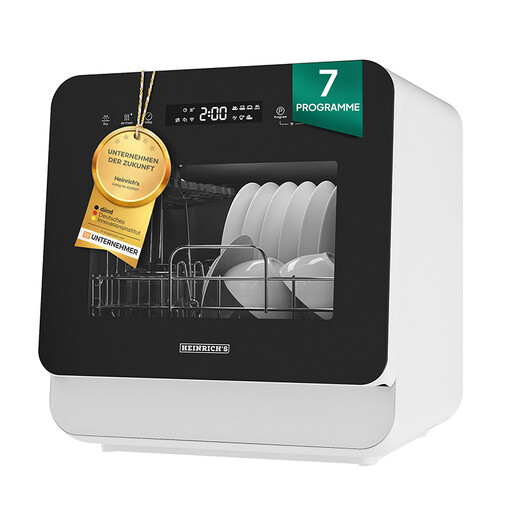 Image unavailable
Heinrich's HTG 8855 mini dishwasher, 3 place settings
This tabletop model is designed for smaller amounts of washing-up, rather than dishes building up over several meals. Its specifications list a capacity of 3 place settings, seven programmes and either a 5 l water tank or a tap connection. The stated noise level is 56.3 dB. If you’ll be using it in your living area, check its reference noise level, dimensions and Eco programme figures.
View on Joybuy
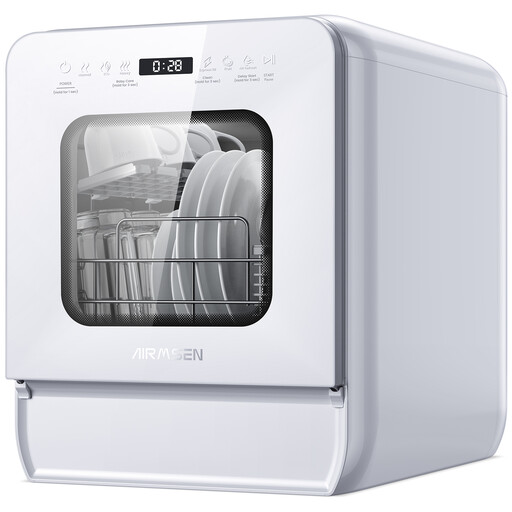 Image unavailable
AIRMSEN tabletop dishwasher, 37 × 50 cm, 5 l water tank
At 37 cm wide, this model could be worth considering if space is tight. Its description lists a capacity of 4 place settings and says it can be filled from the water tank or connected to a tap. Measure the available height too, and check the connections. For an open-plan kitchen, check the stated noise level and Eco programme consumption figures before comparing it with other models.
View on Joybuy
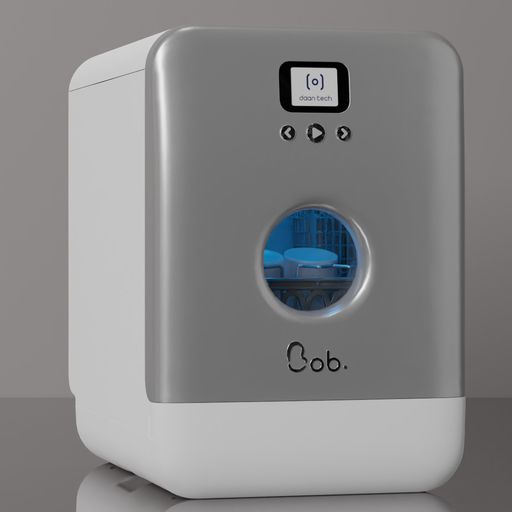 Image unavailable
Bob Mini, 3 place settings, 34 cm, metallic grey and white
This compact model, with a capacity of 3 place settings, is worth considering if you have few dishes to wash and space on your worktop. Its specifications list 43 dB, 2.9 l of water and 0.39 kWh per cycle. Before comparing these figures with an Eco label, check which programme they refer to, as well as the connections required.
View on Joybuy
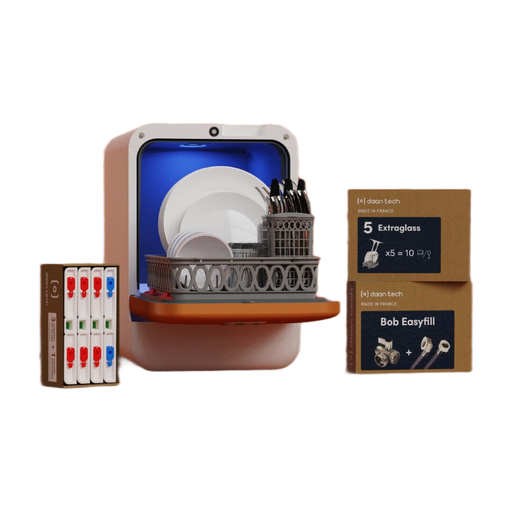 Image unavailable
Bob All-Options Pack, white and copper
With a stated capacity of 2 place settings, this version is designed for very small amounts of washing-up. Its specifications list five programmes, 43 dB, 1.9 l of water and 0.39 kWh per cycle. Before choosing it, check the installation type and connections, and find out which programme the noise and consumption figures refer to.
View on Joybuy
Frequently asked questions
Which figures on the label should I compare for an open-plan kitchen?
Check the capacity in place settings, stated noise level and acoustic class, then the kWh per 100 cycles, litres per cycle and duration of the Eco programme. ADEME recommends using these label figures to compare models, but they don’t necessarily describe a quick programme.
Why check the noise level before choosing a quiet programme?
The stated noise level and acoustic class let you compare specific models, while a quiet programme may have its own conditions of use. In an open-plan kitchen, also think about when you plan to run the appliance and for how long.
Does a 45 cm dishwasher always use less energy and water?
No: 45 cm refers first and foremost to the width. Compare the litres per cycle and kWh per 100 cycles for the Eco programme, then estimate how many cycles you’ll need with the capacity you choose.
How can I take repairability into account in France?
For dishwashers covered by the scheme, the repairability index out of 10 helps you compare how easy different models are to repair, according to the French Ministry for Ecological Transition. It doesn’t predict whether a fault will occur or how much a particular repair will cost.
What should I arrange for my old dishwasher when replacing it?
Ask the retailer about taking it back before delivery. Guidance from the French Ministry for Ecological Transition includes a ‘one for one’ take-back scheme when you buy an appliance of the same type. Confirm with the retailer how this works in practice for a bulky appliance.


